
Commentary
Recent Commentary
The Plight of Venezuela – II
Date: September 23, 2025
Following elections In January 2019, the United States and some 60 other countries recognized Juan Guido as the legitimate leader of Venezuela. However, Nicolas Maduro refused to step down and after six years of his rule, and in January, 2020 we wrote a Commentary called “The Plight of Venezuela” recommending using specialized military and complementary forces to weaken his “Palace Guard” consisting of Cuban and Russian mercenaries. This was not done, and during the four years of the Biden/Obama administration made little effort to displace Maduro.
We now have depressing proof of the effects of the United States and its allies not using all efforts needed to remove this dictator from office at that time.
Some effects:
- Six million Venezuelan citizens fled the country, mostly coming to the United States as undocumented immigrants.
- Venezuela descended from being the richest country in South America to the one of the poorest.
- It became a firm member of the “Axis of Evil” in its close relationship with Russia, China and Iran.
The Trump administration has now taken new measures to put pressure on Maduro. On August 5, the US State Department announced a reward of $50 million for the arrest and/or the conviction of President Nicolas Maduro. Recently, the US Navy deployed four warships cruising offshore Caracas with the capability to launch missile attacks against his personal protection units.
We are surprised that no one has yet claimed this reward but assume that many parties (e.g. Mossad) may be working on it. This reward may be sufficient incentive for Maduro to accept Vladimir Putin’s offer to move to Russia and join Bashar Al Assad in their home for retired dictators. That we be a great day for Venezuela and all freedom loving people.
Byron K. Varme. Chairman
The Guns of June
Date: July 9, 2025
June 2025 will go down in history as the month when three exceptional military campaigns were executed which transformed the global situation.
- On June 1, 2025 Ukraine launched a brilliant attack on four Russian airbases thousands of miles from its borders using drones shipped in boxes by Russian trucks. These drones destroyed 13 long range bombers capable of attacking the US.
- On June 9, Israel launched continuous attacks on Iranian air defense systems used to protect their fortified sites for developing nuclear weapons nearing completion and other missile sites. They also assassinated eleven senior Iranian nuclear scientists.
- On June 22, seven B-2 Spirit bombers launched an attack on four Iranian nuclear development sites, including the Fordow location where activities are conducted in an extensive network sheltered under 300 feet of mountain range. The bombers each launched a 30,000 pound “Bunker Buster” bombs obliterating the site and killing top nuclear scientists. Simultaneously US submarines launched 30 Tomahawk missiles against the three other Iranian nuclear sites.
These attacks were authorized by President Trump two days after the expiration of the 30-day formal negotiation period with Iran. The simple fact that Iran was developing nuclear technology in scattered underground sites confirmed their intention to create nuclear weapons and were not for peaceful power generation uses. The whole world knew this but did little about it until last month.
Both Israel and Ukraine are engaged in ongoing existential battles to protect their freedom and the success of these attacks Is inspirational. The participation of the US Air Force, with superb efficiency, was a welcome victory for the free world. Iran’s totalitarian allies, Russia and China did not offer Iran any support during its crisis. With the recent loss of Syria following the overthrow of the Assad regime, Russia’s interests in the Middle East have been substantially weakened. In summary, June 2025 was a great month for the forces of Freedom. Any actions that weaken autocratic governments are welcome developments for other nations threatened, especially the Baltic nations and Taiwan.
Byron
Byron Kahrs Varme, Chairman
Iran – A Geopolitical Opportunity for the Free World
Date:June 21, 2025
The International Atomic Energy Agency recently confirmed that Iran is close to achieving its long-term objective of creating nuclear weapons that have the capability to destroy Israel and threaten its other perceived enemies including “The Great Satan”, the United States.
The massive aerial war initiated by the Israel Air Force on June 12th included attacks on several Iranian nuclear development sites but have not destroyed the major facility at Fordow where several thousand centrifuges are located about 300 feet under a mountain precisely to protect them from such an attack. The only weapon system which has the potential to seriously damage this location are the GKU-57, 30,000 pound “block buster” bombs developed by the US Air Force together with the B-2 Stealth bomber.
Following the meeting of the Group of Seven at Calgary on June 17th the Group stated that the destruction of these sites was in the interest of global peace. While returning from the meeting President Trump indicated he would make the decision to launch such an attack within two weeks unless he received an “unconditional surrender” from Iran.
The United States should not seek regime change in Iran. As Nikki Haley stated in an email on June 19th, “Our focus should only be on our national security, The Iranian regime has threatened the U.S. with nuclear production for years. We should support Israel in eliminating the Natanz and Fordow sites to prevent the threat of Iran getting a nuclear weapon, but the Iranian people should decide on who they want to be their leader. It is their decision, not ours.”
It is important for the US and our global partners to emphasize that they are not attacking the Iranian people, whom we admire, but their government which has chosen affiliation with the other totalitarian governments and carried out attacks throughout the Middle East by proxies in Lebanon, Syria, Yemen and Somalia. The weakening of Iran’s military and the loss of its nuclear threat will not be welcomed by Putin or Xi Janping. Iran has been the key supplier of drones and other military equipment to Russia in their invasion of Ukraine. Taiwan also will benefit from Iran’s loss of military power in world affairs.
In summary, the destruction of Iran’s development of nuclear power for military use will be a great step forward towards global peace, and President Trump should authorize these attacks as soon as the Pentagon determines the optimum time to launch them. This opportunity should not be lost.
– Byron Kahrs Varme, Chairman
Freedom on the Cusp
Date:January 10, 2025
We are witnessing a massive change in world affairs, human society and how we live. This change process, we are told, may last for several years; but, started, it has!
We live on the cusp of change.
We have enjoyed the freedoms of the current ending era for approximately 75 years.
It was then that our parents and grandparents experienced the last cusp.
History tells us these eras generally last between 70 to 80 years.
But the one before that lasted only 20.
The First World War ended many of the monarchies of Europe and started the demise of colonization.
But dictatorships replaced them.
The end of the Second World War and its destruction created the cusp which led to the creation of numerous institutions such as the United Nations, NATO the EU and the massive growth of globalization which lifted millions out of poverty.
It was freedom’s time. For some!
So “our” era has, compared to others, been a period of relative peace and prosperity – and freedom for many people.
The question is, however, what happens in the era to come?
The cusp will give us a guide.
Will the freedoms this Foundation support grow or just maintain. Or will they die?
Of course we don’t know!
But we will be watching – and keeping the flame alive and bright at all costs. If we are able!
We need your help to do this please.
© Robert Michael Hick 2025
The Dogs of War
Date: October 12, 2023
A Ukrainian Eagle Squadron?
February 27, 2023
In his excellent article, “Give Ukraine What It Needs to Win” Nicholas Kristof concludes that winning the war quickly is the only way to prevent an ongoing massive loss of life is to supply a range of armaments to Ukraine as quickly as possible. He concludes, “I think that Biden will get there eventually, but lives would most likely be saved if he got there this month”.
Because of the fear of escalation of the war by involving NATO directly, which has been called “Sleepwalking into WWIII, no military forces from NATO countries have been directly involved. Amongst the array of armaments sought by Zelensky, the immediate need is to achieve air superiority of the Ukrainian airspace that could greatly reduce the damage created by Russian drones and air support for Ukrainian ground forces. The most readily available and suitable aircraft for both missions is the F-16 Super Hornet of which 4,600 were manufactured. Although some Ukrainian pilots are now in training in Western countries, this process takes about six many months. If NATO aircraft and personnel cannot be involved, there are many other countries with well-trained aircrews flying these aircraft.
In 1939, before Pearl Harbor and the entry of the US in WWII, many young American men with some flying experience went to Canada to learn to fly for the RAF. Three Eagle Squadrons were formed, which were later incorporated into the RAF. The cost of developing these squadrons was borne by a group of private American citizens.
Presumably, there probably are many qualified pilots who would be eager to be involved in the fight against the Russian invasion. Countries such as Egypt, which are major recipients of US aid could be persuaded to either join the fray directly or release their aircraft and personnel under special arrangements, such as the lend-lease programs in WWII.
Selected aircraft, the F-16 or other types, could be sold or leased from non-NATO countries to Ukraine, and flown by qualified pilots to Ukraine bases. To compensate the personnel involved for the loss of pay and benefits and ongoing professional services, a new organization, such as an offshore foundation, run by ex-military could be formed. The funding required could be put on a credit card by several Wall Street titans. Top Gun: Maverick would be a good inspiration.
Byron Kahrs Varme
Executive Director
Ending the War in Ukraine
Date: January 23, 2023
By-Pass the Security Council
Date: December 4, 2022
Iranian Women’s Rights Rebellion
Date: November 22, 2022
Geopolical Sleepwalking
Date:April 24,2002
Russia will Invade Ukraine
Date:February 22, 2022
COMMENTARY ARCHIVES INDEX
2025
- The Plight of Venezuela – II – September 23, 2025
- Exporting Democracy to the Autocratic World – July 23, 2025
- The Guns of June – July 9, 2025
- Iran – A Geopolitical Opportunity for the Free World – June 21, 2025
- Freedom on the Cusp – January 10, 2025
2023
- FIF 2 2023 – October 12 “The Dogs of War”
- FIF 2 2023 – February 27 “A Ukrainian Eagle Squadron?”
- FIF1 2023 – January 23 “Ending the War in Ukraine”
2022
- FIF 5 2022 – December 4 “By-Pass the Security Council”
- FIF 4 -2022 – November 22 “Iranian Women’s Rights Rebellion”
- FIF 3-2022 – August 24th “Celebration of Freedom”
- FIF 2, 2022 – August 3rd “Geopolitical Sleepwalking”
- FIF1 -2022 – February 22nd “Russia Will Invade Ukraine”
A list of previous commentary by the Executive Director follows. Copies of these papers can be obtained by clicking on the link attached. The list does not include blogs made during these years. Comments are always welcomed
2021
Accordion Panel
Members and Friends:
The mission of the Foundation is to defend and expand the basic rights of Western civilization which we believe are inherent for every individual. These basic rights, including the right to life itself, are an anathema to totalitarian regimes. This has proven again to be the case in 2019, but with one hopeful exception that confirms the values we cherish.
Hong Kong ““ Yearning to Protect Its Freedoms
Freedom loving people everywhere owe a large debt of gratitude to the brave citizens of Hong Kong who last April began a series of peaceful demonstrations initially demanding freedom from extradition of suspects to be handed over for trial in courts in Mainland China. The new law proposed by the city government under Chief Executive Carrie Lam was in contradiction to the rights set forth in the treaty of 1997 by which the British Colony would become a part of China in fifty years.
Apparently Chinese President Xi Jinping had no intention of waiting that long and began a program to increase its control over Hong Kong’s citizenry. The proposed extradition law was the first of these measures which incited the first peaceful street protests by Chinese students. The protests continued and grew in intensity and were supported of many established citizens. The millions of demonstrators taking to the streets finally had some effect, and Carrie Lam retracted, but not finally withdraw, the hated extradition proposal but did not meet other demands.
Peaceful protests by millions of citizens of a world class city has to be an embarrassment to Xi Jinping, who’s often stated objective is to re-establish the glory days of the Chinese Empire, i.e. Make China Great Again.
In many ways China has already achieved that goal, developing the second largest economy in the world over the course of some twenty years. With a population of 1.4 billion vs. the US population of 330 million, this would appear inevitable. The speed of this accomplishment is largely attributed to the adoption of a modified western capitalism, development or theft of intellectual property and a very hard-working people under an autocratic government.
As described by Yan Xuetong,[1] this vision of a world order draws upon ancient Chinese philosophical traditions and theories called Wangdau, or humane authority. The word represents a view of China as a benevolent hegemon whose power and legitimacy derive from its ability to fill other countries’™ security and economic needs in exchange for their acquiescence to Chinese leadership. We have heard the term New World Order before and it has an ominous intent.
This Oriental philosophy is reflected by the actions of the Chinese Communist Party since it took power in 1921 and confirmed in 1949 when it sent massive military support to the North Korean government which ended in dividing the country. The Chinese government has been an adversary ever since and often has pursued expansion through brutal means (e.g. the Tibet and Xinjaing Autonomous Regions).
However, Wangdau is certainly not the philosophy of all Indo-Pacific countries. Japan, South Korea, Taiwan, Hong Kong and Singapore all have largely Oriental populations that have become vibrant democracies. The other major Indo-Pacific countries, India, Singapore, Australia and New Zealand were all formerly part of the British Empire and Malaysia, the Philippines and the Southeast Asia group were at one time European or American colonies. Each of these countries, to a greater or lesser extent, have adopted Western style governments and legal systems. These are part of the core values cherished by the “liberal-Atlanticist foreign policy proponents. English is the second language of most of these countries and the common language for business.
The situation in Hong Kong is not yet resolved and the government of Xi Jinping has a made closer integration of Hong Kong and unity with Taiwan a key part of his Chinese dream. His dream is not shared by those who would lose their freedoms as a part of the high-tech police state that is now being created in Mainland China.
The western world, while welcoming China’s acknowledged contributions towards achieving higher standards of living for millions of people, should continue to support all those who seek freedom from autocratic rule. Perhaps the Norwegians should consider awarding the Nobel Peace Prize to the citizens of Hong Kong.
The Foundation for International Freedom supports these efforts.
Venezuela Intervention “ 2 February 7, 2019
The recent blockage the bridge at the Colombian border to prevent humanitarian relief supplies from entering Venezuela is just further evidence that that Nicholas Maduro has no intention to resign the presidency of Venezuela. Pursuant to the Venezuelan constitution, Juan Guaido has become the legitimate president as recognized by the US, Canada, all of the major countries of South America and many others.
2019 Commentary 1 “ Immigration
The essay that I wrote which led to the organization of FIF in 2008 was called Simple Solutions to Complex Problems. It was intended to focus attention on international issues that are indeed complex, but usually could be “managed” but not solved. Immigration is such a situation. It is an ongoing worldwide phenomenon which benefits both the individuals migrating and also their destination country. Uncontrolled immigration can create huge problems such as the Syrian refugees fleeing to Europe.
For the destination countries, the first step in managing a situation is to define the objectives that the governments wish to achieve. This is the problem there is generally not a consensus on the objectives. Governments first should answer these questions:
Betrayal of the Kurds? OCTOBER 8, 2019
There has been much discussion recently about the need for the President to be able to communicate directly and privately with the heads of state of foreign governments. The reason generally given is to allow the President develop personal relationships and possibly prevent catastrophic conflicts. It is the ultimate power.
However, the downside of such direct contact is that a President can be persuaded to take unilateral decisions that are beneficial to our adversaries if the unintended consequences not carefully thought through. This seems to be the case on Sunday when President Trump in a telephone call with Tayyip Erdogan, the President of Turkey, committed to draw down the American forces new serving in the autonomous Kurdish enclave in Northern Syria.
The absence of US troops in the buffer zone along the Turkish border opens the way for Turkey to use its vastly superior military power to take control of this area. Presumably the area will be eventually taken over by the Al-Assad regime and in this process the residents would be subjected to same devastation as he has inflicted his opponents, resulting in some half-million deaths and two million refugees.
The Kurds have been essential in the fight against Isis, and will continue to fight for their own independence. The presence of American and allied forces in the area have been the principal deterrent against Turkish and Al-Assad’s conquering of this last area. We hope that President Trump will again recast his decision to prevent this catastrophe from occurring. The betrayal of the trust built over the past decade could have lasting adverse effects.
Byron K. Varme
Executive Director
We also stand behind Hong Kng OCTOBER 1, 2019
Today marks the 70th anniversary of the founding of the People’s Republic of China which is being celebrated in Beijing with their usual grandiose parade of troops and weapons. The celebration is different in Hong Kong where the parades are composed of angry youths who, with their adult supporters, are continuing to protest the dilution of the freedoms promised in the 1984 agreement with the United Kingdom that ceded the colony to China. One of the personal objectives of Chinese President Xi Jinping is to fully reunite Hong Kong and Taiwan which he considers are an integral part of China. The majority of Hong Kong and Taiwan citizens strongly disagree. They prize their freedoms and have no desire to live under the autocratic rule of Beijing.
In a recent Op/Ed piece[1] Senate Majority Leader Mitch McConnell wrote a scathing analysis of the Hong Kong crisis in which he assured the millions of Hong Kong citizens of American support for their actions to preserve their freedoms. He cites the brutal suppression of other supposedly autonomous regions including Tibet and Xinjiang where the Muslim Uighur population has been horribly persecuted.
As the author of the Hong Kong Policy Act of 1992 which extended special privileges that have contributed to the city’s remarkable growth, Senator McConnell recommends both the US and its allies in the free world both voice their repugnance of these actions and instead adopt policies that will lessen threats to its neighbors and benefit their own citizens.
The Foundation for International Freedom also stands behind Hong Kong.
Byron K. Varme. Executive Director.
D-Day + 75 Remembrance JUNE 6, 2019
Standing beside the rows of white crosses in the American Cemetery overlooking Omaha Beach was an unforgettable experience. The crosses mark the final resting place of some 9,000 men who gave their lives during the invasion of Europe on June 6, 1944. The sheer size of the fields is awesome, and is a welcome reminder that the efforts of the Allied nations participating in the invasion are still appreciated.
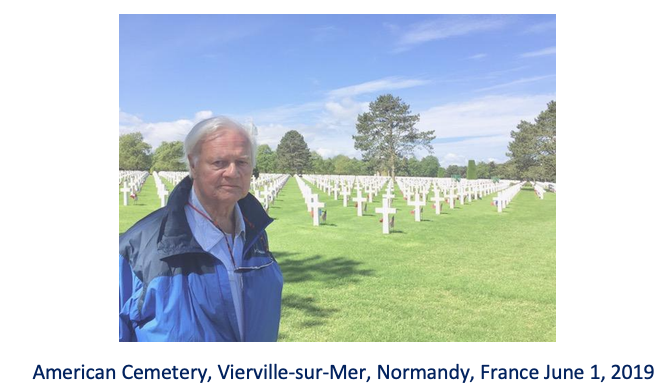
These graves represent only a fraction of the death and devastation caused by the fascist regimes of Germany, Italy and Japan in World War II, the most destructive war in history. It must never be allowed to occur again, but such destruction is not impossibile.
Russia, China, and North Korea each have nuclear attack capability. Other countries, including Iran, could quickly join the nuclear club. Although these nations may not use these weapons themselves, the danger of such weapons falling in the hands of Isis or other terrorist groups is an increasing threat.
It is a vital interest of our civilization to spread freedom and improve the lives of those suffering under oppressive regimes. Free countries seldom wage war against each other.
Byron K. Varme, Executive Director
Aurora Serves Again? MARCH 19, 2019
On January 23rd the United States recognized Juan Guaido as the legitimate President of Venezuela, a decision quickly followed by over eighty other countries. It immediately became apparent that Nicolas Maduro, the former president, would do anything to maintain his tyrannical control of the country.
We suggested that one way, short of war, that the free countries allied behind Juan Guaido could put additional pressure on Maduro to leave would be by positioning a group of warships from the neighboring countries and the US Navy off the coast of Venezuela. The mere presence of these ships should certainly increase anxiety amongst Maduro’s military and palace guard. Traditionally naval forces from friendly countries have worked closely together and often established strong personal relationships. Possibly some commanding officers from the Bolivarian Navy could be induced to deploy their ships and join the Allied task force.
Last weekend the Maduro government blocked the humanitarian relief efforts that produced massive rallies of Guaido supporters. Although the number of defections has increased, Maduro still retains control of most of the military, Russian mercenaries and civilian beneficiaries of his kleptocracy. Juan Guaido has stated that military intervention might be required to overthrow the Maduro regime.
In October, 1917 (202 years ago!) the Russian Cruiser Aurora allegedly fired the first shot to signal the start of the Russian Revolution. It would be both ironic and fitting if a vessel of the Bolivarian Navy replicated that action at an appropriate time. In recognition of Vladimir Putin’s support of the Maduro regime, perhaps the ship could be renamed Aurora II.
Maduro will not Resign FEBRUARY 11, 2019
The recent blockage the bridge at the Colombian border to prevent humanitarian relief supplies from entering Venezuela is further evidence that that Nicholas Maduro has no intention to resign the presidency of Venezuela. Pursuant to the Venezuelan constitution, Juan Guaido has become the legitimate president as recognized by the US, Canada, all of the major countries of South America and many others.
The Venezuelan military is still largely controlled by Maduro, and they are being deployed to intimidate supporters of Juan Guaido.
In a yet unconfirmed report noted by The Economist[1], the Russians recently sent 400 para-military personnel to Venezuela.. The mission of this goon squad is to protect Maduro from enemies within, which is now performed by Cuban security specialists. These are all classic moves from the “Dictator’s Playbook as used by Russia, Turkey Cuba, Syria and others. With their support Madoro is copying the survival plan used by Bashar Al-Assad in Syria.
To counter these actions, we suggest that Colombia, Brazil and Argentina, together with the US and Canada, immediately dispatch appropriate naval ships, such as amphibious support vessels, to operate offshore Venezuela. The mere presence of these vessels would give strong incentives for Venezuelan military personnel to abandon Maduro and pledge support to the new Guido government.
The operation of any vessel in international waters is often done to confirm freedom of the seas. It is not an act of war, but it would confirm the Allies capability to do so. This proposed deployment should be implemented as soon as possible.
2018
Justice Brett Kavanaugh SEPTEMBER 10, 2018
The Senate’s vote to confirm the appointment of Justice Brett Kavanaugh to the US Supreme Court was a very welcome triumph of reason over emotion. There was, on both sides of the aisle, an understanding that Justice Kavanaugh has superb legal qualifications for this job. For almost all Democrats, that was a major part of the problem. They were seeking another Justice who shared their view that the Supreme Court should be an active partner in promoting their social policies. However, this is in conflict with the mission of the Court, as stated in the oath of office, “To support and defend and protect the Constitution of the United States”¦” There appears to be no doubt on either side that Justice Kavanaugh will live up to that commitment. That is good news for the country.
Byron K. Varme
Executive Director
Singapore Summit JUNE 4, 2018
The suspense is over! On June 1st President Trump announced that the meeting with DPRK Chairman Kim Jong Un that he canceled just last week was now on again and the two leaders will have their summit in Singapore on June 12th as previously scheduled. It appears that it will probably happen.
This is good news. By agreeing to meet the “Little Rocket Man President Trump essentially defused the crisis atmosphere that prevailed in 2017 when the DPRK launched a series of ballistic missiles and carried out underground nuclear tests. This welcome change was further enhanced when President Moon of South Korea invited the North Korea to participate in the Winter Olympic Games.
One prediction we can make at this time with a high degree of confidence is that after the meeting each party will proclaim that the Singapore Summit was a great success. For Kim Jong Un it represents the achievement of a three generation objective, the recognition of North Korea as a serious power to be respected an even feared. President Trump has already declared that the meeting will be the first step in the process of denuclearization of North Korea.
In a recent Op/Ed piece, Walter Mead Johnson cited the prospects for Kim relinquishing his nuclear weapons and delivery system most succinctly, “The Kim’s would rather be the absolute rulers of a poor country that the former rulers of a middle income one”
Last year, early in his short term as Secretary of State, Rex Tillerson assured Kim Jong Un that the US was not seeking Regime change. In response, in a Commentary last year titled “Of course, we want regime change!” I surmised that the statement was merely diplomatic blather, because the only way that the DPRK will ever change is when the Kim Dynasty is overthrown and replaced by a government that seeks the betterment of their people. This is a very tall order, not to be accomplished easily. However, it is the only realistic long term objective.
Byron Kahrs Varme
Accordion Panel
Syrian President Bashar Al-Assad and his Russian and Iranian supporters, Vladimir Putin and Ayatollah Khamenei, may have done a great favor to President Trump.
The air attack on the Damascus suburb of Douma on April 6th reportedly killed over 40 men, women and children with chlorine gas, considered a weapon of mass destruction and universally banned. Based on Trump’s recent comments expressing his intention to withdraw all US forces from Syria. Al-Assad et al presumably assumed they could get away with this attack unscathed. However, Trump tweeted they would pay a “Big Price” for this heinous action.
His tweet is the equivalent of the infamous “Red Line” comments by Barrack Obama. Weaseling out of this commitment resulted in Russia and Iran greatly expanding Russian and Iranian involvement in Syria. It was the greatest foreign affairs blunder of the Obama presidency.
What to do? Follow the example set by President George H. W. Bush in the First Gulf War and instruct SECDEV General Mattis to prepare the optimal response then stand aside and let our superb military do the work. While the response is being planned, solicit support from our closest allies to contribute to the effort. Presumably, this could involve cruise missiles to cripple Syria’s new Russian air defenses, followed by attacks on military command facilities and perhaps even on Assad’s presidential palaces.
No doubt such attacks will be labeled acts of war against a sovereign nation, however, the Allied mission is not to invade or occupy, only to punish the bullies and help the decimated opponents of one of the most brutal regimes on the planet. Such response would be welcomed by freedom loving people everywhere and is long overdue.
One collateral effect would be to strengthen our position in the forthcoming negotiations with Kin Jong-un on the DPRK nuclear threat. Go for it, Donald. Show them you are not all words and bluster.
Byron Kahrs Varme
2017
2016
A Dangerous Inter-Regnum 4-2016 “ August 15, 2016
No matter the outcome of the U.S. Presidential election on November 8th, the world will enter a more dangerous period until the inauguration of the new president on January 20th and likely for some months afterwards. As an example, Vladimir Putin could use this period to further expand into the former Soviet controlled states by replicating his annexation of Crimea and intrusion into Ukraine. In each of these cases he began with increased military exercises on their borders, followed by incursion of the “little green men”, soldiers of the Russian Army without insignia.
The reaction of the West to these takeovers was strong denunciation of the acts by Western diplomats and later imposition of increased sanctions. But nothing else happened. It was a Russian fait accompli. Estonia, with 25% of its population ethnic Russian, and bordering on Russia, is a particularly enticing target. Estonia ranks as one of the most advanced countries in the world. No doubt that with any such Russian activities, the Baltic States would immediately call on the NATO countries to live up to their contractual commitments to come to their aid. The reaction of the US would be crucial. Direct military involvement could be considered an act of war against Russia. The Obama Administration would be loath to make such major decisions before the inauguration of the new president.
The other critical decision would be from neighboring Germany, but any overt military action would probably be met by the Russians shutting off the supplies of natural gas. The prospect of a cold Christmas would not be welcomed by German electorate.
Of course, it would be a gamble for President Putin, but he has proved to be an excellent poker player and has as a very strong hand. During the Inter-Regnum, other countries, including China, might also use this period to increase their expansion activities. In short, the inter-regnum beginning tomorrow until a new administration has settled in could be a dangerous time.
Byron K Varme
Executive Director
2015
The Clash of Civilizations and WW III “ December 14, 2015
Conflicts between nations of different cultures are not new. Professor Samuel P. Huntington called this situation “The Clash of Civilizations”, the title of his famous article written in Foreign Affairs in 1993. His hypothesis was that the differences between the major cultures, namely Western, Islamic, Chinese and Japanese, will dominate global politics for the foreseeable future.
The message that Professor Huntington propounded is that it is extremely difficult to impose a different culture on a country or its population.
Children around the world are inculcated since birth in the habits and traditions of their families and friends and, as they grow up, are usually quite content to live with their heritage. It is readily observed that it is very difficult to push a chain uphill.
However, a chain can be pulled uphill. The Western way of life is enormously attractive to most young people, who love the freedom, music, blue jeans, computers, cars, and other aspects of Western culture. The Western life style has been eagerly imitated in the most rapidly growing nations in the Far East and India. However, the Wahhabi clerics of Saudi Arabia and the Iranian Shi’a theocracy strongly resist the “Western invasion” and what they perceive is the abandonment of the teachings of the Qur’an. These nations have produced and financed the Taliban and other jihadists who have adopted terrorism, suicide bombings and martyrdom to combat the spread of Western culture and to restore Islam to the glory days of the caliphate.
Clash About Civilization
Tony Blair, also writing in Foreign Affairs , stated that “The roots of the current wave of global terrorism and extremism are deep. They reach down through decades of alienation, victimhood, and political oppression in the Arab and Muslim world”. He offered a modification to Professor Huntington’s thesis, suggesting that, “This is not a clash between civilizations, it is a clash about civilizations. It is ultimately a battle about modernity. The terrorists do not want Muslim countries to modernize”. Prime Minister Blair concluded that “We need to construct a global alliance for these global values and act through it”
Freedom of Religion
Most people of strong religious conviction believe that the path to true happiness is best done by joining their faith. Thus, for many years Christian missionaries ventured to far off places to teach, heal and spread the faith. Many of these dedicated individuals became beloved by their adherents, and as a result of their influence, were often considered a threat to the established order. As an example, under the communist regime of Chairman Mao, Christian missionaries and churches were severely repressed.
Freedom of religion is enshrined in the U.S. Constitution and the separation of church and state is a well established concept. These rights have been a beacon for all peoples. However, these fundamental rights are not reciprocated in Muslim countries, where other religions are banned or severely restricted. Because Muslims are taught by their religious leaders that Islam is only true faith, non-believers, including the followers of the other Muslim sects, are considered infidels. As such, Islam is considered an “Absolutist” religion.
The attack on freedom of religion by Islamic clerics continues. An article in The Economist entitled “The Meaning of Freedom” described a resolution on “religious defamation” passed by the UN’s Human Rights Council on March 26, 2009. The intent behind the resolution can be surmised from its sponsors, Pakistan, Belarus and Venezuela with support from Saudi Arabia and Egypt. The resolution states that “defamation of religions is a serious affront to human dignity”. The Arab countries commonly define the word “defamation” essentially the same as the crime of “blasphemy” which is interpreted as any dissent from the official interpretation of Islam. In summary, the resolution is intended to provide legitimacy for the punishment of both Muslims and non-Muslims who disagree with any ruling by the clerics. This is an incredibly bold attack on the freedom of speech which is enshrined in the Universal Declaration of Rights adopted by the UN in 1948.
Within all religions, not all believers follow all of the teachings of their clergy. Thus, although the Catholic Church forbids the use of contraceptives (presumably because they want more parishioners) many Catholics ignore these edicts. Similarly, when some Islamic clerics issue Fatwa’s calling for a jihad against the infidels, they are ignored by most Muslims outside the Middle East.
Modernization and the World’s Religions
All of the great religions of the world either embrace or accept most aspects of modernization as beneficial to human progress except the Islamic fundamentalists and some sects within the other faiths (e.g. Quakers). Most followers of the great Eastern religions – Hinduism, Buddhism, Shinto and Confucianism- have accepted modernization within their societies, and these nations have become more secular. Thus, Islam alone is fighting to go “back to fundamentals”, in this case the rules of the 7th Century. The “Clash of Civilizations” is between the fundamentalist Islam and the secular freedoms of the West and modern countries of the world.
Professor Huntington predicted a clash between the Western societies and the three other great cultures, namely the Islamic, Chinese and Japanese. However, the Asian nations have actively embraced with a vengeance many aspects of Western civilization. Japan, progressing from the total devastation of WWII has become the second largest economy in the world. The free market economic model has been adopted by Taiwan, South Korea, Singapore, Indonesia, Malaysia, the Philippines and the emerging “tigers” of Southeast Asia. India, the largest democracy in the world with a substantial Muslim population, has made great strides since it abandoned state run economic policies.
Nations with free market economies, even those which retain totalitarian governments, are not a threat to the West. Why attack your best customers? These countries have eagerly adopted some of the finest aspects of Western culture. Many of the world’s great orchestras have large components of brilliant Asian musicians. Sports competitions are a common bond between all peoples of the world.
Those Islamic nations which have adopted free market economies such as Turkey and the Gulf states are prospering. India has a large Islamic minority and a Muslim President. Indonesia has the largest Muslim population in the world. But these countries are targets for the Jihadists – “Islamofascists” – who commit acts of terror and seek to replace the secular governments with an Islamic theocracy. Their efforts were successful in Iran. To envision the kind of life the Jihadists have in mind one only need to see the restrictions imposed by the Taliban in Afghanistan while they ruled that abject country.
Thus, the real “Clash of Civilization” as perceived by Professor Huntington is no longer the West versus the great Asian civilizations. It is now the Islamic leaders who preach Jihad and their disciples against the rest of the world
Byron K Varme
Byron K. Varme, Executive Director
Year End Commentary -2015
For the past seven years President Obama has described numerous global attacks by terrorists as anything but the obvious title, “Islamic Terrorism”. He has continuously reminded us that not all Muslims are terrorists (certainly true) although almost all terrorist attacks have been made by Muslims (equally true). However, the latest acts of Islamic Terrorism, namely the Paris massacres and most recently the carnage in San Bernardino, may be the tipping point in the process of the US government mounting a meaningful response to global Islamic terrorism.
It is painfully obvious that the policy of “political correctness” (i.e. to do nothing to offend the sensibilities of any Muslim) has been a colossal failure. The question is how best to respond. The first step is to recognize that there is indeed a fundamental difference in the cultures of the Western democracies and Islamic theocracies. This is not a new revelation.
The Clash of Civilizations
The Foundation of International Freedom was organized in 2006 largely on the belief that our Western civilization was engaged in a historic clash of civilizations, as described in a 1993 article in Foreign Affairs by Professor Samuel P. Huntington. In this article he set forth the premise that the fundamental conflicts in the world had become clashes between six major cultural groups, and he noted that they were particularly prevalent between Muslim and non-Muslim countries.
The differences between the two cultures are indeed very real. The Western World, in which the authority of the government is basically granted by the people, is in direct contrast with the rule of the Shar’ia laws that govern Saudi Arabia and other ultra-conservative Islamic states. Countries that have embraced the rights of individuals and free markets have provided a standard of living for their citizen far exceeding the subjects of the Arab states and other totalitarian governments. Of course, the ruling monarchs and their entourage enjoy fabulous wealth, and understandably are reluctant to relinquish and authority that might threaten this arrangement. President Assad of Syria is the “Poster-boy” of this club of dictators.
However, the Islamic and Western cultural heritages do not have to “clash”. Each can go its own way, as long as one does not seek to forcefully impose its way of life on the other. Western businessmen have worked in Islamic countries for many years, living within the restrictive edicts of the host countries. As an example, the Arab Emirates have used their wealth with Western expertise to create a thriving modern society with minimum conflicts. Most Muslims regard IS as a threat to their core beliefs.
Muslims in the West
Muslims have lived peacefully in Western countries for many years, quietly practicing their faith while becoming fully integrated and model citizens in their host countries. However, the flood of recent arrivals in Europe and Scandinavia has established separate Islamic communities surrounding major cities. These areas have established Shar’ia law and have become breeding grounds for terrorists. The significantly higher birth rate within Muslim communities has created a demographic situation whereby Muslim activists use free elections to change their host societies to accept Islamic traditions.
It is particularly ironic that any Muslim emigrants seek to replace the Western societies which have been so successful in offering better lives and opportunities for its citizens with the repressive life under Shar’ia law. Under Shar’ia law women are treated as second class citizens, homosexuals can be killed and honor killing is accepted. The effort to approve any use of Shar’ia in the United States should be regarded as sedition and should be legally prohibited.
Syria
The civil war in Syria began five years ago by a large segment of the population of 23 million in protest against the oppression by the brutal regime of Bashar Al-Assad. After stating that “Assad must go”, Obama erased his famous “Red-Lines” and accepted Putin’s offer to allow Al-Assad to continue in power if he agreed to cease gassing his fellow-citizens. Realizing that there were many other ways to kill them (e.g. barrel bombs) he quickly agreed and Russia became our de facto partner in the debacle. The result has been that the fighting has continued, killing over 250,000 Syrians and over two million refugees have fled to Europe, dramatically expanding the immigrant crisis and increased Islamization of their host countries. This has been a specific objective of Islamic State.
Iran
Since the fall of the Shah is 1979, Iran has become essentially a Shi’a theocracy under the regimes of the Supreme Leaders, Ayatollahs Ruhalla Khomeini and now Ali Khamenei. Iran, with a majority Persian population, is actively seeking to expand its influence with the weak Iraqi government. The Iraqis of southern regions are predominantly Shi’a Arabs, living in an area blessed with some of the largest hydrocarbon reserves in the world. The prospect of Iran controlling these fields and the potential income is a major incentive. As a result of the recent Iran nuclear treaty, most sanctions are about to be removed and the $150 billion which has been withheld will be released. All the while, Iran continues to develop long range ballistic missiles, whose only real utility is to carry nuclear weapons. Its nuclear program may or may not be on a temporary hold. Meanwhile, Iran continues to sponsor conflicts in Yemen and along with Russia, is the primary supporter of Bakar Al-Assad in Syria. Russian air power has kept him in power for the last six months. Islamic State (IS, ISIL and its affiliates, or “Daesh”) Following the withdrawal of the American-led coalition forces from Iraq, the Shi’a led government of Nouri Al-Maliki proceeded to disenfranchise the large Sunni population of the country. These actions created the vacuum which resulted in the formation of Islamic State.
Mohammed Al-Baghdadi’s stated objective is to create a new Caliphate, declaring himself the new Caliph. The last Caliphate was the Ottoman Empire which until 1924 encompassed most of the Middle East. Thus, the term Caliphate represents the pinnacle of Islamic culture, which has great appeal to the pride of many followers. Using barbaric methods unseen since WWII, IS proceeded to capture Mosul, the second largest city in Iraq providing them a large source of funds looted from the banks, individuals and from oil production.
IS Sponsored Terrorism
Through the use of sophisticated social media, IS has been highly successful in attracting new recruits from countries around the world. They have also expanded the reach of the proposed Caliphate by establishing affiliates in Libya, Tunisia, and Nigeria (Boko Haram). In addition, IS has actively sought to export terrorist acts by individuals living abroad. The Muslim team of Syad Rizwan Farook and his wife Tashfeen Malik, who committed the San Bernardino massacres of 14 co-workers, are examples. Potential terrorists are difficult to identify and security authorities expect more attacks in the future.
In an excellent article entitled “How to Beat This Enemy”,[1] Maajid Nawaz states “Islamism is not Islam, but an offshoot of Islam. It is a Muslim theocracy”. He further states that “Islamic State’s leaders insist that the U.S. and the rest of the West are waging global war against all Islam and Muslims. This is obvious nonsense.”
To further this false premise, a major objective of IS terrorism is to promote a backlash against Muslims now living in the Western countries to disrupt the peaceful co-existence with the new host countries. Their reasoning is that to the extent that IS attacks create this backlash, IS can be seen to be the protector of Islam (especially Sunnis) against the “Infidels” thereby driving more malcontent youth into their web.
Until the Islamic State ceases to exist, it will continue to sponsor terrorist attacks and recruit new followers. Like cancer, the longer it exists, the faster it will spread.
World War III
Seventy four years ago Japan launched a surprise attack on Pearl Harbor. The following day this action was declared an Act of War which brought the US into World War II. Since the attack on the Twin Towers and the Pentagon on September 11, 2001, there have been 27,401 terrorist attacks around the world by Muslims (See www.thereligionofpeace.org). These cumulative attacks in many countries over this long period of time constitute acts of war waged by fanatical Jihadist against countries they consider enemies of Islam, or simply “infidels”.
Each country that has been attacked by Islamic State terrorists has justification for a military response to destroy IS. Although the United States military and our allies in the coalitions have been engaged in a modest effort for some time, the US should recognize that we are indeed at war specifically against the Islamic State. The objective should be to destroy IS as quickly as possible.
How to Defeat Islamic State
Most military experts concur that IS will not be defeated without the use of ground forces. Thus far, the Iraqi Army has failed dismally in its efforts to regain significant lost territory, primarily because the local populations are predominantly Sunni Arabs, distrust the Shi’a government. Ideally, the majority of the ground forces should be from the Arabic countries that will benefit from the elimination of IS (e.g. Kurds, Jordan). NATO military forces have unique qualifications to assist in the effort. The campaign should also include the use the new weapons of global conflicts, including financial and cyber warfare, social media and any other means to diminish the attraction of Islamic State.
Regarding the probability that our military will sustain losses, an Army veteran once told me, “Our citizens are in either one of two classes, either sheep or sheep dogs. The duty of the sheep dogs, our military, is to defend the sheep”. Most of our service people are volunteers, proud of their vocation, and willing to undertake dangerous missions to protect our country and all others of good will. The decision to “slip the dogs of war”, to destroy Islamic State will be welcomed at home and with our European and Middle East allies. Most people of good will, no matter whether Christian, Muslim or any other faith, concur that tyrants who maintain power over their citizens by sheer brutality should be deposed.
The gold standard for waging war against Middle East tyrants was established by President George H. W. Bush in the Gulf War in 1991. After Saddam Hussein invaded Kuwait in August 1990, the diplomatic community began efforts to induce him to withdraw his forces from Kuwait. When diplomacy finally failed, President Bush gave the orders to implement the war plan. Ground action began on February 24, 1991 and following liberation of Kuwait and a rout of the Iraqi army. A grateful Kuwait government subsequently reimbursed the US for most of the costs involved.
Although some politicians argue that our government should only undertake actions which directly affect the United States, or colloquially stated, “Our dog is not in that hunt”. While we should carefully assess what is possible to achieve, free countries should do all they can to assist the helpless and defeat tyranny wherever found. It is just the right thing to do.
Byron
Byron K. Varme
Executive Director
December 15, 2015
2014
Islamic State “ November 26, 2014
Members & Friends:
The rise of the Islamic State has been the most significant development of 2014, and the attached Stratfor Report describes the effects of their effort to establish a new Caliphate from the Sunni areas of Iraq and Syria on each of the major players involved. We continue to believe that, first, the entire region would be more stable had the original borders of the states in the region had been drawn to better reflect the ethnicities of the populations, and second, the U.S. administration was not so determined to establish “democratic” regimes. Dictators have long known that rigging elections is a relatively easy way to achieve power in fledgling countries with dominant tribal traditions and lacking established institutions to guard against sedition.
That being said, the destruction of the military forces of both the Al-Assad regime in Syria and the Islamic State is the right thing to do. The often cited objection has been the prediction that chaos would follow the overthrow of any government. We submit this is a better potential outcome than the present situation.
The objective of the Obama administration for the past six years has been to withdraw essentially all military forces from the area and further, to virtually prohibit the deployment of any “boots on the ground”. The statement of this policy has given despots free reign to kill their own people in huge numbers in their efforts to stay in power (e.g. Al-Assad) and virtually an invitation to disenfranchised Sunni leaders to establish the Islamic State.
This new Islamic entity has attracted many young people from around the world to join their cause and some have participated in acts of barbarism not seen in this century. There are many well trained warriors in the civilized world who would gladly use their experience to combat this evil and join a all-volunteer force with this objective, in short, a new mercenary expeditionary force. Financing should could come from every country that fears the success of IS.
Why has this not occurred? A State Department official told me that the Iraqi government would not tolerate any foreign troops in their country, presumably because it could jeopardize their sovereignty. As if this was not the precise objective of the Islamic State.
As always, your comments are welcomed.
Byron
Byron K. Varme, Executive Director
2013
The Syrian Crisis – March-15, 2013
The Syrian Crisis – WesternHE Involvement Long Overdue
The cover of the current issue of The Economist (March 13, 2013) is entitled “Syria, the Death of a Country” citing the death of over 70,000 people and displacement of 5,000 people per day. The article concludes with the recommendation that the Western nations should take such actions as needed to assuage the brutalization of the Syrian population. We strongly agree.
The actions proposed by Britain and France are to ease the arms embargo to permit more weapons to reach the various factions rebelling against the regime of Bashar Al Assad. This proposal had the endorsement of Leon Panetta, General Martin Dempsey and even Hillary Clinton but was vetoed by President Obama. Apparently, he will take no action that could jeopardize his political objectives.
Although more light weapons would help the Syrian rebels, it would do little to affect the devastation caused by the Syrian Air Force. Proposals to send shoulder fired missiles to the rebels have been opposed because of fear that some would likely fall into the hands of jihadists who could use them against civilian airliners. This scenario is not far- fetched.
The apparent answer would be to establish a no-fly zone as was done with great effect both in Iraq and Libya. In both cases, the first objective of U.S. and allied air forces was to take out the air defense infrastructure. Although the Syrian air defense system has benefited from sophisticated Russian equipment and expertise, there is little doubt that they could be destroyed by a “shock and awe” attack.
One proposal to escalate pressure on the Syrian Air Force would begin by stationing an international carrier group (presumably including the US and some allies) off its small Syrian Mediterranean coastline. Syrian ex-pats have suggested the simple presence of these forces would accelerate defections. This could be followed by cruise missile attacks on the air force infrastructure, including aircraft, hangars and supply depots. These could not easily be replaced, and would disrupt the major weapon of killing and damage created by the Assad regime. It would be applauded by all of the rebel factions excepting Hezbollah and its Iranian and Russians backers who stand to lose influence if their client state falls.
Of course, any attack on another nation without at least the cover of a UN resolution, as used in the Korean conflict, would be decried by internationalists as a violation of the sacred concept of national sovereignty. We suggest the Assad regime, and those of other dictatorships such as North Korea, lose their sovereignty when they remain in power only through terrorizing their own people. Legalistic cover when used to perpetuate such brutalization is inherently immoral.
Everyone recognizes that the Syrian situation is extremely complex, from a legal and geopolitical view involving Iran and Russia as the principal supporters of the Assad regime. Any actions taken, such as proposed above, will have unforeseen consequences, both good and bad. However, the present situation is intolerable, and the US, and a few of its allies, has it in their power to help the people of Syria. It is the right thing to do.
2012
The Middle East “ An Historical Perspective “ January 20, 2012
The Struggle for Syria
January 20, 2012
STRATOR today reported that “The deputy chief of Syrian air force intelligence in Deir el-Zour, Brig. Gen. Nasr Mustafa, defected to the Free Syrian Army on Aug. 2, 2012. The defection is significant because Mustafa is an Alawite — as is Syrian President Bashar al Assad, who needs unity among this religious sect to retain power. Losing Mustafa suggests the regime likewise may be losing control of its Alawite-dominated intelligence and security apparatus.
Meanwhile, the regime may be growing more desperate as its offensive against Aleppo continues.”
While the end of the Assad regime is not imminent, he is not likely to end up in a foxhole like Saddam Hussein or be arrested like Hosni Mubarrak. Hopefully we will learn that Assad has left the country with his family, probably moving to Russia.
While the Struggle for Syria Intensifies
It seems a pity that the Obama administration has made the decision to seek UN approval for any overseas military activity, and in this process cedes US sovereignty to an organization that is essentially controlled by the Security Council (with Russia and China blocking any action on Syria) and with 120 of the 194 member states run by dictators. The last thing they want to see is any country meddling in their “internal affairs”. Meanwhile, Syrian citizens are dying by the thousands.
Byron K Varme
Executive Director
The Struggle for Syria – August 3, 2012
The Struggle for Syria
January 20, 2012
STRATOR today reported that “The deputy chief of Syrian air force intelligence in Deir el-Zour, Brig. Gen. Nasr Mustafa, defected to the Free Syrian Army on Aug. 2, 2012. The defection is significant because Mustafa is an Alawite — as is Syrian President Bashar al Assad, who needs unity among this religious sect to retain power. Losing Mustafa suggests the regime likewise may be losing control of its Alawite-dominated intelligence and security apparatus.
Meanwhile, the regime may be growing more desperate as its offensive against Aleppo continues.”
While the end of the Assad regime is not imminent, he is not likely to end up in a foxhole like Saddam Hussein or be arrested like Hosni Mubarrak. Hopefully we will learn that Assad has left the country with his family, probably moving to Russia.
While the Struggle for Syria Intensifies
It seems a pity that the Obama administration has made the decision to seek UN approval for any overseas military activity, and in this process cedes US sovereignty to an organization that is essentially controlled by the Security Council (with Russia and China blocking any action on Syria) and with 120 of the 194 member states run by dictators. The last thing they want to see is any country meddling in their “internal affairs”. Meanwhile, Syrian citizens are dying by the thousands.
Byron K Varme
Executive Director
2011
The Revolutionary Wave in the Middle East “ February 11, 2011
The Jasmine Revolution
The event which has had the greatest historical impact of this year was the “Jasmine Revolution” in Tunisia which began with street demonstrations in December 2010 protesting the repressive government. On December 17th the self-immolation of a street vendor triggered a massive revolt of the people of Tunis which resulted in the fall of President Zine el Abadine Ben Ali, the strongman who ruled the country for twenty-three years. On January 15, 2011 he fled the country for the safe haven of Saudi Arabia.
The events in Tunisia were watched with considerable apprehension by the autocratic leaders throughout the Arab world, most notably in Algeria, Egypt, Yemen and Jordan. The Shi’ia theocratic regime in Iran which violently suppressed the “Green Revolution” in June 2009 was reminded of the power of the people. If tiny Tunisia could sack their leader, who would be next? We did not have long to wait.
Egypt – The First Domino
In his book “The Second World” written in 2008 Paraq Khanna concluded that Egypt was ripe for a revolution, This observation proved prescient, for on Tuesday, January 25th, now called the “Day of Rage”, huge crowds formed in Tahrir Square in Cairo. The demonstrators were generally peaceful, and the Epyptian Army showed considerable restraint. The government response was to shut down the Internet and Al Jazeera. President Mubarak stated on February 10th that he would transfer powers of the presidency to his newly appointed Vice President, Omar Suleiman. Today, STRATFOR reported (see full article, below) that “President Hosni Mubarak has decided to step down from the office of president of the republic and has charged the high council of the armed forces to administer the affairs of the country.”
To this extent, the protestors have succeeded in their primary objective, the removal of President Mubarak, but the country is far from having achieved a truly representative government. Thus, the revolution is already a partial victory for freedom, showing the changes that can be accomplished by unified popular and peaceful dissent.
Our Position
The mission of the Foundation of International Freedom is to preserve and expand the core values of Western civilization. These values include the respect for individual rights of citizens, freedoms of speech, press and religion, separation of church and state, independent judiciary, representative government, right to own property, free market economies and racial and gender equality.
Accordingly, we strongly endorse the efforts of all of the peoples of the Arab countries to replace their authoritarian regimes with some form of representative government. We are well aware of the challenges facing any new democracy from fundamentalist groups such as the Muslim Brotherhood. However, if Egypt follows the Turkish model where the military is predominantly secular with an officer corps with Western training that is generally held in high regard, it appears likely that they can limit the power of the Islamic fundamentalist groups. Of course, this is the Middle East, and nothing can be predicted with great certainty.
Conclusion:
Our hope is that the Tunisian revolution will come to be regarded as the pebble in the pond which resulted in a Tsunami wave of freedom which will eventually sweep over the entire Middle East. How and when this will occur in each country will certainly differ.
Although we certainly recognize the strategic realities which have resulted in the American government supporting a number of very repressive regimes, however, the guiding principal is that the Foundation of International Freedom is always on the side of the people, trusting that in the long term this policy is more sustainable than keeping autocratic regimes in power in the quest for stability.
Your comments are welcomed.
Byron
Byron K. Varme, Executive Director
February 11, 2011
Unleash the Egyptian Army “ February 23, 2011
In his 80 minute speech on Monday, January 21st Moammar Qadafi vowed to die a martyr rather than relinquish his 42 year rule of Libya. As described in the STRATFOR report appended below, Qadafi’s words were backed by machine gun fire by the mercenaries brought in to quell the protesters in Tripoli and directed at any gathering of civilians. Understandably this drove most of the population inside. He then vowed to go house to house to find and exterminate all opponents to his regime. The Colonel has proved he is capable of ordering genocide against his own people, including air strikes against massed protesters.
While the opposition has apparently won control of most of Eastern Libya, in order to force the removal of Qadafi they will have to control Tripoli, the capital city and base of Qadafi’s support, either through the defection of these supporters or through military action. The strategy of non-violent protests that was successful in Tunisia and Egypt will not work in Tripoli.
However, the opponents of the regime have only been able to win battles in Eastern Libya with weapons confiscated from police and militia barracks, and they do not have the weapons, logistical support or training to overcome professional soldiers. It appears that Qadafi still controls the Libyan Air Force.
Thus far the response of the Western governments to the Libyan situation has been to strongly condemn any action against peaceful protestors. Although the United Nations has convened an emergency meeting of the Security Council, we believe it is unlikely that it will issue anything more than a mild condemnation as it would be perceived to be interfering in the domestic affairs of a sovereign nation, which is definitely not in the interest of the 120 or so totalitarian governments in that organization. Military analysts have stated that neither the US or NATO has neither the desire nor the available assets to launch a ground war in Libya. Therefore, what are the options?
What about the Egyptian Army? As we have often heard over the past several weeks, the Egyptian Army is a modern force equipped and trained by the US. It is regarded as an effective and secular organization that is the primary force for stability in that country. With the resignation of Hosni Mubarak, the Army is now running the country until replaced by a new civilian government. These are not strictly military functions.
The Army certainly has the capability of deploying an Expeditionary Force on the western border of Egypt. From this position if would be able to offer assistance to Egyptian citizens now fleeing Libya and if called upon called upon by the protestors to assist them in repelling any effort by pro-Qadafi force to retake Eastern Libya. Presumably, it would also have the capability to make a rapid deployment of the 1614 kilometers (1,002 miles) to Tripoli to confront the mercenaries and militias still supporting Moammar Qadafi and his sons. The mere presence of a significant anti-Qadafi force on the Egyptian/Libyan border should create a disincentive to those still supporting his regime.
I expect that a telephone call from Defense Secretary Robert Gates to the Chief of Staff of the Egyptian Army could accomplish this action, as it would simply require the re-positioning of forces within their own country. This action would be comparable to the deployment of a US aircraft carrier near a war zone or the Russians stationing troops on their border with Georgia.. The net effect would be to increase our available options, which is always a positive position.
In the event that Qadafi proceeds with his plans crush the opposition in Tripoli through a systematic cleansing operation, presumably the Western countries could recognize an opposition group as the new legitimate government of Libya and respond to a call for military assistance with a combined air and ground campaign. It is likely that such a fight would be over quickly but the outcome thereafter could be messy. Although this could be described as just a new quagmire ala Iraq, there would be one major difference…it would be an Arab neighbor coming to the assistance of another Arab neighbor.
Certainly, the other autocratic regimes in the region would not like to see this outcome, but it might be an additional incentive to accelerate the process of freedom for their citizens as well.
Byron
Byron K. Varme
Executive Director
STRATFOR
—————————
February 23, 2011
LIBYAN CHAOS AND ITS REGIONAL IMPACT
On Monday, it became very clear that the Libyan republic founded by Col. Moammar Gadhafi was fighting for its survival. The regime deployed army and air force assets to quell the unrest that had moved beyond the eastern parts of the country to its capital. Elsewhere, several senior Libyan diplomats resigned their posts and there were reports of military officers joining the protesters after refusing to follow orders to use force against the demonstrators.
The current situation is untenable and Gadhafi could be forced to step down. When that happens, the country is looking at a power vacuum. Unlike Tunisia and Egypt, where the ousters of the sitting presidents didn’t lead to the collapse of the state, Libya could very well be the first country in the largely Arab Middle East to undergo regime change.
The military establishments in Tunis and Cairo were robust enough to remove long-serving head of states and maintain power. In Tripoli, however, the regime is centered on the family and friends of Gadhafi, with the armed forces in a subordinate role. Complicating matters is the fact that the modern Libyan republic has had only one ruler — Gadhafi.
“The Libyan descent into chaos could have a profound impact on the unrest brewing in other countries of the region.”
In other words, there is no alternative force that can replace the current regime, which in turn means we are looking at a meltdown of the North African state. The weakness of the military and the tribal nature of society are such that the collapse of the regime could lead to a prolonged civil war. Civil war could also stem from a situation of Gadhafi not throwing in the towel and deciding to fight to the bitter end.
There are already signs that the eastern parts of the country are headed toward a de facto secession. Given the potential options, some people may view civil war between forces centered in Tripoli and Benghazi as a better option than utter anarchy. At least the country can avoid a Somalia-like situation in which multiple forces in different geographic areas run their own fiefdoms.
Libya spiraling out of control has implications for its immediate neighbors, especially Egypt, which is in the process of trying to manage a transition after the fall of former Egyptian President Hosni Mubarak’s government. The last thing the Egyptian generals want to see is their western neighbor becoming a safe haven for Islamist militants. Likewise, the Tunisians and the Algerians (the latter more so than the former), have a lot to fear from a Libya without a central authority. And across the Mediterranean, the Italians are especially nervous, both due to their energy interests in Libya, and as they contemplate the prospects of a flood of illegal immigrants using a post-Gadhafi Libya as a launching pad into Europe.
The Libyan descent into chaos could have a profound impact on the unrest brewing in other countries of the region. Many opposition forces, which have been emboldened by the successful ousters of the Egyptian and Tunisian presidents, could be discouraged by the Libyan example. Opposition forces in countries like Yemen, Bahrain, Morocco, Jordan and Syria would have to take into consideration that street agitation may not necessarily put them on the path toward democracy.
Thus, what happens in Libya will not just be critical for security in North Africa but for political stability in the largely Arab Middle East.
Copyright 2011 STRATFOR.
Never Fight Ground Wars Overseas – March 1, 2011
In what I consider a long overdue breath of fresh air in the realm of American foreign policy, Secretary of Defense Robert Gates last week stated that that “Any future defense secretary who advises the president to again send a big American land army into Asia or into the Middle East or Africa should have his head examined.” No doubt Secretary Gates was referring to our present involvement in Iraq and Afghanistan, concluding essentially that “victory” in these situations is unobtainable by any foreign power, especially the United States. Although our original objectives may have had some merit, a clear look ahead at the inherent difficulties involved should have compelled our leaders to seek other ways to achieve our national objectives, or perhaps modify the objectives to what can reasonably be obtained.
Certainly this dictum should be considered when contemplating any involvement in the civil war that is underway in Libya. Although Secretary of State Hillary Clinton has stated the “All options are on the table”, presumably including the deployment of ground forces, given our present commitments in Iraq and Afghanistan, that “option” would be indeed a last resort. However, if Col. Mummar Qadhafy does indeed fulfill his vow to fight to the death, and turns loose the militias and mercenaries still under his control on the civilian population in Tripoli, the protesters may not have sufficient military strength to carry out the urban assault required. Certainly, air power alone can not accomplish this task.
In our previous blog we suggested that the Egyptian military could be invited to deploy forces along the Egyptian/Libyan border to be ready to provide assistance to the new government of Libya now being formed. The presence of this force certainly should provide an additional inducement to the forces still loyal the Qadhafy to reconsider their support. As of yet, we have Not heard that this proposal is included in
Secretary Clinton’s option list.
George Friedman, Chairman of STRATFOR, has done an analysis of the American involvement in ground wars in Asia, and set forth reasons why these were they were largely unsuccessful. His article follows below.
Byron
Byron K. Varme, Executive Director
NEVER FIGHT A LAND WAR IN ASIA
By George Friedman
U.S. Secretary of Defense Robert Gates, speaking at West Point, said last week that “Any future defense secretary who advises the president to again send a big American land army into Asia or into the Middle East or Africa should have his head examined.” In saying this, Gates was repeating a dictum laid down by Douglas MacArthur after the Korean War, who urged the United States to avoid land wars in Asia. Given that the United States has fought four major land wars in Asia since World War II — Korea, Vietnam, Afghanistan and Iraq — none of which had ideal outcomes, it is useful to ask three questions: First, why is fighting a land war in Asia a bad idea? Second, why does the United States seem compelled to fight these wars? And third, what is the alternative that protects U.S. interests in Asia without large-scale military land wars?
The Hindrances of Overseas Wars
Let’s begin with the first question, the answer to which is rooted in demographics and space. The population of Iraq is currently about 32 million. Afghanistan has a population of less than 30 million. The U.S. military, all told, consists of about 1.5 million active-duty personnel (plus 980,000 in the reserves), of whom more than 550,000 belong to the Army and about 200,000 are part of the Marine Corps. Given this, it is important to note that the United States strains to deploy about 200,000 troops at any one time in Iraq and Afghanistan, and that many of these troops are in support rather than combat roles. The same was true in Vietnam, where the United States was challenged to field a maximum of about 550,000 troops (in a country much more populous than Iraq or Afghanistan) despite conscription and a larger standing army. Indeed, the same problem existed in World War II.
When the United States fights in the Eastern Hemisphere, it fights at great distances, and the greater the distance, the greater the logistical cost. More ships are needed to deliver the same amount of materiel, for example. That absorbs many troops. The logistical cost of fighting at a distance is that it diverts numbers of troops (or requires numbers of civilian personnel) disproportionate to the size of the combat force.
Regardless of the number of troops deployed, the U.S. military is always vastly outnumbered by the populations of the countries to which it is deployed. If parts of these populations resist as light-infantry guerrilla forces or employ terrorist tactics, the enemy rapidly swells to a size that can outnumber U.S. forces, as in Vietnam and Korea. At the same time, the enemy adopts strategies to take advantage of the core weakness of the United States — tactical intelligence. The resistance is fighting at home. It understands the terrain and the culture. The United States is fighting in an alien environment. It is constantly at an intelligence disadvantage. That means that the effectiveness of the native forces is multiplied by excellent intelligence, while the effectiveness of U.S. forces is divided by lack of intelligence.
The United States compensates with technology, from space-based reconnaissance and air power to counter-battery systems and advanced communications. This can make up the deficit but only by massive diversions of manpower from ground-combat operations. Maintaining a helicopter requires dozens of ground-crew personnel. Where the enemy operates with minimal technology multiplied by intelligence, the United States compensates for lack of intelligence with massive technology that further reduces available combat personnel. Between logistics and technological force multipliers, the U.S. “point of the spear” shrinks. If you add the need to train, relieve, rest and recuperate the ground-combat forces, you are left with a small percentage available to fight.
The paradox of this is that American forces will win the engagements but may still lose the war. Having identified the enemy, the United States can overwhelm it with firepower. The problem the United States has is finding the enemy and distinguishing it from the general population. As a result, the United States is well-suited for the initial phases of combat, when the task is to defeat a conventional force. But after the conventional force has been defeated, the resistance can switch to methods difficult for American intelligence to deal with. The enemy can then control the tempo of operations by declining combat where it is at a disadvantage and initiating combat when it chooses.
The example of the capitulation of Germany and Japan in World War II is frequently cited as a model of U.S. forces defeating and pacifying an opposing nation. But the Germans were not defeated primarily by U.S. ground troops. The back of the Wehrmacht was broken by the Soviets on their own soil with the logistical advantages of short supply lines. And, of course, Britain and numerous other countries were involved. It is doubtful that the Germans would have capitulated to the Americans alone. The force the United States deployed was insufficient to defeat Germany. The Germans had no appetite for continuing a resistance against the Russians and saw surrendering to the Americans and British as sanctuary from the Russians. They weren’t going to resist them. As for Japan, it was not ground forces but air power, submarine warfare and atomic bombs that finished them — and the emperor’s willingness to order a surrender. It was not land power that prevented resistance but air and sea power, plus a political compromise by MacArthur in retaining and using the emperor. Had the Japanese emperor been removed, I suspect that the occupation of Japan would have been much more costly. Neither Germany nor Japan are examples in which U.S. land forces compelled capitulation and suppressed resistance.
The problem the United States has in the Eastern Hemisphere is that the size of the force needed to occupy a country initially is much smaller than the force needed to pacify the country. The force available for pacification is much smaller than needed because the force the United States can deploy demographically without committing to total war is simply too small to do the job — and the size needed to do the job is unknown.
U.S. Global Interests
The deeper problem is this: The United States has global interests. While the Soviet Union was the primary focus of the United States during the Cold War, no power threatens to dominate Eurasia now, and therefore no threat justifies the singular focus of the United States. In time of war in Iraq and Afghanistan, the United States must still retain a strategic reserve for other unanticipated contingencies. This further reduces the available force for combat.
Some people argue that the United States is insufficiently ruthless in prosecuting war, as if it would be more successful without political restraints at home. The Soviets and the Nazis, neither noted for gentleness, were unable to destroy the partisans behind German lines or the Yugoslav resistance, in spite of brutal tactics. The guerrilla has built-in advantages in warfare for which brutality cannot compensate.
Given all this, the question is why the United States has gotten involved in wars in Eurasia four times since World War II. In each case it is obvious: for political reasons. In Korea and Vietnam, it was to demonstrate to doubting allies that the United States had the will to resist the Soviets. In Afghanistan, it was to uproot al Qaeda. In Iraq, the reasons are murkier, more complex and less convincing, but the United States ultimately went in, in my opinion, to convince the Islamic world of American will.
The United States has tried to shape events in the Eastern Hemisphere by the direct application of land power. In Korea and Vietnam, it was trying to demonstrate resolve against Soviet and Chinese power. In Afghanistan and Iraq, it was trying to shape the politics of the Muslim world. The goal was understandable but the amount of ground force available was not. In Korea, it resulted in stalemate; in Vietnam, defeat. We await the outcome in Iraq and Afghanistan, but given Gates’ statement, the situation for the United States is not necessarily hopeful.
In each case, the military was given an ambiguous mission. This was because a clear outcome — defeating the enemy — was unattainable. At the same time, there were political interests in each. Having engaged, simply leaving did not seem an option. Therefore, Korea turned into an extended presence in a near-combat posture, Vietnam ended in defeat for the American side, and Iraq and Afghanistan have turned, for the time being, into an uncertain muddle that no reasonable person expects to end with the declared goals of a freed and democratic pair of countries.
Problems of Strategy
There are two problems with American strategy. The first is using the appropriate force for the political mission. This is not a question so much of the force as it is of the mission. The use of military force requires clarity of purpose; otherwise, a coherent strategy cannot emerge. Moreover, it requires an offensive mission. Defensive missions (such as Vietnam and Korea) by definition have no terminal point or any criteria for victory. Given the limited availability of ground combat forces, defensive missions allow the enemy’s level of effort to determine the size of the force inserted, and if the force is insufficient to achieve the mission, the result is indefinite deployment of scarce forces.
Then there are missions with clear goals initially but without an understanding of how to deal with Act II. Iraq suffered from an offensive intention ill suited to the enemy’s response. Having destroyed the conventional forces of Iraq, the United States was unprepared for the Iraqi response, which was guerrilla resistance on a wide scale. The same was true in Afghanistan. Counterinsurgency is occupation warfare. It is the need to render a population — rather than an army — unwilling and incapable of resisting. It requires vast resources and large numbers of troops that outstrip the interest. Low-cost counter-insurgency with insufficient forces will always fail. Since the United States uses limited forces because it has to, counterinsurgency is the most dangerous kind of war for the United States. The idea has always been that the people prefer the U.S. occupation to the threats posed by their fellow countrymen and that the United States can protect those who genuinely do prefer the former. That may be the idea, but there is never enough U.S. force available.
Another model for dealing with the problem of shaping political realities can be seen in the Iran-Iraq war. In that war, the United States allowed the mutual distrust of the two countries to eliminate the threats posed by both. When the Iraqis responded by invading Kuwait, the United States responded with a massive counter with very limited ends — the reconquest of Kuwait and the withdrawal of forces. It was a land war in Asia designed to defeat a known and finite enemy army without any attempt at occupation.
The problem with all four wars is that they were not wars in a conventional sense and did not use the military as militaries are supposed to be used. The purpose of a military is to defeat enemy conventional forces. As an army of occupation against a hostile population, military forces are relatively weak. The problem for the United States is that such an army must occupy a country for a long time, and the U.S. military simply lacks the ground forces needed to occupy countries and still be available to deal with other threats.
By having an unclear mission, you have an uncertain terminal point. When does it end? You then wind up with a political problem internationally — having engaged in the war, you have allies inside and outside of the country that have fought with you and taken risks with you. Withdrawal leaves them exposed, and potential allies will be cautious in joining with you in another war. The political costs spiral and the decision to disengage is postponed. The United States winds up in the worst of all worlds. It terminates not on its own but when its position becomes untenable, as in Vietnam. This pyramids the political costs dramatically.
Wars need to be fought with ends that can be achieved by the forces available. Donald Rumsfeld once said, “You go to war with the Army you have. They’re not the Army you might want or wish to have at a later time.” I think that is a fundamental misunderstanding of war. You do not engage in war if the army you have is insufficient. When you understand the foundations of American military capability and its limits in Eurasia, Gates’ view on war in the Eastern Hemisphere is far more sound than Rumsfeld’s.
The Diplomatic Alternative
The alternative is diplomacy, not understood as an alternative to war but as another tool in statecraft alongside war. Diplomacy can find the common ground between nations. It can also be used to identify the hostility of nations and use that hostility to insulate the United States by diverting the attention of other nations from challenging the United States. That is what happened during the Iran-Iraq war. It wasn’t pretty, but neither was the alternative.
Diplomacy for the United States is about maintaining the balance of power and using and diverting conflict to manage the international system. Force is the last resort, and when it is used, it must be devastating. The argument I have made, and which I think Gates is asserting, is that at a distance, the United States cannot be devastating in wars dependent on land power. That is the weakest aspect of American international power and the one the United States has resorted to all too often since World War II, with unacceptable results. Using U.S. land power as part of a combined arms strategy is occasionally effective in defeating conventional forces, as it was with North Korea (and not China) but is inadequate to the demands of occupation warfare. It makes too few troops available for success, and it does not know how many troops might be needed.
This is not a policy failure of any particular U.S. president. George W. Bush and Barack Obama have encountered precisely the same problem, which is that the forces that have existed in Eurasia, from the Chinese People’s Liberation Army in Korea to the Taliban in Afghanistan, have either been too numerous or too agile (or both) for U.S. ground forces to deal with. In any war, the primary goal is not to be defeated. An elective war in which the criteria for success are unclear and for which the amount of land force is insufficient must be avoided. That is Gates’ message. It is the same one MacArthur delivered, and the one Dwight Eisenhower exercised when he refused to intervene in Vietnam on France’s behalf. As with the Monroe Doctrine, it should be elevated to a principle of U.S. foreign policy, not because it is a moral principle but because it is a very practical one.
This report may be forwarded or republished on your website with attribution to www.stratfor.com.
Copyright 2011 STRATFOR.
Japan and Libya “ March 12, 2011
The Struggle for Syria
January 20, 2012
STRATOR today reported that “The deputy chief of Syrian air force intelligence in Deir el-Zour, Brig. Gen. Nasr Mustafa, defected to the Free Syrian Army on Aug. 2, 2012. The defection is significant because Mustafa is an Alawite — as is Syrian President Bashar al Assad, who needs unity among this religious sect to retain power. Losing Mustafa suggests the regime likewise may be losing control of its Alawite-dominated intelligence and security apparatus.
Meanwhile, the regime may be growing more desperate as its offensive against Aleppo continues.”
While the end of the Assad regime is not imminent, he is not likely to end up in a foxhole like Saddam Hussein or be arrested like Hosni Mubarrak. Hopefully we will learn that Assad has left the country with his family, probably moving to Russia.
While the Struggle for Syria Intensifies
It seems a pity that the Obama administration has made the decision to seek UN approval for any overseas military activity, and in this process cedes US sovereignty to an organization that is essentially controlled by the Security Council (with Russia and China blocking any action on Syria) and with 120 of the 194 member states run by dictators. The last thing they want to see is any country meddling in their “internal affairs”. Meanwhile, Syrian citizens are dying by the thousands.
Byron K Varme
Executive Director
Further Deliberation Will Keep Qadaffi in Libya ““ March 15, 2011
Background
In our initial message of 2011 we reported on the peaceful “Jasmine Revolution” in Tunisia which resulted in the overthrow of President Zine Bin Ali on January 15th and triggered the revolution in Egypt which removed President Hosni Mubarak. We concluded that these events will come to be regarded as the tsunami wave of freedom which will eventually sweep over the entire Middle East.
Libyan Uprising
It was not long before the predicted wave began. The oppressed people of Libya observed the successful revolutions which were carried out by the two neighboring countries, and by February 20th a full scale revolt was underway. On February 21, 2011, Saif al-Islam Muammar Al-Gaddafi, oldest son of Muammar Gaddafi, spoke on Libyan television of his fears that the country would fragment and be replaced by “15 Islamic fundamentalist emirates. Shortly after this speech, the Libyan Ambassador to India announced that he had resigned in protest at the “massacre” of protesters. In short, Col. Qadhafi would not go without a bloodbath.
Two days later President Barrack Obama said “The United States…strongly supports the universal rights of the Libyan people. That includes the rights of peaceful assembly, free speech, and the ability of the Libyan people to determine their own destiny. These are human rights. They are not negotiable…And they cannot be denied through violence or suppression.”
After hearing these fine words, and the belated cheering for the revolutions in Tunisia and Egypt by the US and many other countries, the anti-government people in Libya could logically conclude that the U.S. and its allies would welcome the removal of the mad Muammar and his extravagant sons and lend material support to their revolution. Such support could be compared with the critical role the French Navy played at Yorktown, Virginia in another revolution some 235 years ago. So far, meaningful support from the US has not been forthcoming.
Chronology
It is helpful to review some significant events that have transpired since the Libyan revolution began.
March 8th. In an op/ed piece that appeared in the Wall Street Journal on Tuesday, March 8th entitled “The US Should Keep Out of Libya” Foreign Affairs Council President Richard Haass, arguing against the imposition of a no-fly zone stated that the Qadhafi “regime could defeat the opposition without resorting to attack plane and helicopter gunships simply by exploiting its advantages in terms of foot soldiers and light arms.” Mr. Haass goes on to say that “intervening militarily in Libya would be a potentially costly distraction for the U.S. military.”
. March 10th. The French government recognized the Libyan National Transitional Council as the sole representative of the Libyan people. (See their web site, http/ntclibya).
. Friday, March 11th the European Union and the U.S. both increased the sanctions imposed on Libya. Such actions merely constitute a mild reprimand, and are largely meaningless in the short term to a regime that has billions of dollars stashed away.
. Saturday, March 12th. The Arab League, consisting of 22 Arab countries, asked the Security Council to impose a no-fly zone over Libya. As vividly shown in the Iraq war, any unopposed air power is deadly over desert terrain.
. Saturday/Sunday March 12-13. In a scathing editorial the Wall Street Journal summarized, “the damage from a Qadhafi victory would not merely be humanitarian, though that would be awful enough, The only way Gadhafi can subdue Benghazi and the east is with a door-to-door purge and systematic murder.
. Sunday, March 13th. Secretary of Defense Bob Gates, after a firestorm of criticism of his earlier remarks, recanted and said “If we are directed to impose a no-fly zone, we have the resources to do it”. On the same day, in another op/ed piece in the WSJ, Eliot Cohen asked, “Why are top defense and intelligence officials (i.e. Bob Gates and Leon Panetta) disparaging military action and publicly predicting Gadhafi’s survival?” Note: The implied answer, of course, is that this is the outcome that the administration wants.
These criticisms of military action come from patriotic Americans. Why would they do this? One plausible reason is that by allowing a despised dictator to overwhelm a legitimate popular rebellion sends a message to the other authoritarian regimes who are our allies, notably Saudi Arabia, Bahrain, the UAE and Kuwait, that it is OK to use force against rebels to stay in power. The Ayatollahs in Iran must be dancing with joy (if they know how to do that).
My military contacts assure me that one carrier air group could probably destroy the 113 Soviet-era Libyan Air Force in one day (The knowledge that a carrier group lurks offshore might well inspire more pilots to defect). The three airfields surrounding Tripoli could be rendered useless by cruise missiles fired from Aegis cruisers or submarines aimed at the runways. With no air force there is no need to establish a no-fly zone. Arming the new Council forces with shoulder-fired Stinger missiles would render any use of helicopters by Qadhafi’s militias very expensive indeed. Communications equipment and other vital military gear can be delivered through the Port of Benghazi.
What Has Been Done
In his press conference on Friday, March 12th, President Obama listed the actions that the U.S. has taken in response to the Libyan situation. These included:
Evacuating American citizens and embassy personnel out of Libya.
Seized financial assets of Qadhafi and his family;
Mobilized the international community through the United Nations;
Seek additional sanctions from the United Nations and NATO partners.
These are all passive actions which put no immediate pressure on Qadhafi. However, if he ultimately prevails, he will certainly take actions he can to remove these sanctions, and that would not be pretty.
Options Remaining
In this conference President Obama further stated: “… that I have not taken any options off the table at this point. I am absolutely clear that it is in the interest of the United States, and more importantly, in the interest of the Libyan people for Mr. Qaddafi to leave. And I have not foreclosed these options.”
“Now, I do take very seriously making sure that any decisions I make that involve U.S. military power are well thought through and are done in close consultation with Secretary Gates, Chairman of the Joint Chiefs of Staff Admiral Mullen, and all relevant personnel. Any time I send the United States forces into a potentially hostile situation, there are risks involved and there are consequences. And it is my job as President to make sure that we have considered all those risks.” (But how long will he consider them?)
President Obama’s statement the he has “not taken any options off the table” is a specious remark. During his drawn out deliberation process, many of these options are disappearing, and if Qadhafi retains power, which becomes more likely every day that Obama fails to act decisively to support the Libyan Revolution, most of these “options” will have left the table by themselves. But perhaps this is his real objective.
When President Obama stated that he is carefully considering what actions to take, it became in essence a green light for Col. Qadhafi to “make facts on the ground”. While the US is dithering, Qadafi’s military is on the verge of destroying the revolution. These forces are now advancing towards Benghazi murdering his opposition along the way.
What Still Can Be Done
On Sunday, March 13th, Secretary of State Hillary Clinton met in Paris with representatives from the Libyan National Transitional Council presumably to ask what can be done. We would have expected that President Obama would have at least shared with her his famous list of “option on the table”. From our vantage point; this list would include the following actions:
. Immediately recognize the new Republic of Libya, and urge our European allies to do the same. They would do so immediately. Once this is done, the U.S. can legally respond to requests from the new Republic of Libya to provide assistance in specific areas, e.g. air strikes.
. Deploy a U.S. carrier to the Mediterranean. On March 1st the USS Enterprise (CV-67) is no in the Red Sea and could reach the Med in a matter of days. Some of its air group presumably could be deployed to bases in Egypt earlier.
. Impose a no-fly zone. George Friedman, Chairman of STRATFOR, wrote a long paper entitled “How a Libyan No-Fly Zone Could Backfire”, and perhaps this thinking has reached the President. If so, don’t bother with a no-fly zone; simply authorize our military to take out the Libyan Air Force as discussed above.
. Lift the Arms Embargo. It only hurt those without arms (the rebels).
. Immediately supply anti-tank weapons and other military gear needed.
. Urge Egypt to deploy troops and armor on the Egyptian/Libyan border to be ready to assist the Republic of Libya. Although they have stated they want no foreign troops in Libya, that might change.
The most common criticism of any of these alternatives is that they would inevitably lead to further involvement, such as in Iraq and Afghanistan. If such involvement was indeed inevitable, we would wholeheartedly concur. Our last blog (February 11th) we discussed the dictum set forth by both President Eisenhower and General Macarthur, and quoted by Secretary Gates, “Never become involved in a ground war in Asia or the Middle East. Accordingly, we proposed that the new Republic of Libya government invite the Egyptian army to assist them to resist the Qadhafi’s militias and mercenaries. Or perhaps hire mercenaries of their own, with the promise to pay from future oil revenues. The role of the Western countries would be solely an air campaign to destroy Qadhafi’s air force and armor. This can be done without setting a foot on Libyan soil.
Conclusion
American involvement in any new overseas action that involves our military and has shown to lead to hugely expensive operations with questionable outcomes such as Iraq and Afghanistan is certainly to be avoided in the future. However, that should not preclude all situations, and especially if the circumstances can be changed to avoid that outcome. I believe that this is the situation in Libya.
Such calculations should indeed be based on what is in our national interest. In the case of Libya, many critics say that the country is a minor player with a small population of about 8 million, and relatively small hydrocarbon reserves as compared with the Arabian Gulf countries. This is true, and certainly our immediate regional interest is in deflecting the ambitions of Iran. This implies maintaining our long and strong relationships with the major oil producing countries, namely Saudi Arabia, Bahrain, Kuwait, Oman and now Iraq. Our active support in the overthrow of autocratic regimes in the region does not give these rulers much comfort. However, the U.S. remains the major detriment to the expansion of Iran, and has provided military assistance when needed (e.g. protecting Saudi Arabia from Saddam Hussein).
We cannot cynically ignore the aspirations of the people of these countries as they seek our freedoms and better lives. The inherent strength of the United States lies in our Constitution and Bill of Rights, and if we want to maintain the respect of the world, we should certainly help those who aspire to these freedoms. While the Obama administration may not think it is expedient, but having strongly endorsed the Libyan rebels in their actions to overthrow Qadhafi, it is the right thing to do.
As President John F. Kennedy said in his inaugural address, “Let every nation know, whether it wishes us well or ill, that we shall pay any price, bear any burden, meet any hardship, support any friend, oppose any foe, in order to assure the survival and the success of liberty. This much we pledge—and more.”
This also is essentially the mission of the Foundation of International Freedom.
Byron K. Varme
Byron K. Varme
Executive Director
Transcript of President Obama’s Remarks on Libya
The following is a transcript of the remarks of President Barrack Obama made concerning Libya in a press conference held on Friday, March 13, 2011:
So, with that, let me take a few questions. And I’m going to start with Mr. Todd.
Q. Thank you, Mr. President. I want to go to — start with Libya. You had said that you want to see Qaddafi leave power, leave office. Are you prepared to use any means necessary in the United States government to make that happen? And if not, why not? I know in the cases of some of these other uprisings there’s been a careful consideration not to take sides, let the Libyan — let the people in those countries make this decision. But in this case, it does seem we have taken sides. So what — what’s the red line here?
THE PRESIDENT: Well, first of all, let’s take a look at what we’ve already done. My first priority obviously was getting out American citizens and embassy personnel out of Libya, and we got that done. The very next day we had already instituted the largest financial seizure of assets in our history. And the day after that we’d imposed sanctions and we had mobilized the international community through the United Nations, so that across the board we are slowly tightening the noose on Qaddafi. He is more and more isolated internationally, both through sanctions as well as an arms embargo.
In addition to that, we’ve provided a host of humanitarian aid measures to make sure that people are not adversely affected as they cross the borders into Tunisia or Egypt. And we will continue to do that.
And what we’ve done is we’ve organized in NATO a series of conversations about a wide range of options that we can take — everything from 24-hour surveillance so that we can monitor the situation on the ground and react rapidly if conditions deteriorated, to further efforts with respect to an arms embargo, additional efforts on humanitarian aid, but also potential military options including a no-fly zone.
NATO will be meeting on Tuesday to consider a no-fly zone, and we’ve been in discussion with both Arab countries as well as African countries to gauge their support for such an action.
In addition, Secretary Hillary Clinton will be meeting with the opposition in the next several days, and we have determined that it’s appropriate for us to assign a representative whose specific job is to interact with the opposition and determine ways that we can further help them. And so we’re going to be in close consultation with them.
So the bottom line is, is that I have not taken any options off the table at this point. I think it is important to understand that we have moved about as swiftly as an international coalition has ever moved to impose sanctions on Qaddafi. I am absolutely clear that it is in the interest of the United States, and more importantly, in the interest of the Libyan people for Mr. Qaddafi to leave. And I have not foreclosed these options.
Now, I do take very seriously making sure that any decisions I make that involve U.S. military power are well thought through and are done in close consultation with Secretary Gates, Chairman of the Joint Chiefs of Staff Admiral Mullen, and all relevant personnel. Any time I send the United States forces into a potentially hostile situation, there are risks involved and there are consequences. And it is my job as President to make sure that we have considered all those risks.
It’s also important, from a political perspective, to, as much as possible, maintain the strong international coalition that we have right now.
Q Are you concerned that because you’ve called for his removal, you’ve imposed all these sanctions, that Qaddafi feels cornered, has no other option in his mind but to just keep fighting, keep fighting? And, in the words of your Director of National Intelligence, he may have the firepower to potentially win this standoff with the rebels.
THE PRESIDENT: I am concerned, absolutely. And I think that’s why it’s so important for us not to stop where we are, but to continue to find options that will add additional pressure, including sending a clear message to those around Qaddafi that the world is watching and we’re paying attention, and that there have been referrals to the International Criminal Court.
Part of what we’re going to be wanting to do is to change the balance not just militarily inside of Libya, but also to change the balance in terms of those who are around Qaddafi and are thinking about what their future prospects are if they continue down the course that they’re on.
But, Chuck, there’s no doubt that I am concerned about it. Qaddafi has a stash of weapons. He not only has some troops that remain loyal to him, but there have been reports that he’s also been hiring mercenaries. Even with the financial freeze that we’ve imposed, he still has some assets. The rebel groups are just now getting organized. And so we’re going to have to continue to apply pressure, and that’s why I say we have not taken any options off the table at this point.
Mimi Hall.
Q Thank you, Mr. President. Just to follow up on Libya, and I also have a budget question. You say you’re concerned, but is Qaddafi staying, is that an acceptable option for you ever?
And my question on the budget is — there’s been some criticism from members of your own party about your leadership on negotiations on spending. And I’m wondering, given that, if you can talk about where you stand on a three-week CR, on longer-term priorities, and what you would and would not accept on cuts.
THE PRESIDENT: Sure.
Q Thank you.
THE PRESIDENT: Going back to the Qaddafi question, as I said before, it is in the United States’ interest and the interest of the people of Libya that Qaddafi leave. And we are going to do a — we’re going to take a wide range of actions to try to bring about that outcome. When you say is it ever acceptable, I think what you’re asking is are we going to do — engage in any potential military action to make that happen. And as I’ve said before, when it comes to U.S. military actions, whether it’s a no-fly zone or other options, you’ve got to balance costs versus benefits. And I don’t take those decisions lightly.
But let me be as clear as I can about the desired outcome from our perspective, and that is that Qaddafi step down. And we are going to continue to work with the international community to try to achieve that, and we are going to be in close consultation with these opposition groups as they get organized to see how we can bring about that outcome.
2010
How Bin Laden Lost the Clash of Civilizations – March 10, 2010
The Struggle for Syria
January 20, 2012
STRATOR today reported that “The deputy chief of Syrian air force intelligence in Deir el-Zour, Brig. Gen. Nasr Mustafa, defected to the Free Syrian Army on Aug. 2, 2012. The defection is significant because Mustafa is an Alawite — as is Syrian President Bashar al Assad, who needs unity among this religious sect to retain power. Losing Mustafa suggests the regime likewise may be losing control of its Alawite-dominated intelligence and security apparatus.
Meanwhile, the regime may be growing more desperate as its offensive against Aleppo continues.”
While the end of the Assad regime is not imminent, he is not likely to end up in a foxhole like Saddam Hussein or be arrested like Hosni Mubarrak. Hopefully we will learn that Assad has left the country with his family, probably moving to Russia.
While the Struggle for Syria Intensifies
It seems a pity that the Obama administration has made the decision to seek UN approval for any overseas military activity, and in this process cedes US sovereignty to an organization that is essentially controlled by the Security Council (with Russia and China blocking any action on Syria) and with 120 of the 194 member states run by dictators. The last thing they want to see is any country meddling in their “internal affairs”. Meanwhile, Syrian citizens are dying by the thousands.
Byron K Varme
Executive Director
Immigration Issues “ April 30, 2010
The Struggle for Syria
January 20, 2012
STRATOR today reported that “The deputy chief of Syrian air force intelligence in Deir el-Zour, Brig. Gen. Nasr Mustafa, defected to the Free Syrian Army on Aug. 2, 2012. The defection is significant because Mustafa is an Alawite — as is Syrian President Bashar al Assad, who needs unity among this religious sect to retain power. Losing Mustafa suggests the regime likewise may be losing control of its Alawite-dominated intelligence and security apparatus.
Meanwhile, the regime may be growing more desperate as its offensive against Aleppo continues.”
While the end of the Assad regime is not imminent, he is not likely to end up in a foxhole like Saddam Hussein or be arrested like Hosni Mubarrak. Hopefully we will learn that Assad has left the country with his family, probably moving to Russia.
While the Struggle for Syria Intensifies
It seems a pity that the Obama administration has made the decision to seek UN approval for any overseas military activity, and in this process cedes US sovereignty to an organization that is essentially controlled by the Security Council (with Russia and China blocking any action on Syria) and with 120 of the 194 member states run by dictators. The last thing they want to see is any country meddling in their “internal affairs”. Meanwhile, Syrian citizens are dying by the thousands.
Byron K Varme
Executive Director
2009
Afghanistan Cut and Run or Stay the Course “ February 5, 2009
That phrase was used incessantly to describe the American policy options in Iraq and now is again used as our options for Afghanistan. The “stay the course” argument in Afghanistan was succinctly summarized in an article in The Economist as follows: Abandoning Afghanistan, leaving a vacuum for the Taliban to fill, would mean a victory for extremism everywhere, a destabilized Pakistan and a less safe world. Losing today’s war would make tomorrow’s wars more likely.
But there are several assumptions implicit in this statement that needs examination. First, it implies that the American-led NATO forces can indeed defeat the Taliban. It also implies that the Taliban are a threat to the stability of Pakistan and, because Pakistan is a nuclear power, a potential threat to the US and its allies (e.g. Israel) from terrorists gaining access to the bomb.
Afghanistan is not the same situation as Iraq. The country is a large, desperately poor landlocked nation in the middle of Central Asia. Supplying armed forces there is a logistical nightmare requiring the permission to transit Pakistan or other routes through the “Stan” countries adjacent to Russia. Of course, there is a price to be paid for this access. There is no way that Afghanistan could conceivably be a threat to the United States.
The reason that the US attacked Afghanistan was that the Taliban had provided sanctuary and the bases from which Osama Bin Laden and the al-Qeada planned the 9-11-01 attacks after they were forced from Somalia. But the Taliban are not al-Qeada. According to the CIA analysis, they are a large group within the Pashtun tribes which make up about 30% of the Afghan population. The Afghans are a tribal people with a warlike culture and a long tradition of expelling foreign forces, including the armies of Britain and Russia.
These lessons were obviously overlooked by the Bush administration. As Henry Kissinger recently said, “In 2009 the realities of Afghanistan will impose themselves. No outside power has ever prevailed by establishing central rule, as Britain learned in the 19th century and the Soviet Union in the 20th. The collection of nearly autonomous provinces which define Afghanistan coalesce in opposition to outside attempts to impose central rule. Decentralization of the current effort is essential”
The “cut and run” argument was well described in an article by George Friedman, Chairman of Stratfor (see www.stratfor.com) , essentially concluding that the only way that the Taliban could be blasted out of
The “cut and run” argument was well described in an article by George Friedman, Chairman of Stratfor (see www.stratfor.com) , essentially concluding that the only way that the Taliban could be blasted out of their formidable mountain positions would be a large deployment of NATO (read US) forces and the conversion of Afghanistan into a relatively content and prosperous nation. This is a “nation building” objective, with which we are all too familiar. Is there any good reason to spend many billions of American taxpayer dollars fighting this war and building infrastructure in that country when ours is deteriorating?
1. “Overstretched, overwhelmed and over there”, The Economist, January 31, 2009 page 14.
2. Henry Kissinger, former Secretary of State and Founder, Kissinger Associates. Writing in The Economist, Jan 31, 2009, “An end to hubris”, page46
3. “Strategic Divergence: The War Against the Taliban and the War Against Al Qaeda” StratFor, January 26, 2009
Conclusion
The conclusion is that it would be far better if the US and its allies had never become involved in this effort. However, we are, and then the question remains how best to cut our losses. We leave this small “exit strategy” problem with the new administration. Good luck.
Byron
Byron K. Varme, Executive Director
Foundation of International Freedom (www.intlfreedom.org)
February 5, 2009
Iran “ Carrot and/or Stick Diplomacy “ February 27, 2009
The Bad News
The fundamentalist regime of Ayatollah Khomeini appears to be firmly in control of the mechanisms of power and has increased fundamentalist restrictions on the population. Until mid-2008 high oil revenues provided resources for the nuclear and armament programs and the financing of its surrogates, Hezbollah and the Shi’a militias. Thus far, the regime has been able to rebuff all of the efforts of the United Nations, the US, the EU and Russia to suspend their nuclear program, and Iran appears on the verge of developing the enriched uranium needed for atomic weapons.
The Good News
Iran has a large and literate population that had wide exposure to Western culture during the reign of the Shah. It has sought democracy twice, in 1953 with the election of Dr. Mohammed Mossadegh and again in 2002 when Ali Akbar Rafsanjani lost the election (36% to 62%) to Mahmoud Ahmadinajad’s. Its youthful population is largely pro-West. Young people everywhere resent impositions on their freedom, and Iranian youth understandably prefer Western culture and life style to the return to the 7th century fundamentalist life proposed by the Ayatollahs.
The recent severe drop in oil prices will curtail Iran’s ability to support its external ventures. Government promises of a higher standard of living have not been fulfilled thereby diminished its credibility with the population and making it more vulnerable to a peaceful regime change.
The Best News
A nationwide poll of Iran conducted by Terror Free Tomorrow (in Farsi) in June 2007 produced the following results:
• 88% considered improving the Iranian economy their first priority;
• 29% thought developing nuclear weapons important;
• 80% favored full international inspections of nuclear facilities;
• 70% favored normal relations with and trade with the US.61% oppose the current Iranian system of government.
• 79% favor a democratic system.
Clearly, this indicates that the majority of the Iranian people are voting for peaceful relations with the West.
The Opportunity
With the departure of George W. Bush, whose inclusion of Iran in the “Axis of Evil” was regarded as a monumental insult to the proud Iranian people, the new administration of President Obama has the best opportunity in decades to accomplish Western objectives regarding Iran. Optimally, the free world would like to see Iran become a free and prosperous nation with stable and secular government which respects human rights and does not seek to spread its influence and control over its neighbors. These objectives clash diametrically with those of the present Iranian theocracy,
Therefore, the question is what policies should be adopted by the Western countries and the peaceful and stable regimes in the Middle East to accomplish these objectives. Obviously, the optimum solution would be for a peaceful overthrow of the present Iranian theocracy to be replaced by a more benign and open society as desired by the majority of Iranians. This is not an easy task in any nation controlled by a ruthless autocracy that is intent on holding onto its power.
That description certain applies to the present Islamic theocracy and is a principal reason behind their drive for nuclear weapons. But if the premise that the majority of the Iranian people want to live in a modern secular society (albeit with a benign Muslim culture like Indonesia) is correct, than the issue is how best to accomplish the regime change.
The overthrow of a “rogue government”, be it Iran, North Korea or Venezuela, is not an easy task, A coup d’etat can backfire. The coup engineered by the CIA and MI5 in 1950 which resulted in the installation of the Shah achieved the immediate goal of delaying nationalization of the Anglo-Iranian Oil Company (than owned 51% by the British government, later became BP). It also created the animosity of the Iranian people towards the Western powers which greatly contributed to the situation today. The recent Iraq experience, where the highly successful “Operation Iraqi Freedom” was followed by a hugely expensive and controversial occupation, certainly has sufficiently chastened the Coalition governments from attempting to impose regime change through a military invasion and occupation
Thus, if the active support of coups or military invasion is ruled out, the only realistic foreign policy options are to support actions which will (a) lessen external threats of the present regime, and (b) encourage the population towards integration with the peaceful nations of the world.
In his presidential bid, Barack Obama was highly criticized by his statements that he would “sit down with anyone” including Mahmoud Ahmadinajad. Although his unconditional remark was naïve, the intent was correct. However, the American leadership in Iranian relations may not be the most effective strategy to accomplish Western objectives.
The Bush administration’s primary policy towards Iran was to impose a series of economic sanctions supported by the UN, the EU and Russia to induce the Iranian government to suspend its nuclear development program. Despite their protests that these programs had a peaceful intent, ongoing UN inspections and the development weapons grade plutonium give little credence to these claims. These denials are in essence a negotiating technique to gain time while these weapons and delivery systems are developed. Given the ineffectualness of the sanction programs to date, without the use of military strikes to destroy the nuclear facilities, it is likely that Iran will in due course join the “Nuclear Club”.
Is this outcome necessarily disastrous? Does even a nuclear-armed Iran pose any direct threat to the United States? The countries which should be most interested in a peaceful Iran are its immediate neighbors, and to the extent that Iran ever develops long range delivery systems, the countries of the EU and Russia, However, these nations have lived and prospered under a “nuclear cloud” for over half a century. Iran’s neighbors, Israel, Pakistan and India each have developed a nuclear capability, but have restrained from using them, presumably because of the threat of massive retaliation. Further, during the Cold War years Western military forces developed a significant capability to monitor and defend against such attacks.
A more likely and dangerous threat is the acquisition of smaller, artillery nuclear weapons by terrorist groups with the possible conversion into a “dirty bomb” smuggled in to target cities in one of the ubiquitous containers. This possibility gives security forces far more sleepless nights than aerial launched strikes.
The major opponents to a nuclear Iran are the government of Israel and its supporters. Considering the history of Islamic-Jewish animosity, they regard the possession of nuclear weapons by the present Iranian theocracy as an existential threat. But is this a likely scenario? Given the effectiveness of surrogates such as Hezbollah to project Iranian influence, would the Supreme Leader authorize a nuclear attack on Israel knowing the country would be destroyed in retaliation? Does he possess the power within his government to actually carry off such an attack?
The pressure tactics used by previous administrations and its allies have had the undesirable consequence of uniting the Iranian people in an “us against them” bunker mentality. A more positive approach would be to welcome them into the free world through increased trade and contacts at all levels and through all media The Chinese experience of developing trade and cultural ties with an autocratic regime shows the power of defusing tensions and creating greater trust and prosperity. It is logical that Iran’s neighboring countries should take the lead in diplomatic efforts to protect themselves. American involvement should primarily be support their policies, This approach may not satisfy the hawks in Israel, but their objectives need not determine US foreign policy. That is the subject of further discussion.
Byron
Byron K. Varme,
Executive Director, Foundation of International Freedom
www.intlfreedom.org
February 28, 2009
Philanthropy Under Attack “ March 18, 2009
Administration Tax Proposals
In the new budget submitted by the Obama administration there is a proposal to reduce the deduction value for charitable contributions for Americans making over $250,000 from 35% to 28%. This proposal, if enacted, would devastate the lifeblood of many charitable organizations, such as museums, symphonies, medical research, education and a myriad of other cultural, academic and social organizations that make a huge contribution to our quality of life.
As Loman S. Henry stated , “The goal of the administration is to increase dependency on government, particularly the federal government. A healthy nonprofit sector with people giving voluntarily and taking care of themselves does not further the dependence society which the president seeks. By reducing the charitable tax deduction more money would be taken from the wealthy by the federal government which would then control the spending”
Independence of Philanthropic Organizations
Certain liberal activists, notably Greenlining Institute, are seeking legislation which would compel charitable organizations to “diversify” their directors and management teams to include representation of ethnic minorities and gay, lesbian and transgender groups. The obvious objective is to direct funding to these groups.
Founders of philanthropic organizations usually define a specific mission for the organization, and the funds they contribute, and those of other donors, are intended to fulfill that mission. FoIF believes that any effort to coerce philanthropic organizations to direct their funding to purposes other than their established missions is, in effect, in violation of personal property rights. The Fifth Amendment of the Bill of Rights of US Constitution states that private property shall not be taken for public use without just compensation (see Appendix A). However, many philanthropic organizations are constrained from actively opposing liberal pressure groups because of their mission objectives and other considerations.
Our Mission and Response
The primary mission of the Foundation of International Freedom (FoIF) is to protect and defend the core values of Western civilization, including the rights of individuals and private entities to acquire and own private property.
The Board of Directors of the Foundation of International Freedom has resolved that it is appropriate to take whatever actions it can to (a) defeat any legislation which would adversely affect the tax deductions
Our Mission and Response
The primary mission of the Foundation of International Freedom (FoIF) is to protect and defend the core values of Western civilization, including the rights of individuals and private entities to acquire and own private property.
The Board of Directors of the Foundation of International Freedom has resolved that it is appropriate to take whatever actions it can to (a) defeat any legislation which would adversely affect the tax deductions for charitable donations and (b) to defend the right of philanthropic organizations to allocate grants according to the wishes of their founders and their established missions.
Specific Actions
Accordingly, FoIF’s management proposes to undertake the following activities:
1. Identify the major liberal advocacy groups which are seeking to coerce philanthropies;
2. Prepare specific responses to their arguments through blogs and letters to editors;
3. Seek support from philanthropic organizations that may be constrained from active opposition to these threats by their missions or other factors;
4. Contact legislators and give them background information and our support. (Note: This is strictly an “informal” effort – FoIF is not a registered lobbyist);
5. Develop public awareness of this threat through the Internet and other media
Funding requirements
In order to accomplish these objectives, FoIF will need additional funding. These funds will be used for Internet marketing, including web site changes; back office upgrades, marketing efforts, including travel and entertainment, and overhead and executive and staff compensation. The proposed budget for these activities is $100,000 for the remainder of 2009.
Timing
There is an urgent need for this plan to be implemented as soon as possible because the new Obama budget is now being considered by Congress and certain legislation prepared by liberal groups is now being considered in California and other states to alter tax provisions to limit deductions to charitable organizations and compel them to allow minority representation on their Boards of Directors and management.
Summary
The Foundation of International Freedom is positioned to take on this project on a full time basis. Its primary mission to defend our freedoms was established at its founding and this mission is now being challenged at home. We can respond aggressively to these challenges on behalf of other foundations that may be constrained from these activities.
Byron
Byron K. Varme
Executive Director
Fifth Amendment to the Constitution of the United States
No person shall be held to answer for a capital, or otherwise infamous crime, unless on presentment or indictment of a Grand Jury, except in cases arising in the land or naval forces, or in the Militia, when in actual service in time of War or public danger; nor shall any person be subject for the same offense to be twice put in jeopardy of life or limb; nor shall be compelled in any criminal case to be a witness against himself, nor be deprived of life, liberty, or property, without due process of law; nor shall private property be taken for public use, without just compensation.[1]
Iraq “ Operation Iraqi Freedom “ A Success or Failure “ March 21, 2009
Coalition Objectives
Although many reasons have been given for the invasion of Iraq, the ultimate objective of the Coalition has always been to leave a stable, prosperous, pro-Western country, under a constitutionally elected, secular government. If these results indeed could be achieved, it would accomplish a number of important goals of US (and Israeli) foreign policy, namely to: (a) Establish a beachhead of a democratic and secular government in a region of Arab monarchies and the Iranian theocracy; (b) remove the threat of the Saddam Hussein regime to Israel, and (c) secure American influence in a country with possibly the second largest oil & gas reserves in the world. To a large extent, it now appears that these objectives can be accomplished. Some milestones in this process: Note: Some of the words in the following section were underlined in the blog. These came from the Wikipedia site, and should be omitted.
. The 2003 invasion was a highly successful military operation, reconfirming the military prowess of American and allied armed forces.
. After the invasion, the US established the Coalition Provisional Authority to govern Iraq. This was widely considered the greatest mistake of this effort.
. A Sunni led insurgency to protest against Shia control instigated widespread sectarian violence and civil disorder. The al-Qaeda took advantage of the insurgency to entrench itself in the country.
. The Coalition Provisional Authority completed the transfer of sovereignty on June 28th, 2004 to the Iraqi Interim Government, formally ending the “occupation.”
. Despite threats of disruption by the insurgents, the elections held on January 30th, 2005 had widespread turnout and created the Iraqi Transitional Government.
. The capture and hanging of Saddam Hussein with most of his closest associates.
. This body drafted the Constitution of Iraq, approved by referendum on October 25th, 2005. Under the new Constitution, elections chose a new Iraqi National Assembly to form the Government of Iraq under Prime Minister Nouri al-Malaki.
. The U.S. “troop surge” advocated by President Bush against contentious US political opposition proved very successful in essentially ousting al-Queda from the country and reducing the levels of sectarian violence.
. A general election held inpermanent 275-member Iraqi National Assembly was elected in a general election in December 2005,
. The UN mandate of the multinational force in Iraq ended on December 31, 2008.
. Although some Sunni-Shi’ite violence continues, it is at a far reduced level, and the Iraqi security forces are slowly becoming more effective.
Commentary
Although much progress has been achieved, the cost in terms of lives lost and wounded, (both the Coalition forces and the far greated Iraqi civilian casualties), the financial impact and the damage to our international reputation was far greater than ever anticipated by the Bush Administration and certainly the extent of these costs was never conveyed to the American people. Over the past six years this has become the source of increasing alienation of the public towards the Bush Adminstration, resulting in his disasterous low polling numbers and ultimately the loss of control of Congress and the Presidency to the opposition.
Much has been made of the financial costs of the war, now estimated at about $640 billion. While this is indeed a large sum, several factors should be considered. First, these funds were expended over period of about six years, or roughly $100 billion per year, a fraction of the $12-13 trillion gross national product during those years. While there is no doubt much waste in these expenses, much of the funds were spent within the US economy for arms purchases and personnel, etc. and a large part of the expenditures in Iraq were paid to American contractors. However, rebuilding Iraq’s infrastructure, long neglected under Saddam’s dictatorship, only can be considered beneficial to the extent that it will help create the stable and prosperous country that was the Coalition objective cited above.
Although disussions of the rationale for Operation Iraqi Freedom will continue to stir passions on both sides, they are now mostly irrelevant. The Bush Adminisration is gone, and the opposing party now essentially controls both houses of Congress (witness the passage of the “stimulous” legislation).
The US will remain committed for a long period in Iraq, as military forces are withdrawn and financial transfers reduced. Iraq has moved off center stage, and the far more imporant issues are what changes should be made in US foreign policy in the Middle East and Central and South Asia. Perhaps the most valuable result of the Iraq venture will be the wise application of the lessons learned towards the rest of the region. Perhaps this is asking too much, but in the future ourIraq experience will be referred to in our analysis of foreign policy options in the rest of the region.
For additional background on Iraq and commentary on related topics, visit www,intlfreedom.org.
Byron
Byron K. Varme, Managing Director,
Foundation of International Freedom
March 21, 2009
Afghanistan “ Questions to Ponder “ April 1, 2009
The Struggle for Syria
January 20, 2012
STRATOR today reported that “The deputy chief of Syrian air force intelligence in Deir el-Zour, Brig. Gen. Nasr Mustafa, defected to the Free Syrian Army on Aug. 2, 2012. The defection is significant because Mustafa is an Alawite — as is Syrian President Bashar al Assad, who needs unity among this religious sect to retain power. Losing Mustafa suggests the regime likewise may be losing control of its Alawite-dominated intelligence and security apparatus.
Meanwhile, the regime may be growing more desperate as its offensive against Aleppo continues.”
While the end of the Assad regime is not imminent, he is not likely to end up in a foxhole like Saddam Hussein or be arrested like Hosni Mubarrak. Hopefully we will learn that Assad has left the country with his family, probably moving to Russia.
While the Struggle for Syria Intensifies
It seems a pity that the Obama administration has made the decision to seek UN approval for any overseas military activity, and in this process cedes US sovereignty to an organization that is essentially controlled by the Security Council (with Russia and China blocking any action on Syria) and with 120 of the 194 member states run by dictators. The last thing they want to see is any country meddling in their “internal affairs”. Meanwhile, Syrian citizens are dying by the thousands.
Byron K Varme
Executive Director
The Nanny State “ March 15, 2009
The Nanny State
Is the concept that the government is responsible for eliminating all risks from everyday life realistic?
One botched attempted bombing by the “Shoe Bomber” has resulted in millions of people taking there shoes off to go through airport security. The resulting cost in time and effort has been enormous. I Is this really necessary? The terrorists win by losing!
Life is inherently risky. Do we need a Nanny State to watch over every possible way that a terrorist can attack us? A far better way is to spend the funds on the national security and intelligence agencies (CIA and FBI, etc.) with the cooperation with international agencies, to
catch the terrorists before they strike.
Byron
Byron K. Varme
Executive Director
The Crescent Moon on Canterbury “ April 29, 2009
The Crescent Moon on Canterbury
Demographic trends predict that the replacement of the Christian cross with the Islamic crescent moon is not as far fetched an event as it might appear today. Already many churches with declining congregations have been sold to Muslims and converted into mosques.
Although the conversion to alternate forms of energy from hydrocarbon fuels is occurring, this process will take many years. As the worldwide demand for oil and gas increases reserves will eventually decline and these commodities will become increasingly more valuable.
Since the majority of the world reserves are in the Islamic countries of the Middle East and Central Asia, their hydrocarbon sales will generate massive funds controlled by Muslims who are using them with great effect to spread Islam.
Traditional Islam does not tolerate other religions, and communities of new Muslim immigrants cluster together around their mosques, often under the control of Wahhabi clerics. Accordingly, these new citizens don’t integrate well into the established Western cultures. Because our democracies elect leaders representing the majority of their constituents, these communities gain political power. As shown in Venezuela and Russia, democracies are fragile institutions which can be taken over by charismatic individuals intent on accretion of power and then destroying the institutions intended to protect diversity. Is this sedition?
Byron
Byron K. Varme
Executive Director
The Clash of Civilizations
Conflicts between nations of different cultures are not new. Professor Samuel P. Huntington called this situation “The Clash of Civilizations”, the title of his famous article written in Foreign Affairs in 1993. His hypothesis was that the differences between the major cultures, namely Western, Islamic, Chinese and Japanese, will dominate global politics for the foreseeable future.
The message that Professor Huntington propounded is that it is extremely difficult to impose a different culture on a country or its population.
Children around the world are inculcated since birth in the habits and traditions of their families and friends and, as they grow up, are usually quite content to live with their heritage. It is readily observed that it is very difficult to push a chain uphill.
However, a chain can be pulled uphill. The Western way of life is enormously attractive to most young people, who love the freedom, music, blue jeans, computers, cars, and other aspects of Western culture. The Western life style has been eagerly imitated in the most rapidly growing nations in the Far East and India. However, the Wahhabi clerics of Saudi Arabia and the Iranian Shi’a theocracy strongly resist the “Western invasion” and what they perceive is the abandonment of the teachings of the Qur’an. These nations have produced and financed the Taliban and other jihadists who have adopted terrorism, suicide bombings and martyrdom to combat the spread of Western culture and to restore Islam to the glory days of the caliphate.
Clash About Civilization
Tony Blair, also writing in Foreign Affairs , stated that “The roots of the current wave of global terrorism and extremism are deep. They reach down through decades of alienation, victimhood, and political oppression in the Arab and Muslim world”. He offered a modification to Professor Huntington’s thesis, suggesting that, “This is not a clash between civilizations, it is a clash about civilizations. It is ultimately a battle about modernity. The terrorists do not want Muslim countries to modernize”. Prime Minister Blair concluded that “We need to construct a global alliance for these global values and act through it”
Freedom of Religion
Most people of strong religious conviction believe that the path to true happiness is best done by joining their faith. Thus, for many years Christian missionaries ventured to far off places to teach, heal and spread the faith. Many of these dedicated individuals became beloved by their adherents, and as a result of their influence, were often considered a threat to the established order. As an example, under the communist regime of Chairman Mao, Christian missionaries and churches were severely repressed.
Freedom of religion is enshrined in the U.S. Constitution and the separation of church and state is a well established concept. These rights have been a beacon for all peoples. However, these fundamental rights are not reciprocated in Muslim countries, where other religions are banned or severely restricted. Because Muslims are taught by their religious leaders that Islam is only true faith, non-believers, including the followers of the other Muslim sects, are considered infidels. As such, Islam is considered an “Absolutist” religion.
The attack on freedom of religion by Islamic clerics continues. An article in The Economist entitled “The Meaning of Freedom” described a resolution on “religious defamation” passed by the UN’s Human Rights Council on March 26, 2009. The intent behind the resolution can be surmised from its sponsors, Pakistan, Belarus and Venezuela with support from Saudi Arabia and Egypt. The resolution states that “defamation of religions is a serious affront to human dignity”. The Arab countries commonly define the word “defamation” essentially the same as the crime of “blasphemy” which is interpreted as any dissent from the official interpretation of Islam. In summary, the resolution is intended to provide legitimacy for the punishment of both Muslims and non-Muslims who disagree with any ruling by the clerics. This is an incredibly bold attack on the freedom of speech which is enshrined in the Universal Declaration of Rights adopted by the UN in 1948.
Within all religions, not all believers follow all of the teachings of their clergy. Thus, although the Catholic Church forbids the use of contraceptives (presumably because they want more parishioners) many Catholics ignore these edicts. Similarly, when some Islamic clerics issue Fatwa’s calling for a jihad against the infidels, they are ignored by most Muslims outside the Middle East.
Modernization and the World’s Religions
All of the great religions of the world either embrace or accept most aspects of modernization as beneficial to human progress except the Islamic fundamentalists and some sects within the other faiths (e.g. Quakers). Most followers of the great Eastern religions – Hinduism, Buddhism, Shinto and Confucianism- have accepted modernization within their societies, and these nations have become more secular. Thus, Islam alone is fighting to go “back to fundamentals”, in this case the rules of the 7th Century. The “Clash of Civilizations” is between the fundamentalist Islam and the secular freedoms of the West and modern countries of the world.
Professor Huntington predicted a clash between the Western societies and the three other great cultures, namely the Islamic, Chinese and Japanese. However, the Asian nations have actively embraced with a vengeance many aspects of Western civilization. Japan, progressing from the total devastation of WWII has become the second largest economy in the world. The free market economic model has been adopted by Taiwan, South Korea, Singapore, Indonesia, Malaysia, the Philippines and the emerging “tigers” of Southeast Asia. India, the largest democracy in the world with a substantial Muslim population, has made great strides since it abandoned state run economic policies.
Nations with free market economies, even those which retain totalitarian governments, are not a threat to the West. Why attack your best customers? These countries have eagerly adopted some of the finest aspects of Western culture. Many of the world’s great orchestras have large components of brilliant Asian musicians. Sports competitions are a common bond between all peoples of the world.
Those Islamic nations which have adopted free market economies such as Turkey and the Gulf states are prospering. India has a large Islamic minority and a Muslim President. Indonesia has the largest Muslim population in the world. But these countries are targets for the Jihadists – “Islamofascists” – who commit acts of terror and seek to replace the secular governments with an Islamic theocracy. Their efforts were successful in Iran. To envision the kind of life the Jihadists have in mind one only need to see the restrictions imposed by the Taliban in Afghanistan while they ruled that abject country.
Thus, the real “Clash of Civilization” as perceived by Professor Huntington is no longer the West versus the great Asian civilizations. It is now the Islamic leaders who preach Jihad and their disciples against the rest of the world
Byron K Varme
Byron K. Varme, Executive Director
Solutions to Islamic Terrorism
The Struggle for Syria
January 20, 2012
STRATOR today reported that “The deputy chief of Syrian air force intelligence in Deir el-Zour, Brig. Gen. Nasr Mustafa, defected to the Free Syrian Army on Aug. 2, 2012. The defection is significant because Mustafa is an Alawite — as is Syrian President Bashar al Assad, who needs unity among this religious sect to retain power. Losing Mustafa suggests the regime likewise may be losing control of its Alawite-dominated intelligence and security apparatus.
Meanwhile, the regime may be growing more desperate as its offensive against Aleppo continues.”
While the end of the Assad regime is not imminent, he is not likely to end up in a foxhole like Saddam Hussein or be arrested like Hosni Mubarrak. Hopefully we will learn that Assad has left the country with his family, probably moving to Russia.
While the Struggle for Syria Intensifies
It seems a pity that the Obama administration has made the decision to seek UN approval for any overseas military activity, and in this process cedes US sovereignty to an organization that is essentially controlled by the Security Council (with Russia and China blocking any action on Syria) and with 120 of the 194 member states run by dictators. The last thing they want to see is any country meddling in their “internal affairs”. Meanwhile, Syrian citizens are dying by the thousands.
Byron K Varme
Executive Director
2008
International Boundaries “ April 2, 2008
The Struggle for Syria
January 20, 2012
STRATOR today reported that “The deputy chief of Syrian air force intelligence in Deir el-Zour, Brig. Gen. Nasr Mustafa, defected to the Free Syrian Army on Aug. 2, 2012. The defection is significant because Mustafa is an Alawite — as is Syrian President Bashar al Assad, who needs unity among this religious sect to retain power. Losing Mustafa suggests the regime likewise may be losing control of its Alawite-dominated intelligence and security apparatus.
Meanwhile, the regime may be growing more desperate as its offensive against Aleppo continues.”
While the end of the Assad regime is not imminent, he is not likely to end up in a foxhole like Saddam Hussein or be arrested like Hosni Mubarrak. Hopefully we will learn that Assad has left the country with his family, probably moving to Russia.
While the Struggle for Syria Intensifies
It seems a pity that the Obama administration has made the decision to seek UN approval for any overseas military activity, and in this process cedes US sovereignty to an organization that is essentially controlled by the Security Council (with Russia and China blocking any action on Syria) and with 120 of the 194 member states run by dictators. The last thing they want to see is any country meddling in their “internal affairs”. Meanwhile, Syrian citizens are dying by the thousands.
Byron K Varme
Executive Director
Platitudes re the US and the Middle East “ April 22, 2008
The Struggle for Syria
January 20, 2012
STRATOR today reported that “The deputy chief of Syrian air force intelligence in Deir el-Zour, Brig. Gen. Nasr Mustafa, defected to the Free Syrian Army on Aug. 2, 2012. The defection is significant because Mustafa is an Alawite — as is Syrian President Bashar al Assad, who needs unity among this religious sect to retain power. Losing Mustafa suggests the regime likewise may be losing control of its Alawite-dominated intelligence and security apparatus.
Meanwhile, the regime may be growing more desperate as its offensive against Aleppo continues.”
While the end of the Assad regime is not imminent, he is not likely to end up in a foxhole like Saddam Hussein or be arrested like Hosni Mubarrak. Hopefully we will learn that Assad has left the country with his family, probably moving to Russia.
While the Struggle for Syria Intensifies
It seems a pity that the Obama administration has made the decision to seek UN approval for any overseas military activity, and in this process cedes US sovereignty to an organization that is essentially controlled by the Security Council (with Russia and China blocking any action on Syria) and with 120 of the 194 member states run by dictators. The last thing they want to see is any country meddling in their “internal affairs”. Meanwhile, Syrian citizens are dying by the thousands.
Byron K Varme
Executive Director
2007
The United Nations “ April 7, 2007
In resolving the major problems in international affairs – terrorism, weapons of mass destruction and despotic rulers as a start, it would be useful for free nations to collectively support the remedial actions. This multilateral approach has the benefits of (a) conferring moral legitimacy. (B) diffusing opposition to the policies amongst the group of nations; and (c) spreading the costs.
At the present time the only forum available to assemble international approval is the United Nations. According to Rudolph W. Giuliani, “…the UN, while founded with noble intentions, has drifted dangerously astray and is desperately in need of reform”
There is no doubt that a large percentage of the American population is fed up with the United Nations. The extent of its corruption, anti-American activities, and general incompetence has been spelled out in detail by the Volker Commission, by investigative journalists and many books on the subject. These sources just provide the factual corroboration of what is widely believed by many Americans and its friends overseas.
Those nations and their UN representatives who personally benefit from the UN’s malfeasance are especially aware of this situation and understandably are highly resistant to change. Therefore, despite so-called “reform” efforts, the UN will not be fixed anytime soon. It will be perpetually hampered in its peace keeping activities by provisions set forth in Article 2 of UN Charter:
. Membership is open to all other peace-loving nations which accept the obligations of the Charter. Many of the 192 member nations hardly can be considered “peace-loving”;
. 38 of the member nations are predominantly Muslim;
. The UN is based on the principle of sovereign equality of all its Members. This provides cover for many of the worst autocrats to control their people with impunity from outside intervention in their “internal affairs”:
. The veto power of the Security Council is used by the five Permanent Members to kill any measures which act against their own self interests;
. The UN has no permanent military forces to enforce any action. Therefore, it has become essentially just a debating society.
Finally, it is an incredibly good deal for the UN representatives who live extraordinary life styles in New York City, many from countries of extreme poverty.
Because of these provisions it is highly unlikely that the UN will ever reform itself, or act in the interests of the defense and expansion of the values of Western civilization.
Byron
Byron K. Varme
Executive Director
Iranian Issues “ September 15, 2007
The Iranian people of today are the inheritors of a civilization which began over six thousand years ago. Under the Great Cyrus and Darius, the Achaemenid Empire eventually became the largest and most powerful empire in human history to that time (648-330 BCE) ruling over most of the known world. Successive invasions and regimes ruled the area, until the Islamic conquest of Persia (637-651) led to the end of the Sassanid Empire and the eventual decline of the Zoroastrian religion in Persia. However, the achievements of the previous Persian civilizations were not lost, and Farsi, the Persian language was largely retained. Over the ensuing centuries the region which is Persia was conquered by a series of invaders until the beginning of the 20th century (see: http://www.mapsofwar.com/images/EMPIRE17.swf ).
Historic Background
The Iranian people of today are the inheritors of a civilization which began over six thousand years ago. Under the Great Cyrus and Darius, the Achaemenid Empire eventually became the largest and most powerful empire in human history to that time (648-330 BCE) ruling over most of the known world. Successive invasions and regimes ruled the area, until the Islamic conquest of Persia (637-651) led to the end of the Sassanid Empire and the eventual decline of the Zoroastrian religion in Persia. However, the achievements of the previous Persian civilizations were not lost, and Farsi, the Persian language was largely retained. Over the ensuing centuries the region which is Persia was conquered by a series of invaders until the beginning of the 20th century (see: http://www.mapsofwar.com/images/EMPIRE17.swf ).
The rise of modernization and the interests of the Western powers and Russia in the area fostered the Persian Constitutional Revolution of 1905-1911.The Constitution eventually became law, but its provisions were seldom followed. In 1921 Cossack army officer Reza Khan (later Shah) staged a coup against the Qajar dynasty. He was a supporter of modernization, and initiated the development of railroads, modern industry and a national education program. The region was known as Persia until 1935 when the nation was renamed the Islamic Republic of Iran.
In 1941 Britain and Russia invaded Iran to prevent its alliance with the Axis powers. Raza Shah was forced to abdicate in favor of his son, Mohammed Reza Pahlavi. In 1951 Mohammed Massadegh was elected Prime Minister and proceeded to nationalize the Anglo-Persian Oil Company (later BP) which controlled the countries oil reserves. This action adversely affected the British economy much weakened from WWII, and the UK government invited the US to join them in a covert action to depose the Prime Minister. President Eisenhower assented, and in 1953 authorized the CIA to join the British which led to the return to the monarchy under Mohammed Reza Shah. Although the country continued to rapidly modernize, his rule became increasing autocratic and political opposition was brutally crushed by SAVAK, the internal security agency.
In 1979 the ruling monarchy of Shah Mohammed Reza Pahlavi was overthrown and the Shah was forced into exile. Ayatollah Ruhoallah Khomeini returned triumphantly from exile in Paris to become the Supreme Leader and conservative clerics established a theocratic government with ultimate political authority vested in the Ayatollah.
As shown above, its geo-strategic location has made the country an important target for a succession of conquests. In the 20th century access to Iran’s huge oil reserves was of great importance to the Western powers. In both World Wars the British needed Iranian oil for its Navy, to protect its access to India, and to deny these assets to its adversaries. Following WWII John Foster Dulles orchestrated alliances with Iran, Israel and Turkey keep the expansionist Soviet Union from occupying the major oil producing region of the world.
As a result of these geopolitical-driven events, Iranians understandably developed a distrust of Great Britain and the US. Some other Iranian grievances are:
• The US active support of Iraq during the war between Iraq and Iran (1980-1988);
• On July 3, 1988 the USS Vincennes accidentally shot down an Iran Air Airbus 300, resulting in the death of 289 civilians.
• The ongoing US support of the Arab Sunni nations against the Shi’a lead Iranian government.
Principal US grievances are:
• The seizure of the American Embassy by Iranian students on November 4, 1979 and the holding the embassy personnel as hostages for 444 days;
• Iranian support of terrorism in Lebanon and elsewhere. The Iranian pursuit of nuclear technology widely believed for atomic weapons;
• Its ongoing threats to destroy Israel;
• Iran is presently holding two American citizens, Haleh Esfandiari and Kian Tajbakhsh in Evin prison under false charges. (Note: These individuals entered the country with Iranian passports, and can be legally held by the government. However, this action is perceived primarily as a negotiating tactic by the Islamic regime.).
Iranian Government Objectives
Nuclear Capability
The Iranian government is actively pursuing the development of a nuclear capability which it claims is both its legitimate right as a sovereign nation and that its nuclear technology will only be used to produce electric power needed to generate additional revenues from the sale more of its oil resources to foreign customers. Although both claims have some merit, and the government states that it will not use its nuclear capability to develop nuclear weapons, this claim has been continually refuted by evidence from examiners at the International Atomic Energy Agency (IAEA).
Probably the main incentive for the Iranian government to develop nuclear weapons is its desire to remain in power, an “insurance policy” much the same as for Kim Jong Il in North Korea. Other motives are national pride, reasoning that if their adjacent neighbors, Pakistan, India and Israel all have nuclear weapons; they should not be denied the same capabilities. The possession of nuclear weapons by an Islamic fundamentalist regime that periodically asserts its desire to “Wipe Israel off the map” is obviously a great concern to the State of Israel, and to the extent that it can deliver these weapons or provide them to terrorists, to Western countries as well.
The Ayatollah’s use of schoolboys to clear minefields in the Iraq-Iran Gulf War and suicide bombers in the current conflicts in Iraq, Lebanon and elsewhere illustrates the power of martyrdom to Islamic fundamentalists. The callous disregard for the lives of their followers (in this world) provides scant credence to the strategic concept of “Mutual Assured Destruction” which kept the Cold War adversaries from using their atomic weapons.
Regional Dominance and the Spread of Shi’a Fundamentalist Islam
The internecine conflict in Iraq between the Sunni and Shi’a militias is the primary evidence of the intensity of the 1100 year dispute between these two sects over which is the legitimate heir of the Prophet Mohammed. With its 60% Shi’a population, the Bush administration’s desire to establish a democracy in Iraq provided Iran with a golden opportunity to influence a Shi’a led government in its oil rich Arab neighbor. By funding the Shi’a militias in Iraq and Hezbollah in Palestine and Lebanon, Iran has confirmed its intention to expand its influence throughout the region.
Summary
The Bad News
The fundamentalist regime of Ayatollah appears to be firmly in control of the mechanisms of power and is increasing fundamentalist restrictions on the population. The great increase in oil revenues has provided resources for the nuclear and armament programs and the financing of its surrogates Hezbollah and the Shi’a militias fighting in Iraq. Thus far, the regime has been able to rebuff all of the efforts of the United Nations and financial incentives from the Western countries to suspend their nuclear program. Its nuclear program appears on the verge of developing the enriched uranium needed for atomic weapons.
The Good News
Iran has a large and literate population that was exposed to Western culture during the reign of the Shah. It has sought democracy twice, in 1953 with the election of Dr. Mohammed Mossadegh and again in 2002 when Ali Akbar Rafsanjani lost the election (36% to 62%) to Mahmoud Ahmadinajad. Its youthful population is largely pro-West. Young people everywhere resent any impositions on their freedom, and Iranian youth understandably prefer Western culture and life style to the return to the 7th century fundamentalist life proposed by the Ayatollahs. However, their access to knowledge of the West is obtained largely over the Internet, which is a two-edged sword…it also is the prime media for spreading terrorism.
Although Iran has received a huge increase in revenues from the oil price increase, the Islamic government has squandered most of this windfall on funding armaments, the nuclear program, government expansion and foreign adventures to spread Shi’a influence. The funds have not been used to for needed investments in the oil infrastructure or to increase the welfare of the people, as promised. Accordingly, the government has diminished its credibility with the population, making it more vulnerable to a peaceful regime change.
The Best News
A nationwide poll of Iran conducted by Terror Free Tomorrow in Farsi in June 2007 produced the following results:
• 88% considered improving the Iranian economy their first priority;
• 29% thought developing nuclear weapons important;
• 80% favored full international inspections of nuclear facilities;
• 70% favored normal relations with and trade with the US.
• 61% oppose the current Iranian system of government.
• 79% favor a democratic system.
Clearly, this indicates that the majority of the Iranian people are voting for peaceful relations with the West. These results are summarized from an Op/Ed article in the Wall Street Journal June 12, 2007.
Western Policy Options:
The American and European governments thus far have been frustrated in their attempts to influence the government of Iran to suspend their pursuit of technology to produce enriched uranium. The policy approaches which are proposed by their adherents are:
Option A – the “Carrot” Approach
Negotiate with Iranian leaders. Like most people in the region, Iranians love to negotiate, and the refusal to do so is regarded with disdain. Above all, the government seeks respect and legitimacy, which can be conveyed by agreement to negotiate. The Western countries presumably will offer sufficient incentives for Iran to abandon its nuclear enrichment program, with verifiable inspections.
Other incentives proposed are to end the isolation of the regime, and welcome the Iranian people to join the free world. Proposed programs include scholarships to Western universities for qualified students, conduct athletic and cultural exchanges, promote commercial trade in non-sensitive products, (e.g. food stuffs not weapons).
Leading Advocates: The Baker-Hamilton Commission Report
The Iraq Study Group (ISG), also known as the Baker-Hamilton Commission, was a bipartisan panel appointed on March 15, 2006 charged with assessing the situation in Iraq and the US-led Iraq War and making policy recommendations. The ISG’s final report was released on December 6, 2006. Its analysis concluded that stability as ‘elusive’ and the situation as “deteriorating”. Its major recommendations were (a) a phased withdrawal of US combat forces from Iraq and (b) that all of Iraq’s neighbors (including Iran and Syria) must be included in an external diplomatic effort to stabilize Iraq. This last recommendation was rejected by the Bush administration on the grounds that it would not negotiate with Iran until it suspended its nuclear development program. However, on May 28th, US and Iranian officials met in Iraq for the first time in almost 30 years solely to discuss the Iraq situation. This meeting is considered a step towards the two countries working together to take actions to alleviate the conflicts in Iraq.
Option B – the “Stick” Approach
The standard diplomatic solution for “rogue” regimes which are deemed to present a danger to the world is to first pass UN resolutions condemning the action and thereafter impose economic sanctions to adversely affect the economy of the wayward nation. Both of these methods have been used in the attempt to dissuade Iran from acquiring a nuclear weapons capability, with little effect. Additional sanctions have been proposed by the US and its European allies.
Iran imports a large percentage of refined petroleum and heavily subsidizes gasoline prices for its people. Any action to restrict refined product imports could indeed have a significant negative effect. However, economic sanctions generally more create hardships for the people than their government officials. However, all coercive actions serve to unite the people by creating an “It’s us against the World” mentality.
Leading Advocates : Norman Podhoretz – Benjamin Netanyahu
In an article entitled “The Case for Bombing Iran” quoted President Bush in his 2002 State of the Union address, stating “I will not stand by, as ….draws closer and closer. The United States of America will not permit the world’s most dangerous regimes to threaten us with the world’s most dangerous weapons”. He goes on to say, “Accordingly, my guess is that he intends, within the next 21 months, to order air strikes against the Iranian nuclear facilities from the three U.S. aircraft carriers already sitting nearby”.
Former Israeli president Benjamin Netanyahu contends that Iran is economically vulnerable, and seeking to dissuade US corporations from doing any business with Iran by urging institutional investors to divest holding of shares in those companies.
Option C – “Teddy Diplomacy”
This policy is an extension of Theodore Roosevelt’s doctrine, “Talk softly but carry a big stick”. Until recently, this policy option appears to have been largely ignored by the Bush administration, but on May 27, 2007 an official meeting was held for the first time between officials from both countries.
Leading Advocates: Patrick Clawson
Patrick Clawson wrote that “Economic inducements are unlikely to persuade the Islamic Republic to freeze its nuclear program. The principal levers of power in Iran are in the hands of revolutionaries who are not motivated primarily by economic concern.
Byron
Byron K. Varme
Executive Director
References:
i. Robert Fisk, “The Great War for Civilization”
ii Norman Pohoretz, Commentary Magazine, May 2007.
iii Wall Street Journal, Op/Ed article, May 26, 2007
iv. Patrick Clawson, “Could Sanctions Work Against Iran”, Middle East Forum, December 7, 2006.
Energy Independence – January 10, 2007
Much has been written and said about the benefits accruing to the U.S., and other countries, from achieving “Energy Independence”. Thomas L. Friedman, the New York Times journalist and author, has been at the forefront of this concept. The consensus of experts in the energy industry is that for the U.S. to achieve total self-sufficiency in energy is an unattainable pipe dream, and even if achievable, the costs would far outweigh the benefits. However, there certainly are strong and valid economic and political reasons to lessen the dependence on foreign energy sources and to maximize the energy imported from countries that share our basic values (e.g. Canada).
The calculation of sophisticated estimates of the values for each of the effects are complex and require the skills of professionals in energy economics. The following is an outline of actions and decisions which could be taken by the government and companies in the energy industry to lessen the dependence on imported oil, and the effects.
I. Reduce Fossil Fuel Consumption:
1. Transportation
1. 1 Automobiles:
1.11 Reduce miles driven, by increasing gas taxes, car pooling incentives, offer
more efficient public transportation.
1.12 Smaller, lighter vehicles – tax incentives
1.13 Switch to diesel engines
1.14 Develop and produce hybrid engines (gas and diesel)
1.2 Metro and Inter-City Public Transportation
1.21 Convert buses to alternate fuels (e.g. LPG or CNG)
1.3 Truck Transport
1.21 Higher fuel prices will reduce miles driven, providing incentives to switch to
rail for long haul transport (possibly increased taxes for longer hauls). There
are economic costs involved, e.g. increased delivery times.
1.22 Conversion to diesel + ethanol fuel mix.
1.4 Locomotives
1.31 Convert to ethanol blended diesel fuels.
1.5 Airlines
1.51 Newer aircraft are more fuel efficient, long flights more efficient that short
commuter runs, which can be served more efficiently by rail networks.
2. Power Generation
2.1 Consumer incentives to reduce consumption, e.g insulation, etc.
2.2 Nuclear – Replace old coal and gas fired facilities with nuclear plants;
3. Industrial – Major users
3.1 Petrochemical
3.2 Heavy oil production – tar sands, shale oil, tight sands, coal bed methane
3.3 Steel industry
3.4 Pulp & Paper Industry
II. Increase Domestic Production of Oil & Natural Gas
1.1 Exploration in “Off-Limits” areas: ANWAR, Atlantic, Pacific coasts, Eastern
GOM;
1.2 Secondary and tertiary recovery from old fields
III. Decrease the Cost of Imported Fuels
1. Decrease the “Political Risk” component of oil prices and seek alternative sources of supply by developing new fields and producing Countries
2. Improve pipelines and mid-stream infrastructure
Quantifying the Exercise
There is a considerable “political risk” component in the price of crude oil, less in natural gas (including LNG). Decreasing energy imports lessens the political risk, thereby reducing the geo-political leverage of the producing countries. This reduced leverage will serve to further reduce political risk, putting further downward pressure of pricing. There is a compounding effect here:
a. Decreasing energy imports will substantially reduce the U.S. balance of payments deficit, while
b. Decreasing the deficit will strengthen the U.S. dollar.
c. A stronger dollar has many both positive and negative effects: it increases the cost of American exports and reduces costs of imported products. It decreases the value (purchasing power) of government debt instruments held by foreign lenders.
Summary:
This is a solvable problem assuming that the government and the private sector are on the same page. However, that will require a reconciliation of their mutual objects, which will not easily be accomplished.
Byron
Byron K. Varme
Executive Director
2006
Simple Solutions to Complex Problems “ October 26, 2006
Simple Solutions for Complex Problems
October 26, 2006
Copy No_
Simple Solutions
For
Complex Problems
A personal and politically incorrect
discourse on global issues
By
Byron Kahrs Varme
2409 Bering Drive No. 3
Houston, Texas 77057
Tel: 713.787.5095
E-mail: bvarme@houston.rr.com
Copyright 2006
All Rights Reserved
Simple Solutions for Complex Problems
Simple Solutions
For
Complex Problems
| Introduction | Contents | Page | |
| 4 | |||
| I. | HISTORICAL PERSPECTIVE | 5 | |
| Major Conflicts of the Past 100 Year 1. World War I – 1914 to 1918 2. World War II – 1939 to 1945 3. The Korean War – 1950 to 1954 4. Cuba – Bay of Pigs and the Missile Crisis – 1960 to 1961 5. The Second Indo-China War (Viet Nam) – 1954 to 1975 6. The First Gulf War – 1990 to 1991 |
|||
| II. | CURRENT CONFLICTS | 9 | |
| 1. Palestine vs. Israel – 1945 to date 2. The War of Terror – 1979 to date 3. Afghanistan – The War against the Taliban – 2001 to date 4. The Second Iraq War – 2002 to date |
|||
| III. | INTERNATIONAL CHALLENGES | 17 | |
| The 21st Century Problem “The War on Terrorism” Weapons of Mass Destruction |
|||
| IV. | RELIGION IN WORLD AFFAIRS | 18 | |
| The Role of Religion Islamic Fundamentalism Spreading the Faith The Other Religions |
|||
| V. | DESPOTS AND ROGUE STATES | 20 | |
| Despots, Dictators, Autocrats, Tyrants and Oppressors The Rogue States |
|||
| 1. Iran 2. Democratic Peoples Republic of Korea (DPRK) 3. Iraq |
|||
| VI. | STRATEGIC ISSUES | 26 | |
| Introduction The Project for the New American Century The Arrogance of Power The Clash of Civilizations Sovereignty Displacing Despots |
|||
| VII. | GLOBAL ORGANIZATIONS | 30 | |
| Internationalism vs. Unilateralism The United Nations Other International Organizations |
|||
| VIII. | ORGANIZATION OF FREE COUNTRIES (OFC) | 33 | |
| The Need Background 1. Flaws in UN 2. Flaws in NATO The Solution OFC Charter Membership Criteria Table A – OFC Founding Members Monarchies The Charter Site Selection The Mercenary Military Implementation |
|||
| IX. | CONCLUSIONS | 38 | |
| Appendices | 40 | ||
|
A. Organization of Free Countries – Proposed Charter Members
|
|||
| And Other World Organizations | |||
| Table A – NGO Affiliations | |||
Introduction
The basic premise of this paper is that the solutions for some of the world’s most vexing problems are obvious if one just uses a bit of common sense. The main reason that these problems are not solved is that it is not in the self-interest of many of the individuals who are in a position to solve the problems to do so. This paper considers the major international issues confronting the United States and other countries in the so-called developed world, (which we call the “Civilized World”) and proposes “Simple Solutions” to these global problems. This is an ambitious undertaking indeed.
Millions of words have been written about the issues discussed herein, and the author assumes the readers will have a good understanding of the history of the 20th century. However, to put events into their historic framework, we begin with a very condensed review of the major conflicts of this period.
The next phase is to consider the major strategic options which are open to our leaders, and analyze the policies chosen by our government. Finally, based upon the lessons learned from this background, we make a recommendation as to how best to proceed forward.
In this age of modern communications, changes in major world events are daily news, and any effort to analyze the effects of these events is necessarily a work in progress. However, the author’s objective is to penetrate the heart of the issues to try to ascertain the larger international policy decisions which should be followed to best achieve our common objectives of a peaceful, free and prosperous world.
The opinions expressed herein have been arrived at through personal experience and readings on the topics. Several of the concepts are shared with these authors, others are not. To the extent that any of the editorial comments or proposed solutions offend the reader, please accept my apologies, but so be it.
I. HISTORICAL PERSPECTIVE
Major Conflicts of the Last 100 Years
It is said that those who forget the lessons of history will be condemned to repeat these mistakes. Accordingly, a quick review of the major conflicts of last 100 years and the principal lessons that can be derived from these experiences should be helpful in considering the possible solutions to our current international problems and the optimum role to be played by the U.S. in the remainder of the 21st Century.
1. World War I – 1914-1918
This was the last of the European wars fought between the old monarchies – with personal motivations – over the balance of power in Europe. The US became a reluctant participant to prevent the domination of Europe by Germany. The massive loss of life and cost of the wars led to the formation of the League of Nations, which failed because of isolationist sentiment in the US. This national mood delayed overt American involvement in WWII until the Japanese strike at Pearl Harbor on December 7, 1941.
Some Lessons:
(a) A costly war will lead to an isolationist sentiment in the U.S.
(b) International peace keeping organizations cannot survive without the active involvement of the U.S.
2. World War II – 1939 -1945
The harsh peace extracted by the Allies, and the ensuing world depression laid the foundation for the rise of Hitler, who used the democratic mechanisms to gain control of the German government. The democratic processes were dismantled forthwith, illustrating the fragility of democracies under control of a dictator. The great tragedy of WWII is that it could have been prevented by the Allies acting in concert while Hitler was still weak.
The Allied victory left only two major powers standing, the US and the USSR. Learning from past mistakes, the victorious powers did not impose harsh reparations, but instead helped rebuild Germany through the Marshall Plan, and in Japan General Macarthur became revered for respecting the role of the Emperor and the culture of the Japanese people. Both policies were hugely successful in turning former enemies into new allies.
Some Lessons:
a. A coalition of allies from free countries needs to be in place before a dictator has consolidated his power.
b. Victors should not impose punitive terms on the defeated nations, but respect their cultural differences.
c. Dictators of powerful countries are to be feared more than dictators of weak countries.
3. The Korean War – 1950-1954
A miscalculation by the USSR on the seriousness of the US commitment to defend the South Korean government led to the invasion of South Korea by its neighbor to the north. Russian leaders did not believe that defense of the Korean Peninsula was of vital interest to the US when they encouraged the North Koreans to invade the South.
The US involvement was enabled when the USSR walked out of the Security Council meeting authorizing the “Police Action” against the North Koreans. The subsequent involvement of Red China in sending its troops prevented the takeover of the entire Korean Peninsula by the South Korean government. This marked the emergence of Communist China as a global power, and the development of North Korea under the totalitarian regime of Kim Il Song, and his successor, his son Kim Jong Il, as one of the most isolated and dangerous nations in the world today.
Sadly, this “Forgotten War” is now mainly remembered because of M.A.S.H.
Some Lessons:
a. Be careful what diplomatic signals are being sent.
b. Don’t commit to a ground war where your opponent has unlimited Infantry available and little concern for loss of life.
4. Cuba – The Bay of Pigs and the Missile Crisis – 1962.
Fidel Castro rode into Havana on a tank on January 1, 1959 as the head of a popular movement to overthrow the corrupt government of Fulgencio Batista. Since then, with charismatic leadership qualities and by brutally suppressing any opposition, El Primo has managed to stay in power. In 1960, acceding to the recommendations of his advisors and Cuban refugees that Castro could be easily overthrown, the newly elected President Kennedy launched the abortive Bay of Pigs invasion.
Their expectation that the Cuban/American troops would be received with open arms by the suppressed population proved to be an illusion. There is an eerily familiar ring to this horrendous miscalculation. However, in a difficult and brave decision, President Kennedy beat back the threat of a nuclear armed Cuba with the famous blockade.
Subsequently, the U.S. imposed an embargo, forbidding most trade between the countries and the status is largely unchanged today. This policy has played into the hands of the large Cuban refugee population in South Florida who are seeking the return of their expropriated property upon the overthrow of the Castro regime. This dream has kept the embargo and enmity between the two countries alive far longer than was ever justified.
The Simple Solution to the Cuban issue is to remove the embargo and welcome the Cuban people into the civilized world whenever they change their government.
Some Lessons:
a. Leaders should get second opinions from sources other than the CIA about the feasibility and risk/rewards from covert action.
b. Don’t let domestic political considerations influence US foreign policy.
5. The Second Indo-China War – (Viet Nam) 1954-1975
Despite Dwight Eisenhower’s caution about sending American troops to fight a land war in Asia, President Kennedy began assigning “Advisors” to Viet Nam in 1961 to prevent the takeover of South Viet Nam by the Communist Hanoi regime and the continuation of the “domino effect” so feared by John Foster Dulles. With a great loss of life largely by American conscripts, the war became increasingly unpopular at home, ending in the decision by Lyndon Johnson not to seek reelection.
The series of blunders made by all three administrations involved, namely Presidents Kennedy, Johnson and Nixon, ended with the capture of the Presidential Palace in Saigon on April 30th, 1975. This humiliating defeat was indelibly ingrained by pictures of American helicopters leaving the US Embassy roof. Only a handful of those who sought refuge from the expected retribution by the victorious National Liberation Front (i.e. North Viet Nam) were able to escape.
The effect of the Viet Nam defeat, with 58,191 American dead and 153,303 wounded had a profound influence on the American public and the military establishment for the next fifteen years. Ironically, today the unified Viet Nam, still under control of the Hanoi government, has become a prosperous country with a free market economy and good relations with its former enemy and the western world.
Some Lessons:
a. Western powers should not engage in a land war in South East Asia.
b. It is difficult to defeat a regime that has the support of a majority of the people.
c. The American public has no stomach for a drawn out war. The nightly report of casualties, will raise the public sentiment to “Bring our Boys Home”, which in a democracy, is politically very difficult to overcome.
6. The First Gulf War – 1990 – 1991
The major legacy of the defeat in Viet Nam was fifteen years of malaise in the U.S. military. However, again there was a miscalculation by an opponent, this time Saddam Hussein, in which he underestimated the American commitment to defend our major interests in the region. The war began with the invasion of Kuwait on August 2, 1990 and Iraq’s forces quickly seized control of the country.
Within days, the U.S. and the UN both demanded Iraq’s immediate withdrawal. When this was rejected, the US began assembling a coalition of major countries and began to deploy major forces to the area. The following months involved intensive negotiations between the UN countries and the Iraq regime, during which time the combined military forces built up a massive force and perfected war plans.
When the negotiations failed, on January 16, 1991 the Allied forces began a devastating bombing attack on Iraq’s military forces and infrastructure. This campaign continued until February 23rd, when the American led forces launched a ground attack on Kuwait city and reached as far as Basra. Within three days the remains of the Iraqi forces were in full rout, and were being pounded by Allied air strikes.
On February 27th President Bush, acting on the advice of his military commanders and the leaders of Saudi Arabia, ordered the cease fire. On March 3rd the Iraq government accepted these terms and the conflict was ended. It was an overwhelming victory. Current estimates place Iraqi dead at about 20,000 military and 2,300 civilian dead, and many wounded. The Allied forces lost 148 killed in action and 458 wounded.
There has been a great deal of subsequent criticism of the decision to stop the war at this point and not go on to Baghdad and topple the hateful regime of Saddam Hussein. Given the fact that we are now engaged in a war to accomplish exactly that (plus some other ancillary objectives), it is an easy exercise in “Monday morning quarterbacking” to attack this decision. These critics ignore the circumstances which existed at the time.
First, the American military, chastened by the drawn out conflict and defeat in Viet Nam, wanted a specific objective to be accomplished by this war. This was established as the liberation of Kuwait. Although the victory was overwhelming, and no doubt some of the forces could have moved on to Baghdad, certainly the logistical support for the occupation of a city of some four million people was not available at the time (and may not be today). Further, we did not then have the intelligence and military assets to find and take out Saddam Hussein directly.
Second, the war could not have been waged without the support of the Kingdom of Saudi Arabia, which was the staging ground for the conflict. The Royal Family was not interested in seeing the replacement of the Sunni-led government in Iraq by a Shiite regime. The Shi’ites are strongly resentful of the Saudi control over the Muslim holy cities of Mecca and Medina, and the pro-Western culture (read decadence) of the Saudi royals. In short, the Saudi bases would likely not been available to the Allied forces to continue the war.
Some Lessons:
a. When one starts a war, it is best to have thorough planning, overwhelming power, and carefully defined objectives and an exit strategy.
b. Establish firm objectives for the military and stick with them.
II. CURRENT CONFLICTS
1. Israel vs. Palestine – 1945 to date
If you wish to go back far enough, the origins of the conflict can be said to begin in Biblical times, when the Philistines (mainly Greeks) clashed with the Jewish settlers moving up from the Sinai into the Fertile Crescent. However, the creation of the modern state of Israel is usually attributed to the efforts of Chaim Weizman, who in 1917 persuaded the English Foreign Secretary, James Arthur Balfour, of the merits of the Zionist cause and to endorse a new homeland for the Jewish people. Balfour, a devout Christian, was a great admirer of the Jewish people and was very sympathetic to their cause.
However, in announcing his intent to achieve a National Home for the Jewish People, he was well aware of the potential for conflict, and added the provision in the Balfour Agreement, “it being clearly understood that nothing shall be done which may prejudice the civil and religious rights of the existing non-Jewish communities in Palestine”. This caveat has been conveniently ignored by successive Israeli governments. With the need for a place to resettle the survivors of the holocaust of WWII, and the historic support of the UK government and the American Jewish community, the State of Israel was
formed on May 14, 1948 from an area carved out of the British administrative mandate of Palestine just before its expiration.
formed on May 14, 1948 from an area carved out of the British administrative mandate of Palestine just before its expiration.
The process of creating a new nation on lands owned by others cannot be done without engendering great bitterness from the dispossessed. Injecting a group of highly motivated European Jewish settlers, many survivors of the Holocaust, into a virtual sea of Arabs could only exacerbate the problem. This has certainly shown to be the case.
It has now been 51 years since its founding of Israel, and the existence of the State of Israel is a fait accompli. The country has survived continuous series of wars and terrorist attacks continuing to this day. Israel now has a population of 6.3 million, of which 80% are Jewish settlers and the remaining 1.3 million Israeli Arabs, all living in an area about the size of New Jersey.
The West Bank, the so-called Occupied Territories, has an area about the size of Delaware with a population of 3.9 million, of which 83% are Arabs and 17% Jewish settlers in some 242 separate settlements. Gaza packs 1.4 million Arabs in an area somewhat larger than Washington, D.C.
There is little doubt that Israel could not have made it this far without the military and financial support of the US, now running about $5.billion per year. This unflinching support for the past 51 years has poisoned the attitudes of the Palestinians and much of the rest of the Arab world towards the American government. The bitterness of the Palestinians towards Israel is understandable. Their major grievances include:
a. The displacement of the Palestinians from their homes in 1948;
b. The humiliation of the series of military defeats suffered at the hands of the American-equipped Israeli armed forces;
c. The resentment of the occupation of their homeland by another country with the resultant painful restrictions on normal life;
d. The huge disparity in the relative economic situation. In the Occupied Territories there is a 50%unemployment rate and 81% of the people live below the poverty line.
b. The humiliation of the series of military defeats suffered at the hands of the American-equipped Israeli armed forces;
c. The resentment of the occupation of their homeland by another country with the resultant painful restrictions on normal life;
d. The huge disparity in the relative economic situation. In the Occupied Territories there is a 50%unemployment rate and 81% of the people live below the poverty line.
Thomas A. Friedman, perhaps the best and least biased commentator on the region, has written that, of all of the reasons cited above, the humiliation of a once-proud and prosperous people probably creates the most deep seated animosity. During the past 51 years of Israeli control, two generations of young Palestinians have grown up in the Occupied Territories. They are mostly unemployed and uneducated, and despise the situation in which they find themselves. They see the source of their oppression as both Israel and the US, which has provided the tanks, Apache helicopters and other military equipment to the Israeli armed forces. The Palestinians have no comparable weapons with which to fight back, except to resort to terrorism. This is essentially the same profile as the young Saudis who participated in the 9/11 attacks. That is scary.
The usual Israeli answer to all these issues is that it is not their fault. If the Arabs would only agree to recognize the existence of Israel, live in peace and stop the terrorist attacks, all of these issues could be addressed. This may be intellectually sensible, but inaccurate. If the State of Israel had not been created, the situation would not exist. The reality is that Israel was created, does exist, and the policies followed by successive Israeli governments have created far too much emotional baggage and perceived wrongs for this solution to be easily accepted.
Further, it has not been in the self interest of the Palestinian leadership to accept any of the peaceful solutions offered. Yassir Arafat’s entire career as the key spokesman for the Palestinians was intended to magnify the inequities created by Israel and its US supporters on the hapless Palestinian people. He was not about to relinquish that role, no matter how attractive the deals offered, including the generous proposals from Prime Minister Barak and in the Oslo accords. His successors, the cynical leaders of Hamas based in Syria, care little about the plight of the people as long as they can continue to foment the discord.
Probably the large, silent majority of the Palestinian people do want peace with Israel. However, the new government of Palestine, including their police force, is too weak to control terrorism even it wanted to. In this situation the historic Israeli precondition for the government to stop terrorist attacks before any concessions are made is a cynical “Catch-22” non-starter.
The Israeli leadership is not blameless in this situation. The right wing Likud Party envisions the expansion of Israel to its historic Samaria and Judea boundaries. In pursuit of this goal it has created 275 Jewish settlements within the West Bank and has continuously annexed Palestinian land to provide room for the expansion of the Jewish population.
This is not a happy scenario. However, in the past two years there were signs of progress. The decision of Ariel Sharon to unilaterally withdraw from Gaza was an act of statesmanship. The free Palestinian elections were another step forward, although the world was distressed that they chose Hamas as their new leaders. An aside to George W. Bush – free elections do not always produce the results anticipated!
The Hezbollah Attacks
The progress towards a peaceful settlement was not in the interests of Hezbollah, who have assumed the mantle of Yassir Arafat in fomenting strife with Israel. After a small incursion captured two Israeli reservists, on July 11th Hezbollah launched a barrage of short range missiles from Southern Lebanon into Northern Israel. These attacks are continuing as this is written. The Israeli response included ferocious air strikes on infrastructure targets and the Shi’ite section of Beirut aimed at destroying Hezbollah. The response has now escalated to a full fledged war, with Israel pulverizing many cities in Lebanon and invading the south to establish a so-called buffer zone.
Sheik Hassan Hasrallah, the 46 year old charismatic leader of Hezbollah, claims their objective is to protect the people of Lebanon. This is total hypocrisy. Lebanon’s population was about fifty percent Christian and the country was considered the most civilized and Western nation in the Middle East. Beirut often called the “Paris of the Orient”.
Hezbollah is essentially a Shi’ite organization largely funded by Iran and about 60% of the Lebanese population is Shi’ite. The attacks on Israel have little to do with the Palestinian/Israeli situation. The Islamic Republic of Iran advocates the complete destruction of the Zionists and the formation of a new Caliphate over the entire region, and then the world. These fundamentalist clerics despise the Western civilization as corrupt and immoral.
Thus, this war is not between two sovereign nations, but more of a clash between two branches of Islam, Sunni and Shi’ite, each fighting for dominance. This situation was described by Vali Nasr, an Iranian ex-pat who is now Professor at the Naval Postgraduate School in Monterey, California. Professor Nasr has briefed high level U.S. officials, including President Bush.
It is truly a classic example of the “Clash of Civilizations” described by Samuel B. Huntington. The war is being fought by proxies on both sides. The Iranians are using Syria and Lebanon as their surrogates to attack Israel, and the United States, with few supporters elsewhere, continues to back Israel. Although Israel could be considered a model for democracy and economic development in the Middle East, given its six decades of bitter history with its Arab neighbors it is probably the worst possible surrogate to expound the virtues of Western Civilization.
Summary:
With the Hezbollah attacks, the government of Ehud Olmert reverted to its old form – pound the hell out of a defenseless people until the international community becomes involved to halt the attacks and thereby guarantee the continued sovereignty of Israel. This Israeli response will inspire a new set of terrorists and set the stage to renew the cycle of violence. The violence is likely to continue for another 50 years until the Palestinian kids have a life to look forward to other than simple vengeance.
It is ironic that the more Israel arms continue to demolish the infrastructure and kill civilians in Lebanon, the more hatred they create. Israel has succeeded in totally marginalizing the moderate elements in the Islamic world, and have turned not only the Muslims but most of European and the rest of the world against it. The fact that the Bush administration has so far resisted calls for a cease fire has been almost universally condemned, further isolating the
U.S. This has been the worst policy disaster of the Bush administration.
Some Lessons:
a. Do not create countries from land one does not own, for “Ye shall reap what ye have sown”.
b. As the leading military power in the area, forbearance and generosity is required by Israel if they ever hope to heal the hatreds developed from the founding and occupation of Arab lands.
The Simple Solution
Two words – Palestinian Prosperity – hold the key to the Palestinian situation and much of the Middle East. Prior to the WW II, Palestine was relatively a prosperous Mediterranean country. The people were renowned traders (often referred to as the “Jews of the Levant”) who lived in peace with their neighbors. Today, the West Bank and Gaza are desperately poor with most living below the poverty level. A few Palestinian workers cross into Israel to go to work in low level jobs.
There are a number of highly successful and peaceful countries in the world that are ruled by authoritarian regimes. Singapore is a classic example. Under the tight control of Lee Kuan Yew, the country has prospered enormously, and the population, with a high standard of living and opportunities for self-betterment, is very content. Most of the South East Asia “Tigers” are following this example.
What is needed is to unify the countries commercially, create legitimate businesses within the West Bank and Gaza with partnerships between Israeli and Palestinian businessmen. There are practical individuals on both sides of the Wall, and the economic – (certainly not political) – combination of the two counties would create more viable and faster growing economies for both people. The great commercial success of Beirut, Dubai and Bahrain have shown that Arabs – with Western expertise – can create world class enterprises, basically secular in structure and free from the anger that presently consumes the Levant.
Is this just a dream? Maybe. But the best way to defuse the present situation is to offer some ray of hope for a better life. As Tom Friedman has pointed out, ‘The World is Flat”, and there is no reason that the literate and entrepreneurial Palestinians cannot be a part of this flattening process. Perhaps some prominent Jewish philanthropists could direct part of their ample resources towards this objective. That would be a great and symbolic start which could begin to offset the negative image of the attitudes of the Jewish people towards their Palestinian neighbors. However, don’t hold your breath.
2. The “War of Terror” – 1979 to date – World War III
With the statement “Death to America” by Ayotollah Khomeini in 1979, followed by the attack on the American Embassy in Teheran (in which Mahmoud Ahmadinejad participated as student leader), the war of terror on the United States has been waged continually for some 27 years. Since that time some 20 separate attacks have been launched by terrorists in and outside the U.S. killing over 800 people before the World Trade Center disaster of 9/11. Perhaps this scenario may have played differently had the Marines actually defended the
U.S. Embassy rather than surrender and submit to the 444 days of blackmail by the Iranian government with the resultant loss of respect for the power of the “Great Satan”.
U.S. Embassy rather than surrender and submit to the 444 days of blackmail by the Iranian government with the resultant loss of respect for the power of the “Great Satan”.
Since then, terrorist attacks orchestrated by Al Qaeda have been carried out in London, Madrid, Bali and Chechnya, with a considerable loss of life. The effects on the global economies and the loss of our freedoms are an enormous cost. To this extent, the war of terror waged by Islamist militants has been highly effective campaign.
That sounds like World War III to me.
Some Lessons:
a. Never allow any mob to take over an American Embassy. All embassies and consulates are considered the property of their own governments, and an attack constitutes an act of war. It is the obligation of the host nation to prevent such attacks, and tacit acquiescence to a mob attack confirms that this is their intent. By this criterion, we have been at war with Iran since 1979.
b. Surrender only emboldens the mob and causes further lose of respect. The military and diplomats should resist to the death. This is part of their job description. Of course, retribution for such an attack should be prompt and sufficiently painful to deter similar adventures.
c. With our “smart” aerial weaponry, targeted response can be made almost immediately. All foreign governments, the American people and the serving diplomats and the military should be made aware of this policy. The embassy guards should not be under the control of the State Department.
3. Afghanistan – The War Against the Taliban – 2001 to date
Afghanistan is a landlocked country about the size of Texas which has been a battleground between outside forces since (and before) its founding in 1747. As a result, the Afghani people are renowned warriors, which both the British and Russians learned to their chagrin.
In December, 1979 the Soviets invaded with a force of some 30,000 troops, which, reminiscent of the American experience in Viet Nam, eventually rose to some 100,000 troops. The Afghan resistance forces, the mujahidin, were supported by weapons and financial aid provided by the US, China and Saudi Arabia. Eventually this improved weaponry, especially the shoulder-fired anti-aircraft missiles diminished the Soviets technical superiority. These had their effect, and over the ten year period 15,000 Russian soldiers were killed and another 37,000 wounded. Needless to say, the war was unpopular on the home front, and in 1988 Mikhail Gorbachev announced the withdrawal of the Soviet troops.
However, the ten year war had decimated the Afghan people and economy. Over one million Afghans died and another five million fled the country, primarily to Pakistan. This situation created a political void, and led to the rise of the Taliban forces. The Taliban, an extreme Sunni fundamentalist group largely sponsored by Pakistan, seized control of Kabul in 1996 and established control over most of the country by 1998. It also became the refuge and training center for Osama Bin Laden’s al-Qaeda terrorists.
The al-Qaeda attacks on the World Trade Center and Pentagon on September 11, 2001 became the call to battle for the United States, and George W. Bush seized the opportunity to declare a “War on Terrorism” which has become the defining policy of his administration.
The first logical target was to eliminate the Al Qaeda bases and their Taliban patrons, which could only be accomplished with an invasion of Afghanistan.
Given the sorry experience of the British and Russians in previous attempts, this plan was met with considerable skepticism. However, because of the world-wide sympathy from the World Trade Center attacks, the US was able to assemble considerable military and political support for the project. The coalition was composed of military forces from the US, UK, Canada, Australia, France, New Zealand, Italy and Germany, working together with the Northern Alliance forces of Afghanistan. The UN backed the operation with Security Council resolutions demanding that the government turn over Osama Bin Laden or face the consequences.
Operation Enduring Freedom, as the mission to liberate Afghanistan from the Taliban forces turned out to be a text book military action. With the support of the Northern Alliance troops, who did most of the early ground fighting, and the massive air superiority, the war which began on October 7, 2001, less than one month after the al-Qaeda attacks, was essentially concluded March 6, 2002 five months later.
With the defeat of the fundamentalist Taliban regime, personal liberty was restored; women shed the veil and began attending schools. A new constitution was adopted and on December 7, 2004 Hamid Karzai became the first democratically elected President of Afghanistan. The reconstruction process is ongoing, and the country has major economic problems. Its major export is opium, which is, of course, good for the producers but very bad for the consumers.
The major event since the invasion in 2002 was the takeover of command of operations in southern Afghanistan by the North Atlantic Treaty Organization (NATO) on July 31, 2006. This is was the heart of the Taliban movement, and there remains resistance to the change in government. However, the displacement of the American forces (ex those attached to NATO) can be considered a major diplomatic achievement.
Some Lessons
a. It is far easier to undertake foreign military operations with worldwide popular support.
4. The Second Iraq War – 2002 to date
Lastly, there is Iraq. This unfortunate country is now the Poster Child for the results of a misguided effort for the removal of a brutal dictator, Saddam Hussein, from power. There was a whole smorgasbord of reasons which contributed to the decision to invade Iraq. No doubt, the relatively quick success of Operation Enduring Freedom in Afghanistan enhanced the confidence in the American military. The fact that no nuclear WMD were found does not disprove the fact that Saddam’s regime was certainly trying to acquire them (See “Saddam’s Bomb Maker”). Some of the other “reason theories” advanced were to (a) acquire Iraqi oil; (b) avenge the botched assassination attempt on GHWB (# 41), and (c) use Iraq as the model state to spread democracy in the Middle East.
This last scenario was envisioned by Paul Wolfowitz and his colleagues in The Project for the New American Century. This organization, which includes Donald Rumsfeld and Dick Cheney, amongst other prominent conservatives, obviously has been influential in setting the objectives and tone of the Bush administration. Each of these reasons, and others, were input into the “Go” decision to invade Iraq as well as the very legitimate desire to end the horrendous regime of Saddam Hussein. However, it is very clear that George W. Bush was pre-disposed for the invasion and thereby become a wartime president.
Whatever the original objectives, the fact is that the United States is indeed in Iraq. The problem is how to make the best of a bad situation without a defined end game and exit with the best possible results.
In the lingo of the “vulture” capitalists, “What is the “Exit Strategy”? Certainly it appears our leaders had not read nor learned the historic lessons from the conflicts cited above. Although the conflict is ongoing, some of the lessons set forth above appear to be applicable to the current conflict.
Some Lessons:
a. The US perceives itself as liberators, but most of the Iraqi people regard us as “Occupiers” and want us gone. Don’t become an occupying power.
b. The American public, as in Viet Nam, cannot stomach a drawn out international conflict unless the US is gravely and directly threatened.
c. The concept of establishing Iraq as the base to spread “democracy” is fatally flawed. It is an attempt to impose a new culture on a people who are quite content with their own way of doing things.
III. INTERNATIONAL CHALLENGES
The 21st Century Problem
By far the most vexing situation facing the civilized world is potential major damage that can be inflicted by small groups of fanatical individuals that are inspired by their leaders to create terror, often involving suicide, to achieve their objectives. The effects caused by the attacks on the World Trade Center on September 11, 2001 have been profound, and can be considered to mark the beginning of a new focus in international affairs for the 21st Century.
The “War on Terrorism”
It has been pointed out that by strict definition, terrorism per se is not an enemy, and it is a technique employed by our enemies. We call groups that use terrorism to achieve their aims “terrorists”; to those on the other side they are martyrs. Further, terrorism usually implies the indiscriminate killing of non-combatants, such as in cafes, buses, etc.
The ubiquitous roadside bombs in Iraq are usually aimed at military targets, and passive mines have been an accepted method of warfare for many years, and like the very effective Kamikaze strikes in WWII, sailors and soldiers are considered legitimate combatants. Thus, the “War on Terrorism” properly should be called the “War on Terrorists”. However, this administration is not known for its careful use of the language, and apparently has decided that the slogan, “War on Terrorism” has more traction with the great unwashed electorate. However, this Clintonesque parsing of words is largely irrelevant.
Weapons of Mass Destruction (WMD)
Although the focus of many leaders is on weapons of mass destruction, namely atomic, biological and chemical devices, the attack on the World Trade Center did not make use of any of these weapons, but rather the hijacking of four airliners in a coordinated attack. Many other “civilian” facilities are potentially highly destructive, such as oil and LNG tankers, power generation facilities, containers, etc. Each could be used to create large destruction, even if not on the massive level of an atomic, biological or chemical attack.
When the media describe WMD, most people think of nuclear weapons, generally forgetting that nuclear weapons much harder to obtain and more difficult to use (i.e. a delivery system). The bombings in London, Madrid and Bali were carried out by terrorists with readily available explosives. Although they did not result in mass destruction, these attacks are harder to prevent and certainly had wide adverse effect. They are the weapons of choice of terrorists.
IV. RELIGION IN WORLD AFFAIRS
The Role of Religion
It is obvious for even the casual observer that the major source of international conflicts today is the different religions of large segments of the world population. This is not a new phenomenon. Over the course of history religious wars have probably killed more people than any other cause
The apparent reason for the development of the organized religions is to provide answers to the eternal questions of who created the universes and why we are here. Across the centuries men have offered various solutions to this quest. Philosophers like Moses, Jesus and Mohammed became revered or deified, and their disciples or followers created great organizations which became the three monotheistic religions.
The enormous respect for these individuals, and the solutions they offered, became codified in large man-made organizations called Judaism, Christianity and lastly, Islam. The great Eastern religions – Buddhist, Hindu, Shinto, Confucian and many splinter groups- developed along more passive lines and today do not represent any threat to the civilized world. To their followers these leaders offered not the proof of a hereafter, but a belief in an eternal life spent in either heaven or hell. They then set forth codes of conduct in the Talmud, Bible and Koran which proscribe the paths to follow to reach these alternate afterlife destinations. Notably missing are realistic descriptions of either of these destinations.
But of these great religions, only Islam today represents an aggressive threat to world peace. Why?
Islamic Fundamentalism
The civilized world is facing a challenge from a group of individuals who have as their objective the replacement of Western Civilization by an Islamic theocracy, the re-establishment of the Caliphate. In short, the major threat to world peace today is Islamic fundamentalism. Is this a mere prejudice?
We see no use of terrorism by Christians, Buddhists, or most other religions (albeit Indian Muslims and Hindus continue to clash periodically). Similarly the Chinese, Indians and the other Far East “Tigers” are too busy trying – and succeeding – to bring their countries into the modern world through education, hard work and commercial competencies.
Islam is the one major religion in the world that considers non-believers as “Infidels”, (which can include both Shi’ites and Sunnis to each other) and certainly includes all people of other faiths. Infidels who do not convert to Islam are fair game, and any Koranic passages instructing “Thou Shalt Not Kill” is conveniently waived for non-believers. Apparently killing another human being is OK if done to spread Islam.
Traditional Islam is not a beneficent religion. Mohammed was a warrior, and his Messengers (i.e. disciples) spread the new religion not through passive example as the Christian martyrs, Buddha, Baha’Ullah and Gandhi, but through force and conquest. While certainly not all Muslims are terrorists, and it is politically incorrect to offend anyone by calling the religion what it is, the fact remains that all of the terrorist attacks, including the military attacks in Somalia, have been carried out by Islamic organizations. If these attacks were perpetrated by a small and isolated group of deranged individuals, one would rightly expect a huge outcry condemning the attacks by the Muslim clerics and governments. Their response has been, at best, muted, and then only forthcoming, if at all, after intensive prodding by Western governments.
Spreading the Faith
The historic method to spread Islam was through the use of their extraordinary military prowess. However, to achieve their goal of a global Islamic theocracy in a world where they do not possess the military power to do so by conquest, Islamic clerics and their supporters still have two very effective weapons at their disposal, namely the use of terrorism, as described above, and secondly, demographics.
The traditional means to spread Islam is a deliberately contrived strategy to conquer through demographics. This idea is simple, and highly effective…keep the women isolated at home, uneducated, and oppressed, where they can start bearing children with the onset of puberty and continue to generate new offspring as long as they are able. The result is that in one generation – a period of twenty-five years – Islamic families can produce five or more children vs. a birthrate which, in many Western countries, is failing to even sustain their population numbers. It has resulted in large scale redistribution of the secular makeup of Europe, with the Muslim population in some countries now exceeding twenty percent. The success and threat of this strategy is vividly described by Oriana Falacci in her book, “The Force of Reason”.
In the view of the fundamentalist Islamic clerics, the traditional values established by Mohammed in the 7th Century are superior to the “decadence” of the West, and the only true path is to create governments run as Islamic theocracies. There is no division of church and state in Islam. Even moderate Western Muslims envisage a world which has been converted to Islam. This is truly a scary .prospect for the non-Islamic civilizations.
The Other Religions
While Islam today is the current major danger to the civilized world, other religions certainly are not without their historic baggage. Christianity was spread by the swords of the Spanish Conquistadors throughout South America. The Crusades to recapture Jerusalem from the Arabs are still used by Al Qaeda and other Islamic fanatics as a reminder of the aggressive acts of Christians. The Inquisition was no Sunday school picnic for those branded heretics. However, these events occurred centuries ago, and the expansion of the Christian faith is now being done by Catholic, Protestant and Mormon missionaries who have performed many wonderful works of humanitarian assistance, often at great personal risk.
Similarly, Mahatma Gandhi set an example for Hindus and others on how to change authoritarian rule through passive resistance. Buddhism is the classic example of peaceful, non-violent religion, and the Ba’Hai faith welcomes individuals of all religions who renounce violence.
The Oriental faiths, primarily Confucianism and Shintoism, are no longer aggressive. The historic lesson is that as the Islamic community prospers and becomes more sectarian and less rigid, its followers will become integrated into the civilized world. The problem is how to convert the 7 th Century mentality into the modern world.
Reza Aslan, a contemporary Islamic scholar, concluded in his book, “No god but God”, that the real conflict is not the “Clash of Civilizations” as described by Samuel Huntington, but the clash within Islam itself. He describes an internal conflict between the fundamentalists, primarily the Wahabbi sect, and the moderates in the other three branches of Islam that seek to bring Islam into the 21 st Century. We hope he is correct and that the pressure within the religion can control its fanatical element. To date this has not been the case and there appears to be little chance for this outcome any time soon.
Proposed New Credo:
God (and/or Allah – whoever he or she may be) – Save us from religious fanatics, of all faiths!
V. DESPOTS AND THE ROGUE STATES
Despots, Dictators, Autocrats, Tyrants & Oppressors
These terms are used interchangeably to describe individuals who are invested with absolute authority and rule without restrictions from constitutions or laws. Although there are circumstances which may limit their degree of power, the reality is that the rulers of far too many countries have obtained a position of power over their constituents that enable them to control their lives in a way that is unacceptable to civilized people.
Countries that come under control of ruthless individual such as Hitler, Kim Jong Il and more recently, Hugo Chavez in Venezuela, stand by and watch as the legal safeguards are dismantled enabling their new leaders to assume absolute and lifetime control. The list of these countries includes many of the UN member countries who have signed the charter pledging peace among their neighbors, as long as they can operate without restrictions within their own borders.
To secure immunity from outside forces opposed to their regimes, some of these countries are pursuing the development of weapons of mass destruction together with delivery systems or sales to terrorist organizations. These countries have become “Rogue States”.
The Rogue States
Although many countries in the world have authoritarian governments, my definition of rogue states are those that have an authoritarian government, possess or have the potential to acquire weapons of mass destruction (WMD) and are actively attacking the interests of the United States and other countries of the free world. The current list of “Rogue Nations” includes Iran, North Korea and Venezuela. Of course, Iraq was in this category until the Coalition attacks toppled the government of Saddam Hussein.
1. Iran
Iran is an oil-rich country with the crude oil reserves estimated at 133 billion barrels. It produces about 4 million bpd of which 2.4 million bpd are exported. At present prices the sales generate about $50 billion annually and the country has cash reserves of over $40 billion. Although flush with crude oil, Iran has a shortage in refinery capacity, and is heavily dependent upon the import of gasoline and diesel fuel to keep its cars and truck running and the people relatively content. That is why Iran is desperate to avoid UN sanctions.
With the election of Mahmoud Ahmadinejad as Prime Minister over the rich and relatively conservative Rafsanjani, the electorate chose a populist theocratic demagogue as their leader. Despite its oil wealth, the vast majority of Iran’s 40 million people are very poor. They are easy prey for Islamic fundamentalists.
Since his election Ahmadinejad has consolidated his power and moved the country farther towards the conservative Shi’ite theocracy of Supreme Leader Ali Khomeini. In this process he as exacerbated the relations with the West and proceeded with their plans to develop a nuclear capability.
Of course, Iran claims it only wants nuclear technology for domestic power generation, and no doubt some would be so used. However, as most of the world believes, its real reason is to acquire nuclear weapons. Iran has some legitimate reasons to want to acquire a nuclear capability, primarily to decrease domestic consumption of their oil reserves to gain more revenues from export. However, probably its most important motivation is prestige. Iranians prize their Persian heritage. Each of their neighbors – Russia, Israel, Pakistan and India has nuclear weapons and they see no reason why they should not have them as well. With their oil wealth and the conflicts between the Shi’ite and Sunni branches of Islam, (fueled by the resentment of the Sunni control over Mecca & Medina), Iran’s fundamentalist Shi’ite leaders foresee Iran creating a new Islamic Caliphate based in Teheran.
Abbas Milani, co-director of the Hoover Institution’s Iran Democracy Project, states that “The regime is keen on developing [the bomb] because it sees its own survival dependent upon it. They think that if they have the bomb, they will get the North Korean treatment rather than the Saddam treatment”. He goes on to conclude that… “The most serious consequence is that it would delay the onset of democracy for at least a couple more decades”. a
Israel is terrified of a nuclear armed Iran. Israelis take very seriously the statements of the Prime Minister Ahmadinejad that he would like to blow them off the face of the earth. Even with relatively short range nuclear missiles he could possibly accomplish that objective. The Israelis would no doubt launch a preventative strike to meet this threat. Any such response would be largely attributed to the US (with some reason), thereby really exacerbating our already awful relations in the Muslim world.
The ongoing support of Hezbollah in Lebanon is no doubt part of Iran’s strategy. It is a Shi’ite organization that has wide popularity with the population and representation in the Lebanese government. As shown in the present conflict with Israel, it also is a potent military force that cannot be easily defeated. The present Iranian regime cannot be displeased to show the rest of the world the potential damage that can be done by its surrogates.
There is a price to be paid for peace, and it appears that finally the offers of the European countries and Russia to present a lucrative package of economic incentives (usually called “bribes”) may temporarily defuse the situation. This is basically nuclear extortion, and it is the primary reason that both Iran and North Korea want the US (Uncle Sugar) to be present at the negotiation table. Recently President Bush has agreed in principal to US participation with its EU allies and Russia in this overt blackmail scheme. It appears that Ahmadinejad learned his souk trading lessons well.
2. Democratic Peoples Republic of Korea (DPRK or North Korea)
North Korea is the prime example of an international basket case which has been created by a totalitarian dictatorship. The county has a population of 23 million people with a 99% literacy rate in an area about the size of Mississippi. There is no starker contrast of the effects of two disparate political systems in the world than DPRK and the Republic of South Korea. It is a tragedy for the North Korean people, who share the same culture and work ethic of their prosperous blood relatives to the South, but are ruled by a barbaric government whose only objective is self preservation.
To insure his power, Kim Jong Il, the weird and unpredictable Chief of State, has squandered their scant resources to create a standing army of over one million, armed with enough missiles with sufficient fire power to devastate Seoul, the capital of South Korea about 20 miles south of the DMZ. However, traditional military forces were not sufficient to achieve Kim Jong Il’s self-preservation objectives. For the past fifteen years DPRK has been trying to develop weapons of mass destruction, including chemical, biological and nuclear devices. Apparently they are now within a few years of achieving that objective.
On July 4, 2006, the day that the US launched its peaceful space shuttle vehicle Discovery, North Korea test launched a barrage of seven missiles including the ICBM Taepodong 2. This missile has a designed range of about 8,000 miles, capable of hitting the West Coast of the US. Although the rocket blew up shortly after launch, it indicates the seriousness of the governments intent to develop a delivery system for nuclear weapons. If the concerned nations allow this to happen, the DPRK will have achieved its primary objectives, namely to create a deterrent that will keep its megalomaniac ruler in power; and the means to blackmail the outside world for increased economic support.
After ten days of negotiations, on July 15, 2006 the United Nations Security Council unanimously passed resolution No. 1965 condemning the DPRK for its missile testing program, forbidding the sale and export of nuclear and other technology and requesting that the country rejoin the Nuclear Non-Proliferation Treaty which it abandoned some time ago. This resolution was not made under the provisions of Chapter 7 of the UN regulations which would have authorized the use of force to assure compliance. This stronger authorization would have been vetoed by China and Russia.
The possession of atomic weapons certainly is a threat to neighboring countries, but without a long distance delivery system the threat is limited to the sale of weapons to terrorist groups. On October 9, 2006 North Korea detonated a small nuclear device underground, and soon thereafter Kim Jong Il bragged that the country had become a member of the exclusive “Club of Nine” nations that have nuclear weapons. Although both their missile and nuclear programs are still relatively primitive, over time they certainly can develop into very credible threats. The combination of WMD and intercontinental missiles is indeed bad news.
The foreign policy of DPRK can best be described as another “Roaring Mouse” situation. It is a blatant attempt to force the outside world – mainly the US – to provide economic support to the country to keep the Kim regime in power.
However, the DPRK does possess one viable threat to U.S. interests. Since the division of the country in 1954 the United States has stationed a large contingent of ground forces, about 40,000 strong, along the DMZ. In the event of an all out invasion from the north, they certainly would be amongst the first troops overrun, albeit with the infliction of heavy casualties on the invaders. These U.S. troops are, in effect, hostages which demand our involvement in the confrontation between the DPRK and South Korea.
The US forces are there under a treaty arrangement, but the original purpose, essentially to defend the weaker South Korean people from their blood relatives to the north, is no longer valid. After two generations, young Koreans look on the American military as occupiers, and blame much of the world’s troubles on US foreign policy. .
These agreements should be renegotiated. There is no longer any need for the United States to be involved in a conflict between North and South Korea. This is a problem best solved by the countries most threatened, namely ROK, Japan, China and Russia, or a world organization such as described later.
Some Lessons:
a. Nip a dictatorship situation in the bud before he gains control of the country. Destroy the palaces and, hopefully, the dictator with precision weapons, but do not occupy the country. This will dissuade other would-be dictators
b. Don’t fall for the old “Mouse that Roared” ploy. Ignore the country and let its neighbors – China, Japan and South Korea – solve the problem.
c. Remember U.S. history in dealing with the Barbary pirates – “Millions for defense, not one cent for tribute!”
Simple Solutions:
a. Withdraw all US troops from South Korea as soon as possible (renegotiate treaties if necessary). These troops are, in reality, hostages which enshrines the status quo. Their withdrawal will remove a great deal of leverage of the DPRK on the U.S.
b. To replace this deterrent, the U.S. could provide the ROK Army tactical atomic artillery. Most certainly the US Navy has nuclear equipped submarines stationed offshore. Any attack on South Korea would result in a ‘dead zone” along the northern side of the DMZ, as well as strikes against strategic targets, such as were quickly disabled in the Iraq campaigns.
c. Resolve the situation the old fashioned way – take Jong out! Put out a contract on Kim Jong Il (but not by the U.S – see below).
3. Iraq
Lastly, there is Iraq. This unfortunate country is now the Poster Child for the results of a misguided effort to control a rogue state, which it certainly was under Saddam Hussein. The fact that no nuclear WMD were found does not remove the fact that Saddam’s regime was certainly trying to acquire them (See “Saddam’s Bomb Maker”). But there is a whole smorgasbord of reasons which contributed to the decision to invade Iraq. Some of the “reason theories” advanced were to (a) acquire Iraqi oil; (b) avenge the botched assassination attempt on GHWB (# 41), and (c) use Iraq as the model state to spread democracy in the Middle East.
This last scenario was envisioned by Paul Wolfowitz and his colleagues in The Project for the New American Century. This organization, which includes Donald Rumsfeld and Dick Cheney, amongst other prominent conservatives, was very influential in setting the objectives and tone of the Bush administration. Each of these reasons, and others, were input into the “Go” decision to invade Iraq and end the horrendous regime of Saddam Hussein.
Certainly Iraq would qualify as a rogue state by the above definition. This classification was used to justify the “pre-emptive or “preventative” action by the U.S. and the “Coalition of the Willing” to invade the country, dispose of the dictator, and attempt to create a democratic and secular government in a largely Muslim country. The United States is now, no doubt, in a situation without a defined end game, or in the lingo of the Vulture Capitalists, the “exit strategy”.
Senator Joe Biden (DEM-DE) supports a proposal first put out by Leslie Gelb, formerly Chairman of the Council of Foreign Affairs. They propose that administrative authority for Iraq be divided between the Kurds, Sunnis and Shi’ites, each running an autonomous region, but with the Iraq oil revenues divided proportionately between the regions according to population. Baghdad would remain the capital of the country, operating the usual functions of a sovereign state, including border defense, international treaties, etc.
This very sensible allocation is what the British probably should have done when they first carved up the Middle East in the 1920’s, and it might have saved a lot of grief. It will be difficult to do so at this stage, but it seems the optimum direction to go given the level of animosity between these sectarian segments at this stage.
Simple Solution
We have gone from being considered liberators to being considered an occupying force. Our principal objective was to remove Saddam Hussein from power. That will be accomplished when he is finally executed by the new Iraqi courts. If at that time in the unlikely event that the Iraqi government has established some sort of stability, it can assume control as envisioned by the utopian planners, we can leave gracefully. If not, we should divide the country into three autonomous regions, and turn the military chores over to an international force, such as NATO in Afghanistan. If they choose not to participate, we should “declare victory” and withdraw anyway.
Summary – Dealing with Rogue States:
1. Don’t threaten them orally. Threatening a country is the surest way to rally the people around a leader who otherwise would be widely unpopular and much more likely to be overthrown.
2. The U.S. should not enter into direct negotiations with rogue nations. Direct negotiations add to the prestige and internal political power of the dictator. It is exactly what he is trying to achieve, and is diametrically opposed to our objectives. It is giving into extortion, and what the really want is our money and to be seen by their citizens as standing up to the “Big Satan”.
3. Essentially treat them as naughty children. When they grow up and stop behaving badly, they will be rewarded. Until then, make them stand in the corner or sit them on a dunce chair.
4. Lastly, if they really appear about to do something bad, like illicit production of atomic weapons, or the threat launch ICBM’s or to sell WMD to terrorists then by all means use the military option to destroy that capability before it is used, or better still, kill the dictator. Replay pictures of how US air strikes took out Al Zawakari.
VI. STRATEGIC ISSUES
Introduction
As shown by our involvement in the conflicts described above, American foreign policy has long alternated between isolationist and global views of the world. Because of our good fortune in being blessed with self-sufficiency in most resources, and our geographic location between two oceans which provided defense against attack, the American public is not known for their concerns with foreign affairs,
The Project for the New American Century (PNAC)
PNAC is an organization founded in 1997 by a group of prominent neo-conservatives including Paul Wolfowitz, Dick Cheney, Jeb Bush (the intellectual brother of the President), Steve Forbes and Donald Rumsfeld. All of these individuals except Mr. Forbes presently are in high places in the current administration. It can be assumed that their policy decisions actions are based guided by the objectives of PNAC.
The basic premise of the organization is to actively spread American values. Because of America’s predominant military and economic power, they believe it is an opportunity and responsibility of the American government to take actions that will achieve this goal. Their Statement of Principals says “The history of the 20th Century should have taught us that it is important to shape circumstances before crises emerge and to meet threats before they become dire”. This certainly sounds like justification for the invasion of any country presumed to have WMD. An example comes readily to mind.
However, this activist approach certainly appears to be in conflict with a basic premise of Samuel Huntington, that these other cultures have different values than ours, and they are quite content to keep them. To Islamic clerics, the Western world is decadent (and they have a point there …e.g. widespread pornography) and to them it appears that America is trying to convert Muslims to Christianity. Actually, even in the free world, Islam is spreading faster than Christianity! Obviously, they perceive the spreading of our values as a dire threat to their religion, and the loss of their status, perquisites, and control over their people. For the clerics, this is worth fighting to defend. For both Iran and Iraq, this is indeed the case.
Certainly, the desire to spread our Western values is a noble objective. But is the use of force and outside coercion the best way to achieve this objective? Judging from the situation in Iraq, there obviously must be a better way.
The Arrogance of Power
In his book, The Arrogance of Power, written in 1966 primarily in condemnation of the Viet Nam war, Senator J. W. Fulbright provided some insights which appear relevant to the current American foreign policy. Some quotations:
“Throughout our history two strands have coexisted uneasily; a dominant strand of democratic humanism and a lesser but durable strand of intolerant Puritanism. There has been a tendency through the years for reason and moderation to prevail as long as things are going tolerably well or as long as our problems seem clear and finite and manageable. But… when some event or leader of opinion has aroused the people to a state of high emotion, our puritan spirit has tended to break through, leading us to look at the world through the distorting prism of a harsh and angry moralism.”
Fulbright also related his opposition to any American tendencies to intervene in the affairs of other nations:
Power tends to confuse itself with virtue and a great nation is particularly susceptible to the idea that its power is a sign of God’s favor, conferring upon it a special responsibility for other nations — to make them richer and happier and wiser, to remake them, that is, in its own shining image. Power confuses itself with virtue and tends also to take itself for omnipotence. Once imbued with the idea of a mission, a great nation easily assumes that it has the means as well as the duty to do God’s work.
He was also a strong believer in international law:
Law is the essential foundation of stability and order both within societies and in international relations. As a conservative power, the United States has a vital interest in upholding and expanding the reign of law in international relations. Insofar as international law is observed, it provides us with stability and order and with a means of predicting the behavior of those with whom we have reciprocal legal obligations. When we violate the law ourselves, whatever short-term advantage may be gained, we are obviously encouraging others to violate the law; we thus encourage disorder and instability and thereby do incalculable damage to our own long-term interests.
The Clash of Civilizations
Samuel P. Huntington called this situation “The Clash of Civilizations”, the title of his famous article written in Foreign Affairs in 1993. His hypothesis is that the difference in cultures between the major cultures, namely Western, Islamic, Chinese and Japanese, will dominate global politics for the foreseeable future. Probably the dominant differences between these four cultures are race, religion and prosperity.
The message that Samuel Huntington is propounding is that it is extremely difficult to impose a different culture on a country or its population. They usually have been “brainwashed” since childhood in the habits and traditions of their families and friends and are quite content to live with this heritage.
This is not to say that there will be no changes. The Western way of life is enormously attractive to most young people, who love the openness, music, blue jeans, computers, cars, and women in various stages of undress. Apparently, the word “Sex” is the word most entered in the web search engines in the Arab countries.
I am very optimistic that ultimately the Western civilization will prevail over all countries with theocratic governments.
Sovereignty
The traditional concept of national sovereignty is obsolete. Richard A. Harris, in his book “The Opportunity” lists four qualities that make a state sovereign: (1) The right to use legitimate force within its borders; (2) the right to control its borders and what goes in and out of the country; (3) the right to adopt the foreign and domestic policies it chooses, and (4) a sovereign state is one so recognized by its peers. Under these criteria, the governments of sovereign states have the right to do whatever they want to their own peoples without any interference from outsiders. No wonder dictators and despots wrap themselves in the protective cloak of sovereignty as they torture dissidents and their family members to maintain power.
The more logical concept of sovereignty is that it is a condition to be conveyed with the consent of the citizen of the country. If there is not a “Government of the people, by the people and for the people”, as succinctly expressed by Abraham Lincoln, then that government should not be considered a sovereign state. In short, the status of sovereignty should be conveyed by the governed to their country, not the other way around.
Displacing Despots
One of the most difficult challenges facing the civilized world is how to reform or replace the worst despots who oppress their people and/or threaten their neighbors. The peaceful means usually advocated by the UN are economic sanctions against the country. These seldom have the intended effect. As illustrated in the infamous Iraq “Oil for Food” program, economic sanctions hurt the population but seldom affect the rulers. Saddam Hussein continued building new palaces while his fellow countrymen were starving.
After years of ethnic cleansing and sanction in the Balkans, the UN finally authorized military action against Slobovan Milosovich’s Serbian forces which resulted in the breakup of Yugoslavia into separate countries based largely upon ethnic lines.
Would it not have been better simply to eliminate these dictators? Most observers agree that one of America’s primary objectives in instigating the present Iraq war was to destroy Saddam Hussein and replace him with a better alternative government. So far this war effort has cost the US at least
$300 billion, some 2,500 dead and 16,000 wounded personnel. Probably the worst loss is that engendered the hatred of a large part of the world and the loss of respect from some our closest friends.
Would it not have been far simpler to just kill Saddam? Granted, all dictators go to enormous lengths to avoid just that. Saddam eliminated all but his most trusted advisors from his inner circle and moved frequently from palace to palace. However, with modern technology such as the “smart bombs” used to eliminate Al Zarkawi, this is not a “Mission Impossible” task requiring the services of Tom Cruise. The systematic destruction of his palaces would certainly have had some effect and disrupted his life. Although the air strike on Qadafi’s home in Tripoli after the Pan Am attack missed its target, it had a profound effect on the subsequent behavior of his regime. This being said, Osama Bin Laden has managed to elude this fate since the attacks of 9/11, however, he probably is in hiding in the caves of Pakistan, guarded by his followers.
Is this assassination? Perhaps, but is there a great moral difference between declaring an individual an international criminal, and then in effect, putting out a contract on him, or alternatively, declaring war against his country with the great loss of innocent life and property? I think not.
VII. GLOBAL ORGANIZATIONS
Internationalism vs. Unilateralism
Broadly speaking, internationalism is the process of seeking the advice and consent of a group of other nations before taking a specific action, such as an act of war. Unilateralism is taking an action without seeking such advice and consent, or in the worst case, proceeding to taking such actions in spite of the opposition to such plans after seeking their advice and consent.
The present US administration is widely perceived to be run by unilateralists, who are disposed to take any action they believe furthers the US interests despite the strong opposition of countries regarded as our allies.
In fact, the differentiation is seldom this clear cut. In the case of the first Gulf War, over a period of some six months following the invasion of Kuwait George H.W. Bush and James Baker, II were able to build a broad consensus of support, including United Nations endorsements, to start the war to evict Saddam Hussein from Kuwait. In the case of the present conflict in Iraq, President George
W. Bush and Colin Powell made strenuous efforts to gain UN approval for the project, and only proceeded with a smaller “Coalition of the Willing” consisting of the UK, our closest friend, and a small group of countries in our sphere of influence.
In reviewing the “Lessons” cited above, it seems apparent that it is almost always advantageous for the US to act in concert with other nations with similar interests to attempt to resolve the problems discussed above. The advantages it brings are:
a. Adds more economic and military power to the problems;
b. Deflects criticism aimed solely at the US;
c. Spreads the costs.
However, the attempt to organize a “Coalition of the willing” to confront or attack a Rogue State is a time consuming process and often impossible given the conflicting interests of the various nations.
Simple Solution:
Create a world organization of countries which share similar values, excluding all others. This organization is described in the following section
The United Nations
The concept of creating a world organization dedicated to peace is certainly not new. It was tried unsuccessfully by Woodrow Wilson in the League of Nations, which foundered on the American isolationist sentiment resulting from the carnage in WWI. However, the utopian ideal did not die, and the United Nations was launched with great hopes and fanfare at San Francisco, CA on October 24, 1945.
Today, the UN is a badly broken organization. It is a bloated bureaucracy composed of a few qualified leaders and staffed by the relatives and friends of the member governments. Perhaps its most successful function is as a training school for young diplomats. During their tours at the UN headquarters these acolytes from rich families learn such useful diplomatic skills as evading parking tickets and finding the newest and best restaurants in New York City. The cost of basing the UN in one of the most expensive cities in the world is largely subsidized by US taxpayers.
The principal problem of the UN is its structure and composition. Each of its 191 members has a vote in the General Assembly. Some of these countries, like San Marino, which has a total population of 29,000, are smaller than Edina, Minnesota. The majority are Muslim nations, which accounts for the continual resolutions condemning Israel, and by association, the United States, its principal benefactor.
Membership in the Security Council was allocated to the victors in WWII, namely the US, Russia, Great Britain, China, and France. Today, the primary power of the Security Council is to block resolutions which are against the perceived self-interest of any of the individual members. Almost every issue that comes before the Security Council, such as the current Iranian nuclear confrontation, will be counter to the self-interest of one of the Security Council permanent members. Since each permanent member has a veto, few meaningful resolutions are ever passed.
Further, neither Japan nor Germany, which have the second and third largest economies in the world, is members of the Security Council. They have been excluded for six decades because of their role in WWII. Isn’t this a bit absurd? India, a nuclear power and the largest democracy in the world, does not have a voice in the Security Council except as a rotating, non-veto member.
Article 51 of the UN Charter pertains to sovereignty of each member country, stating that “Nothing… shall impair the inherent right of individual or collective self-defense if an armed attack occurs against a Member of the UN”. This Article is commonly used by the worst dictators to prevent the international community from intervening while they are committing heinous crimes (e.g. genocide, rape and torture) against their own citizens.
Because the UN has no permanent military force to call upon for its peace keeping missions, it must rely on a consensus of members, which is difficult and time consuming to develop. Thus, in egregious cases of genocide such as the Balkans and Darfur, by the time a peace-keeping effort is eventually launched, many thousands have already died. It is obvious, that to be effective, the world organization should have a military/peace keeping capability in place that can be ordered into action immediately upon approval of a specific project. In Lebanon and elsewhere where UN peacekeeping forces have been deployed, their rules of engagement are so restrictive that they become essentially easy targets for the opposing forces they are supposed to control. Small wonder France wanted to clarify these rules before committing troops to police the Lebanese border.
The United Nations does fulfill many worthwhile functions, including the International Atomic Energy Commission, the International Energy Agency (IEA) and UNICEF. It also does some things appallingly badly, such as the Food for Peace Program, which funded Saddam Hussein’s palaces instead of feeding poor Iraqi citizens, while lining the pockets of UN program administrators.
A major flaw in the United Nations is that “The Organization is based upon the principal of the sovereign equality of all its Members” (Article 2, Paragraph 1 of the UN charter). Further, Paragraph 4 states “All Members shall refrain… from the threat or use of force against the territorial integrity or political independence of any state”. These provisions are widely ignored. Of the 191 nations in the UN, a large majority are totalitarian states, run by dictators whose primary objective is to stay in power. How they ever qualified as “peace loving” in the first place is a real stretch. The second objective is to extract the maximum amount of money from their subjects and the developed world to line their own pockets. Far too little of these funds from international agencies reach their intended objectives, to the delight of the Swiss bankers.
Simple Solutions:
1. Don’t destroy the UN, simply by-pass it. Use it for humanitarian purposes, not international security.
2. Move the headquarters from Manhattan to a place closer to its primary constituencies, such as Lagos, Nigeria or Kampala, Uganda.
Other International Organizations
There is a plethora of other international organizations, such as the European Union (EU, formerly the European Common Market); the G-8, OAS Organization of American States (OAS); Association of South East Asian Nations (ASEAN) defensive groups (NATO); financial institutions, (World Bank and the International Monetary Fund); trading blocks (NAFTA, SEATAC); cartels (OPEC) and the World Trade Organization.
Each of these organizations was formed to accomplish specific objectives. What they have in common is that they all provide a venue and mechanisms for the participating countries to get together to address common problems. Obviously, some work better than others. European countries such as Turkey are eagerly waiting in line to join the EU, and have taken major internal steps to qualify for admission. Similarly, China sought the world recognition and trade benefits afforded by membership in the WTO and opened up many domestic institutions in its attempt to qualify for membership.
Some Lessons:
a. An international organization can provide real benefits to its members and even rogue nations will take actions to modify their internal policies to qualify for membership.
b. It is imperative to have a standing military force ready to deploy as soon as authorization is granted by a majority of the organization.
VI. ORGANIZATION OF FREE COUNTRIES
The Need
With the plethora of existing international organizations, is there a need for another? The answer is that none of these established organizations have the structure, capabilities or resolve to address the global issues that present the greatest dangers to the civilized world.
Background
Each of the global organizations has shortcomings which limit their effectiveness in confronting the major dangers which the civilized world faces today: Items:
1. The UN
➢ The Security Council is limited by the veto power of the five founding nations from taking meaningful actions. (Iran today).
➢ It excludes from this council the two countries with the second and third largest economies in the world, Germany and Japan.
➢ It is essentially a debating society which seeks to settle all conflicts through diplomacy, and has a forty year history of ineffective sanctions.
➢ It has no permanent military force to enforce its decisions.
2. NATO
➢ NATO was formed in December 1949 primarily as a response to the perceived threat from the Soviet Union. It has a direct relationship with the United Nations, and all members must reaffirm their commitment to the principals set forth in the UN Charter.
➢ All members are required to contribute certain military assets, on call when authorized to meet a specific conflict). NATO. Russia is not a member but has a working relationship with the organization.
➢ NATO generally restricts its activities its area of interest, namely Europe and North America. It has an excellent forty year record of protecting its 26 member nations, and has now expended to encompass all of the countries in continental Europe (except Switzerland and Liechtenstein) and Turkey and is considering applications from several other regional states. However, in 2005 NATO authorized sending a military force to Afghanistan to take over peacekeeping activities.
3. ASEAN
➢ The Association of Southeast Asian Nations was organized in 1967, not as an alliance to meet a potential military threat, but as a more benign forum for solving regional problems. Its members “adhere to the Principals of the United Nations Charter”, but are in no way bound by strict commitments. Perhaps the major difference with NATO is that most of the nations in ASEAN are economically underdeveloped countries and have not the means to contribute much towards collective security.
The Solution
The optimum solution would be to create a new exclusive, not all inclusive, world organization. The group should be composed of countries that share our common values, namely freedom of speech, religion, press, and a freely elected government that can be periodically replaced, peacefully, by the consent and will of the people. Of course, not all countries have the same political systems, and vary by degree of freedom in civil rights and economic policies. But of the 191 countries that are now members of the UN, 35 appear to meet the standards for charter membership in the Organization of Free Countries (OFC), as shown in Table A below. The organization will invite other countries to join as they meet the criteria established by its charter members.
However, once established, the effect of the new organization would not be to replace the UN, but to essentially assume the functions of the Security Council. At that point, there would be no reason for the US, or other members, to participate in the Security Council. There are many agencies of the UN that do perform very worthwhile services (e.g. UNICEF, etc.) and these should continue to be funded based upon their objectives and performance.
OFC Membership Criteria
The definition of a “Free Country” is a relative, not an absolute term. Our basic criteria for a free country is one that can and does change its government leadership periodically peacefully, generally through free elections. We envision the following nations are considered the “Core Group” as Founding Members of OFC:
OFC Founding Members
(alphabetical)
(alphabetical)
| Australia | Austria | Belgium |
| Brazil | Canada | Chile |
| Czech Republic | Denmark | Finland |
| France | Germany | Greece |
| Hungary | Iceland | India |
| Ireland | Israel | Italy |
| Japan | South Korea | Mexico |
| Netherlands | New Zealand | Norway |
| Philippines | Portugal | Russian Federation |
| Spain | South Korea | Sweden |
| Switzerland | Taiwan | Turkey |
There are also several countries (e.g. Bahamas) which meet the OFC criteria, but they are too small to have international impact. Perhaps they can be granted an Associate status.
Notably missing from this list is China (including Hong Kong) which is a major world power but with an authoritarian government not likely to change any time soon. However, a number of countries with authoritarian governments do share many Western values, and are likely allied with the cause of international peace for their own self protection. Singapore is a classic example. Also, Thailand and Vietnam have free market economies, and have developed strong commercial ties with the West.
Monarchies
A number of the countries on the list are “constitutional monarchies”, namely United Kingdom, Spain, Belgium, Denmark, Sweden, and Norway. Also, most of the of the Arab countries are monarchies, notably Saudi Arabia and the seven Emirates in the UAE (particularly Dubai and Abu Dhabi), Bahrain, Kuwait, Qatar and Morocco. Several of these nations are making small steps toward democratization, but all of these governments are firmly linked to the West economically.
Perhaps one day the royal family of Saudi Arabia may discern significant merit (e.g., a pending French-type revolution) and set up Mecca and Medina as “Vatican Cities” under the Islamic clergy. Following the English example, the “Royals” could establish a parliamentary government to run the country, and retire to the good life in their palaces and yachts in Marbella.
The Charter
The specific Articles will be worked out between a core group of the founding members, as was done by the EU, hopefully with less contention. Presumably funding will be based upon the relative sizes of the economies of the members. With the U.S. having the largest share, it will have significant influence on the charter of the OFC. The cost of the entire OFC organization could probably be paid for by diverting some funds from their present UN contributions.
Site Selection
For similar reasons, it appears that a new location in a country other than the U.S would be advantageous for the new world headquarters of OFC.
The site selection again will be the decision of a majority of the charter members, but some of the reasons for an non-U.S. site are (a) to create a image that it is not a U.S. operation; (b) to be closer to the scene of the problems (e.g. the Middle East) and the other member countries; and (c) much less expensive for all of the members than the capital cities of the developed world (e.g. New York and Brussels).
As a possible location, it appears that the area around Shannon, Ireland would meet these criteria. There is a large and underutilized airport, within easy range of all European cities and the United States. It is in a non-urban area, with ample room in adjacent areas to develop an entirely new headquarters complex for OFC. The development should be welcomed by the Irish people and government. As a final incentive, they make some great beer and some very good whiskeys. The Irish people are usually very friendly, and although they speak a weird dialect of the English language, it is slightly easier to understand and learn than Chinese.
The Mercenary Military
Perhaps most important, the ideal new organization would have its own permanent military forces in place to enforce the actions authorized by the majority of the members. To be effective, the CFC must have the means to legally enforce its decisions. The forces would be ready to deploy on short notice to answer any crisis as soon as such action is authorized.
The primary mission of the OFC military is to defend the member countries from all forms of aggression, including terrorist attacks.
In the 21st century, these attacks are more likely to be launched by groups directed by religious fanatics, as exemplified by Al-Qaeda and Hezbollah. This is truly an irregular form of war, and calls for revised tactics.
It may well be that the last engagement between two large armies in the field was the First Gulf War. The total destruction of the Iraqi forces by the American-led coalition was not lost on our enemies, who have revised their tactics accordingly. As vividly shown in Viet Nam and again in our present involvement in Iraq, a long drawn out guerilla war is the most effective way to defeat an occupying army. Suicide bombers are the weapon of choice of the Islamist leadership, and are chillingly effective against civilian targets.
The best defense against terrorist attacks is to destroy their leadership before they attack. This is not an easy task, but with modern weaponry and the requisite commitment, it can indeed be done, as shown in the case of Al-Zarkawi.
Thus, the proposed OFC military is not a large ground force, but a group of specialized combatants to gather intelligence, pinpoint leaders, and call in missile and air strikes until they run out of places to hide. In the process, they will likely loose a number of their closest colleagues, as well as camp followers and, unfortunately, a number of innocent civilians as well. This is called collateral damage, which is an integral part of all warfare.
The creation of the CFC military force is not intended to replace the military forces of member countries; however, it should serve to augment and/or replace the forces of any single nation (e.g. the US) and thereby serve to disperse the antagonism of the world towards a perceived act of aggression by one country. It would dispel some of the criticism of the US as “Policeman of the World”.
The OFC military will be an entirely voluntary force, recruited from (or seconded to) the OFC from the services of member countries. A high, uniform pay structure with the best modern equipment should attract the most qualified personnel from all countries. It will be a war fighting, not peace-keeping unit. Member countries will be required to contribute to the permanent force, either in manpower or by proportional payments which will be used to hire mercenaries. For example, although the Japanese constitution prohibits government participation in military affairs, there are no doubt a number of their citizens who would join as individuals.
With good pay, excellent equipment and training, and the chance for advancement, the OFC military could develop into a world-class fighting force. The cost of creating, training and supporting a mercenary military, both in peace time and during combat deployments, if spread between the coalition of OFC members, would certainly be much less than the costs incurred by the
U.S. when engaged in these activities alone (e.g. Iraq).
Part of the larger items of military equipment (e.g. aircraft & ships) could be obtained on a lend- lease basis, the creative financing technique developed by President Roosevelt in World War II. The balance of the equipment required would ether be purchased directly or provided with the personnel assigned to OFC.
Writing in the U.S. Naval Institute Proceedings in November 2005, Admiral Mike Mullen described the process of “Building a Global Maritime Network” and creating a 1,000 ship Navy. This idea involved the integration of the maritime forces of all of our allies in joint operations, thereby greatly expanding the capabilities and coverage of the U.S. Navy. The concept was met with significant enthusiasm, and is, in fact, being continually implemented through joint operational maneuvers. This coordination is an excellent example of how the forces under command of OFC could operate.
Just the presence of these forces – land, sea and air – should give potential opponents pause before incurring actions that would trigger their involvement. Such a committed deterrent would have been very useful in preventing many historic conflicts.
Implementation
Because the formation of OFC will require the consent of each of the participating governments, and each of the founding nations are democracies, the creation of the OFC will require the approval of each administration and a majority of the elected officials, presumably who reflect the will of their constituents. Accordingly, to create the organization will require both an education program to gain general approval of these citizenries, and a massive lobbying effort to gain the support of their elected representatives. This is indeed a formidable task.
The usual way to proceed in such endeavors is to gain the support for the idea from a selected group of prominent individuals who have immediate name recognition, relevant credentials and optimally are held in high esteem. This initial group of supporters of the OFC concept will seek the financing required to implement the project. One objective of this paper is to ascertain the level of support from potential financial and political backers of the concept of the Organization of Free Countries.
VII. CONCLUSION
In looking at the world situation today, it is obvious that globalization is here to stay, and the “Flattening” process described by Tom Friedman is accelerating. The great leaps in communication technology and the Internet make world events immediately known to a large percentage of the world. Growth in international trade increases annually, and isolation is impossible.
Yet most of the world’s population remains desperately poor and illiterate. These people are easy prey for the ruthless dictators who exploit the situation for their own aggrandizement and wealth, too often with the assistance of cynical governments and merchants from the developed world.
This paper acknowledges and welcomes the globalization and flattening process. Its principal recommendation is to create a new world organization composed entirely of countries that share the central ideals of Western societies, namely placing great value of the lives of all individuals, and their inalienable right to “life, liberty and the pursuit of happiness”. These ideals have been embraced by the UK and most countries of the old British Empire, the European Union, Scandinavia, and the Baltic States, and in the Orient by Japan and Taiwan. These countries constitute the core of what is proposed as a new organization to promote world peace. This is called the “Organization of Free Countries”.
Regarding the proposed solutions, while the process of stating them is simple, accomplishing them is not. The implementation is extremely difficult. The UN and NATO are very well established, large bureaucracies, with powerful supporters, albeit with many detractors. The addition of an independent military which has the assets to perform all of the missions of NATO would be a multi- billion undertaking.
Thus, the problems involved in implementing OFC with these objectives, would be, in the short term, very expensive and highly unlikely. However, assuming more limited objectives, the anticipated difficulties do not appear insurmountable. The proposed implementation plan is set forth in a separate document.
In the end, I remain very confident that the Western civilization will eventually prevail over the restrictive Islamic theocratic governments. As a Burmese once told a visiting friend, “America must really be a great country”. When asked to elaborate he replied, “I have never heard of anyone trying to escape from there!”
Although we all have many criticisms of our country, for anyone who has traveled there is no doubt, with all its flaws, the United States is the greatest country in the world, a beacon for all who wish a better life. The challenge is to keep it that way.
Byron K. Varme
October 26, 2006
October 26, 2006
Appendix A
Organization of Free Countries
Proposed Charter Members
And other
World Organizations
| BKV Visited | Country | NATO | OFC | United Nations: General Assembly | Security Council | WTO Members | OPEC Members | Nuclear Weapons | G-8 |
| Afghanistan | x | ||||||||
| Albania | x | x | |||||||
| Algeria | x | x | |||||||
| Andorra | x | ||||||||
| Angola | x | ||||||||
| x |
Antiqua and Barbuda
|
x | x | ||||||
| Argentina | x | x | |||||||
| Armenia | x | x | |||||||
| x | Australia | x | x | x | |||||
| x | Austria | x | x | x | |||||
| Azerbaijan | x | ||||||||
| x | Bahamas | x | |||||||
| x | Bahrain | x | |||||||
| Bangladesh | x | x | |||||||
| Barbados | x | x | |||||||
| x | Belgium | x | x | x | x | ||||
| Belize | x | x | |||||||
| Benin | x | x | |||||||
| Bhutan | x | ||||||||
| Bolivia | x | x | |||||||
|
Bosnia and Herzegovina
|
x | ||||||||
| Botswana | x | x | |||||||
| Brazil | x | x | x | ||||||
| Belarus | x | ||||||||
|
Brunei Darussalam
|
x | ||||||||
| Bulgaria | x | x | x | ||||||
| Burkina Faso | x | x | |||||||
| Burundi | x | x | |||||||
| Cameroon | x | x | |||||||
| Cambodia | x | ||||||||
| x | Canada | x | x | x | x | x | |||
| Cape Verde | x | ||||||||
|
Central African Republic
|
x | ||||||||
| Chad | x | x | |||||||
| Chile | x | x | x | ||||||
| China | x | x | x | x | |||||
| Columbia | x | x | |||||||
| Comoros | x | ||||||||
| Congo | x | x | |||||||
| Costa Rica | x | x | |||||||
| Cote d’Ivoire | x | x | |||||||
| Croatia | x | x | |||||||
| Cuba | x | x | |||||||
| Cyprus | x | x | |||||||
| x | Czech Republic | x | x | x | x | ||||
|
Democratic Rep. Of Congo
|
x | x | |||||||
| x | Denmark | x | x | x | x | ||||
| Djibouti | x | x | |||||||
| Dominica | x | x | |||||||
|
Dominican Republic
|
x | ||||||||
| x | Ecuador | x | x | ||||||
| Egypt | x | x | |||||||
| El Salvador | x | x | |||||||
|
Equatorial Guinea
|
x | ||||||||
| Eritrea | x | ||||||||
| x | Estonia | x | x | x | |||||
| Ethiopia | x | ||||||||
|
European Communities
|
x | ||||||||
| x | Fiji | x | x | ||||||
| x | Finland | x | x | x | |||||
| x | France | x | x | x | x | x | x | x | |
| x | Gabon | x | x | ||||||
| Gambia (The) | x | x | |||||||
| Georgia | x | x | |||||||
| x | Germany (Federal Republic) | x | x | x | x | x | |||
| Ghana | x | x | |||||||
| Grenada | x | x | |||||||
| x | Greece | x | x | x | x | ||||
| Guatemala | x | x | |||||||
| Guinea | x | ||||||||
| Guinea-Bissau | x | x | |||||||
| Guyana | x | x | |||||||
| Haiti | x | x | |||||||
| Honduras | x | x | |||||||
| x | Hong Kong | x | x | ||||||
| x | Hungary | x | x | x | x | ||||
| Iceland | x | x | x | x | |||||
| x | India | x | x | x | x | ||||
| Indonesia | x | x | x | ||||||
| x | Iran | x | x | Dev. | |||||
| x | Iraq | x | x | ||||||
| x | Ireland | x | x | x | |||||
| Israel | x | x | x | x | |||||
| x | Italy | x | x | x | x | ||||
| x | Jamaica | x | x | ||||||
| x | Japan | x | x | x | x | ||||
| Jordan | x | x | |||||||
| Kazakhstan | x | ||||||||
| Kenya | x | x | |||||||
| Kiribati | x | ||||||||
|
Korea (Republic- South)
|
x | x | x | ||||||
| x | Kuwait | x | x | x | |||||
| Kyrgyz Republic | x | x | |||||||
| Laos | x | ||||||||
| Latvia | x | x | x | ||||||
| x | Lebanon | x | |||||||
| x | Liechtenstein | x | |||||||
| Lesotho | x | x | |||||||
| Liberia | x | ||||||||
| Libya | x | x | |||||||
| Lithuania | x | x | |||||||
| x | Luxembourg | x | |||||||
| Macao, China | x | ||||||||
| Macedonia | x | ||||||||
| Madagascar | x | x | |||||||
| x | Malaysia | x | |||||||
| Malawi | x | x | |||||||
| Maldives | x | x | |||||||
| Mali | x | x | |||||||
| Malta | x | x | |||||||
| Marshall Islands | x | ||||||||
| Mauritania | x | ||||||||
| Mauritius | x | x | |||||||
| x | Mexico | x | x | x | |||||
| Micronesia (Federated States | of) | x | |||||||
| Moldova | x | x | |||||||
| Mongolia | x | x | |||||||
| x | Monaco | x | |||||||
| Morocco | x | ||||||||
| Mozambique | x | x | |||||||
| Mauritania | x | ||||||||
| x |
Myanmar (Burma)
|
x | x | ||||||
| Namibia | x | x | |||||||
| x | Nepal | x | |||||||
| Nauru | x | ||||||||
| x | Netherlands | x | x | x | x | ||||
| x | New Zealand | x | x | x | |||||
| Nicaragua | x | x | |||||||
| Niger | x | x | |||||||
| Nigeria | x | x | x | ||||||
|
North Korea (Demo Peoples Rep)
|
x | Dev. | |||||||
| x | Norway | x | x | x | x | ||||
| x | Oman | x | x | x | |||||
| x | Pakistan | x | x | x | |||||
| Palau | x | ||||||||
| x | Panama | x | x | ||||||
|
Papua New Guinea
|
x | x | |||||||
| Paraguay | x | x | |||||||
| Peru | x | x | |||||||
| x | Philippines | x | x | x | |||||
| x | Poland | x | x | x | x | ||||
| x | Portugal | x | x | x | x | ||||
| x | Qatar | x | x | x | |||||
| Romania | x | x | x | ||||||
| x |
Russian Federation
|
x | x | x | x | x | |||
| Rwanda | x | x | |||||||
|
Saint Kitts & Nevis
|
x | x | |||||||
| Saint Lucia | x | x | |||||||
|
Saint Vincent & the Grenadines
|
x | x | |||||||
|
Salomon Islands
|
x | ||||||||
| Samoa | x | ||||||||
| San Marino | x | ||||||||
|
Sao Tome & Principe
|
x | ||||||||
| x | Saudi Arabia | x | x | ||||||
| Senegal | x | x | |||||||
|
Servia and Montenegro
|
x | ||||||||
| Seychelles | x | ||||||||
| Sierra Leone | x | x | |||||||
| x | Singapore | x | x | ||||||
| Slovak Republic | x | x | x | ||||||
| Slovenia | x | x | x | ||||||
| Solomon Islands | x | ||||||||
| Somalia | x | ||||||||
| South Africa | x | x | |||||||
| x | Spain | x | x | x | x | ||||
| Sri Lanka | x | x | |||||||
| Sudan | x | ||||||||
| Surinam | x | x | |||||||
| x |
Syrian Arab Republic
|
x | |||||||
| Swaziland | x | ||||||||
| x | Sweden | x | x | x | |||||
| x | Switzerland | x | x | x | |||||
| x | Taiwan | x | NO | NO | |||||
| x | (Chinese Taipei) | x | |||||||
| Tajikistan | x | ||||||||
| Tanzania | x | x | |||||||
| Thailand | x | x | |||||||
| Timor-Leste | x | x | |||||||
| Togo | x | ||||||||
| Tonga | x | ||||||||
| x |
Trinidad and Tobago
|
x | x | ||||||
| Tuvalu | x | ||||||||
| Tunisia | x | x | |||||||
| x | Turkey | x | x | x | x | ||||
| x | Turkmenistan | x | |||||||
| x | Uganda | x | |||||||
| x | Ukraine | x | |||||||
| x |
United Arab Emirates
|
x | x | x | |||||
| x | United Kingdom | x | x | x | x | x | x | x | |
| x | United States of America | x | x | x | x | x | x | x | |
| Uruguay | x | ||||||||
| x | Uzbekistan | x | |||||||
| Vanuatu | x | ||||||||
| Viet Nam | x | ||||||||
| Venezuela | x | x | x | ||||||
| Yemen | x | ||||||||
|
Democratic Yemen
|
x | ||||||||
| Yugoslavia | x | ||||||||
| Zambia | x | x | |||||||
| Zimbabwe | x | x | |||||||
| Totals | 0 | 0 | 0 | 0 | 0 | 0 | 0 | 0 | |
| 62 | 205 | 28 | 36 | 191 | 5 | 146 | 11 | 7 | 8 |
The Organization of Free States “ October 26, 2006
Organization Of Free Countries
The Need
With the plethora of existing international organizations, is there a need for another? The answer is that none of these established organizations have the structure, capabilities or resolve to address the global issues that present the greatest dangers to the civilized world.
Background
Each of the global organizations has shortcomings which limit their effectiveness in confronting the major dangers which the civilized world faces today: Items:
1. The UN
The Security Council is limited by the veto power of the five founding nations
from taking meaningful actions. (Iran today).
It excludes from this council the two countries with the second and third largest economies in the world, Germany and Japan.
It is essentially a debating society which seeks to settle all conflicts through diplomacy, and has a forty year history of ineffective sanctions.
2. NATO
It has no permanent military force to enforce its decisions.
NATO was formed in December 1949 primarily as a response to the perceived threat from the Soviet Union. It has a direct relationship with the United Nations, and all members must reaffirm their commitment to the principals set forth in the UN Charter.
All members are required to contribute certain military assets, on call when authorized to meet a specific conflict). NATO. Russia is not a member but has a working relationship with the organization.
NATO generally restricts its activities its area of interest, namely Europe and North America. It has an excellent forty year record of protecting its 26 member nations, and has now expended to encompass all of the countries in continental Europe (except Switzerland and Liechtenstein) and Turkey and is considering applications from several other regional states. However, in 2005 NATO authorized sending a military force to Afghanistan to take over peacekeeping activities.
3. ASEAN
The Association of Southeast Asian Nations was organized in 1967, not as an alliance to meet a potential military threat, but as a more benign forum for solving regional problems. Its members “adhere to the Principals of the United Nations Charter”, but are in no way bound by strict commitments. Perhaps the major difference with NATO is that most of the nations in ASEAN are economically underdeveloped countries and have not the means to contribute much towards collective security.
The Solution
The optimum solution would be to create a new exclusive, not all inclusive, world organization. The group should be composed of countries that share our common values, namely freedom of speech, religion, press, and a freely elected government that can be periodically replaced, peacefully, by the consent and will of the people. Of course, not all countries have the same political systems, and vary by degree of freedom in civil rights and economic policies. But of the 191 countries that are now members of the UN, 35 appear to meet the standards for charter membership in the Organization of Free Countries (OFC), as shown in Table A below. The organization will invite other countries to join as they meet the criteria established by its charter members.
However, once established, the effect of the new organization would not be to replace the UN, but to essentially assume the functions of the Security Council. At that point, there would be no reason for the US, or other members, to participate in the Security Council. There are many agencies of the UN that do perform very worthwhile services (e.g. UNICEF, etc.) and these should continue to be funded based upon their objectives and performance.
OFC Membership Criteria
The definition of a “Free Country” is a relative, not an absolute term. Our basic criteria for a free country is one that can and does change its government leadership periodically peacefully, generally through free elections. We envision the following nations are considered the “Core Group” as Founding Members of OFC:
OFC Founding Members
| Australia | Austria | Belgium |
| Brazil | Canada | Chile |
| Czech Republic | Denmark | Finland |
| France | Germany | Greece |
| Hungary | Iceland | India |
| Ireland | Israel | Italy |
| Japan | South Korea | Mexico |
| Netherlands | New Zealand | Norway |
| Philippines | Portugal |
Russian Federation
|
| Spain | South Korea | Sweden |
| Switzerland | Taiwan | Turkey |
There are also several countries (e.g. Bahamas) which meet the OFC criteria, but they are too small to have international impact. Perhaps they can be granted an Associate status.
Notably missing from this list is China (including Hong Kong) which is a major world power but with an authoritarian government not likely to change any time soon. However, a number of countries with authoritarian governments do share many Western values, and are likely allied with the cause of international peace for their own self protection. Singapore is a classic example. Also, Thailand and Vietnam have free market economies, and have developed strong commercial ties with the West.
Monarchies
A number of the countries on the list are “constitutional monarchies”, namely United Kingdom, Spain, Belgium, Denmark, Sweden, and Norway. Also, most of the of the Arab countries are monarchies, notably Saudi Arabia and the seven Emirates in the UAE (particularly Dubai and Abu Dhabi), Bahrain, Kuwait, Qatar and Morocco. Several of these nations are making small steps toward democratization, but all of these governments are firmly linked to the West economically.
Perhaps one day the royal family of Saudi Arabia may discern significant merit (e.g., a pending French-type revolution) and set up Mecca and Medina as “Vatican Cities” under the Islamic clergy. Following the English example, the “Royals” could establish a parliamentary government to run the country, and retire to the good life in their palaces and yachts in Marbella.
The Charter
The specific Articles will be worked out between a core group of the founding members, as was done by the EU, hopefully with less contention. Presumably funding will be based upon the relative sizes of the economies of the members. With the U.S. having the largest share, it will have significant influence on the charter of the OFC. The cost of the entire OFC organization could probably be paid for by diverting some funds from their present UN contributions.
Site Selection
For similar reasons, it appears that a new location in a country other than the U.S would be advantageous for the new world headquarters of OFC.
The site selection again will be the decision of a majority of the charter members, but some of the reasons for an non-U.S. site are (a) to create a image that it is not a U.S. operation; (b) to be closer to the scene of the problems (e.g. the Middle East) and the other member countries; and
(c) much less expensive for all of the members than the capital cities of the developed world (e.g. New York and Brussels).
As a possible location, it appears that the area around Shannon, Ireland would meet these criteria. There is a large and underutilized airport, within easy range of all European cities and the United States. It is in a non-urban area, with ample room in adjacent areas to develop an entirely new headquarters complex for OFC. The development should be welcomed by the Irish people and government. As a final incentive, they make some great beer and some very good whiskeys. The Irish people are usually very friendly, and although they speak a weird dialect of the English language, it is slightly easier to understand and learn than Chinese.
The Mercenary Military
Perhaps most important, the ideal new organization would have its own permanent military forces in place to enforce the actions authorized by the majority of the members. To be effective, the CFC must have the means to legally enforce its decisions. The forces would be ready to deploy on short notice to answer any crisis as soon as such action is authorized.
The primary mission of the OFC military is to defend the member countries from all forms of aggression, including terrorist attacks.
In the 21st century, these attacks are more likely to be launched by groups directed by religious fanatics, as exemplified by Al-Qaeda and Hezbollah. This is truly an irregular form of war, and calls for revised tactics.
It may well be that the last engagement between two large armies in the field was the First Gulf War. The total destruction of the Iraqi forces by the American-led coalition was not lost on our enemies, who have revised their tactics accordingly. As vividly shown in Viet Nam and again in our present involvement in Iraq, a long drawn out guerilla war is the most effective way to defeat an occupying army. Suicide bombers are the weapon of choice of the Islamist leadership, and are chillingly effective against civilian targets.
The best defense against terrorist attacks is to destroy their leadership before they attack. This is not an easy task, but with modern weaponry and the requisite commitment, it can indeed be done, as shown in the case of Al-Zarkawi.
Thus, the proposed OFC military is not a large ground force, but a group of specialized combatants to gather intelligence, pinpoint leaders, and call in missile and air strikes until they run out of places to hide. In the process, they will likely loose a number of their closest
colleagues, as well as camp followers and, unfortunately, a number of innocent civilians as well. This is called collateral damage, which is an integral part of all warfare.
The creation of the CFC military force is not intended to replace the military forces of member countries; however, it should serve to augment and/or replace the forces of any single nation (e.g. the US) and thereby serve to disperse the antagonism of the world towards a perceived act of aggression by one country. It would dispel some of the criticism of the US as “Policeman of the World”.
The OFC military will be an entirely voluntary force, recruited from (or seconded to) the OFC from the services of member countries. A high, uniform pay structure with the best modern equipment should attract the most qualified personnel from all countries. It will be a war fighting, not peace-keeping unit. Member countries will be required to contribute to the permanent force, either in manpower or by proportional payments which will be used to hire mercenaries. For example, although the Japanese constitution prohibits government participation in military affairs, there are no doubt a number of their citizens who would join as individuals.
With good pay, excellent equipment and training, and the chance for advancement, the OFC military could develop into a world-class fighting force. The cost of creating, training and supporting a mercenary military, both in peace time and during combat deployments, if spread between the coalition of OFC members, would certainly be much less than the costs incurred by the U.S. when engaged in these activities alone (e.g. Iraq).
Part of the larger items of military equipment (e.g. aircraft & ships) could be obtained on a lend- lease basis, the creative financing technique developed by President Roosevelt in World War II. The balance of the equipment required would ether be purchased directly or provided with the personnel assigned to OFC.
Writing in the U.S. Naval Institute Proceedings in November 2005, Admiral Mike Mullen described the process of “Building a Global Maritime Network” and creating a 1,000 ship Navy. This idea involved the integration of the maritime forces of all of our allies in joint operations, thereby greatly expanding the capabilities and coverage of the U.S. Navy. The concept was met with significant enthusiasm, and is, in fact, being continually implemented through joint operational maneuvers. This coordination is an excellent example of how the forces under command of OFC could operate.
Just the presence of these forces – land, sea and air – should give potential opponents pause before incurring actions that would trigger their involvement. Such a committed deterrent would have been very useful in preventing many historic conflicts.
Implementation
Because the formation of OFC will require the consent of each of the participating governments, and each of the founding nations are democracies, the creation of the OFC will require the approval of each administration and a majority of the elected officials, presumably who reflect the will of their constituents. Accordingly, to create the organization will require both an education program to gain general approval of these citizenries, and a massive lobbying effort to gain the support of their elected representatives. This is indeed a formidable task.
The usual way to proceed in such endeavors is to gain the support for the idea from a selected group of prominent individuals who have immediate name recognition, relevant credentials and optimally are held in high esteem. This initial group of supporters of the OFC concept will seek the financing required to implement the project. One objective of this paper is to ascertain the level of support from potential financial and political backers of the concept of the Organization of Free Countries.
VII. CONCLUSION
In looking at the world situation today, it is obvious that globalization is here to stay, and the “Flattening” process described by Tom Friedman is accelerating. The great leaps in communication technology and the Internet make world events immediately known to a large percentage of the world. Growth in international trade increases annually, and isolation is impossible.
Yet most of the world’s population remains desperately poor and illiterate. These people are easy prey for the ruthless dictators who exploit the situation for their own aggrandizement and wealth, too often with the assistance of cynical governments and merchants from the developed world.
This paper acknowledges and welcomes the globalization and flattening process. Its principal recommendation is to create a new world organization composed entirely of countries that share the central ideals of Western societies, namely placing great value of the lives of all individuals, and their inalienable right to “life, liberty and the pursuit of happiness”. These ideals have been embraced by the UK and most countries of the old British Empire, the European Union, Scandinavia, and the Baltic States, and in the Orient by Japan and Taiwan. These countries constitute the core of what is proposed as a new organization to promote world peace. This is called the “Organization of Free Countries”.
Regarding the proposed solutions, while the process of stating them is simple, accomplishing them is not. The implementation is extremely difficult. The UN and NATO are very well established, large bureaucracies, with powerful supporters, albeit with many detractors. The addition of an independent military which has the assets to perform all of the missions of NATO would be a multi-billion undertaking.
Thus, the problems involved in implementing OFC with these objectives, would be, in the short term, very expensive and highly unlikely. However, assuming more limited objectives, the anticipated difficulties do not appear insurmountable. The proposed implementation plan is set forth in a separate document.
In the end, I remain very confident that the Western civilization will eventually prevail over the restrictive Islamic theocratic governments. As a Burmese once told a visiting friend, “America must really be a great country”. When asked to elaborate he replied, “I have never heard of anyone trying to escape from there!”
Although we all have many criticisms of our country, for anyone who has traveled there is no doubt, with all its flaws, the United States is the greatest country in the world, a beacon for all who wish a better life. The challenge is to keep it that way.
Byron K. Varme
October 26, 2006
Appendix A
Organization of Free Countries
Proposed Charter Members
And other
World Organizations
| BKV Visited | Country | NATO | OFC | United Nations: General Assembly Council | Security | WTO Members | OPEC Members | Nuclear Weapons | G-8 |
| Afghanistan | x | ||||||||
| Albania | x | x | |||||||
| Algeria | x | x | |||||||
| Andorra | x | ||||||||
| Angola | x | ||||||||
| x |
Antiqua and Barbuda
|
x | x | ||||||
| Argentina | x | x | |||||||
| Argentina | x | x | |||||||
| x | Australia | x | x | x | |||||
| x | Austria | x | x | x | |||||
| Azerbaijan | x | ||||||||
| x | Bahamas | x | |||||||
| x | Bahrain | x | |||||||
| Bangladesh | x | x | |||||||
| Barbados | x | x | |||||||
| x | Belgium | x | x | x | x | ||||
| Belize | x | x | |||||||
| Benin | x | x | |||||||
| Bhutan | x | ||||||||
| Bolivia | x | x | |||||||
|
Bosnia and Herzegovina
|
x | ||||||||
| Botswana | x | x | |||||||
| Brazil | x | x | x | ||||||
| Belarus | x | ||||||||
|
Brunei Darussalam
|
x | ||||||||
| Bulgaria | x | x | x | ||||||
| Burkina Faso | x | x | |||||||
| Burundi | x | x | |||||||
| Cameroon | x | x | |||||||
| Cambodia | x | ||||||||
| x | Canada | x | x | x | x | x | |||
| Cape Verde | x | ||||||||
|
Central African Republic
|
x | ||||||||
| Chad | x | x | |||||||
| Chile | x | x | x | ||||||
| China | x | x | x | x | |||||
| Columbia | x | x | |||||||
| Comoros | x | ||||||||
| Congo | x | x | |||||||
| Costa Rica | x | x | |||||||
| Cote d’Ivoire | x | x | |||||||
| Croatia | x | x | |||||||
| Cuba | x | x | |||||||
| Cyprus | x | x | |||||||
| x | Czech Republic | x | x | x | x | ||||
|
Democratic Rep. Of Congo
|
x | x | |||||||
| x | Denmark | x | x | x | x | ||||
| Djibouti | x | x | |||||||
| Dominica | x | x | |||||||
|
Dominican Republic
|
x | ||||||||
| x | Ecuador | x | x | ||||||
| Egypt | x | x | |||||||
| El Salvador | x | x | |||||||
|
Equatorial Guinea
|
x | ||||||||
| Eritrea | x | ||||||||
| x | Estonia | x | x | x | |||||
| Ethiopia | x | ||||||||
|
European Communities
|
x | ||||||||
| x | Fiji | x | x | ||||||
| x | Finland | x | x | x | |||||
| x | France | x | x | x | x | x | x | x | |
| x | Gabon | x | x | ||||||
| Gambia (The) | x | x | |||||||
| Georgia | x | x | |||||||
| x | Germany (Federal Republic) | x | x | x | x | x | |||
| Ghana | x | x | |||||||
| Grenada | x | x | |||||||
| x | Greece | x | x | x | x | ||||
| Guatemala | x | x | |||||||
| Guinea | x | ||||||||
| Guinea-Bissau | x | x | |||||||
| Guyana | x | x | |||||||
| Haiti | x | x | |||||||
| Honduras | x | x | |||||||
| x | Hong Kong | x | x | ||||||
| x | Hungary | x | x | x | x | ||||
| Iceland | x | x | x | x | |||||
| x | India | x | x | x | x | ||||
| Indonesia | x | x | x | ||||||
| x | Iran | x | x | Dev. | |||||
| x | Iraq | x | x | ||||||
| x | Ireland | x | x | x | |||||
| Israel | x | x | x | x | |||||
| x | Italy | x | x | x | x | ||||
| x | Jamaica | x | x | ||||||
| x | Japan | x | x | x | |||||
| Jordan | x | x | |||||||
| Kazakhstan | x | ||||||||
| Kenya | x | x | |||||||
| Kiribati | x | ||||||||
|
Korea (Republic- South)
|
x | x | x | ||||||
| x | Kuwait | x | x | x | |||||
| Kyrgyz Republic | x | x | |||||||
| Laos | x | ||||||||
| Latvia | x | x | x | ||||||
| x | Lebanon | x | |||||||
| x | Liechtenstein | x | |||||||
| Lesotho | x | x | |||||||
| Liberia | x | ||||||||
| Libya | x | x | |||||||
| Lithuania | x | x | |||||||
| x | Luxembourg | x | |||||||
| Macao, China | x | ||||||||
| Macedonia | x | ||||||||
| Madagascar | x | x | |||||||
| x | Malaysia | x | |||||||
| Malawi | x | x | |||||||
| Maldives | x | x | |||||||
| Mali | x | x | |||||||
| Malta | x | x | |||||||
| Marshall Islands | x | ||||||||
| Mauritania | x | ||||||||
| Mauritius | x | x | |||||||
| x | Mexico | x | x | x | |||||
| Micronesia (Federated States | of) | x | |||||||
| Moldova | x | x | |||||||
| Mongolia | x | x | |||||||
| x | Monaco | x | |||||||
| Morocco | x | ||||||||
| Mozambique | x | x | |||||||
| Mauritania | x | ||||||||
| x |
Myanmar (Burma)
|
x | x | ||||||
| Namibia | x | x | |||||||
| x | Nepal | x | |||||||
| Nauru | x | ||||||||
| x | Netherlands | x | x | x | x | ||||
| x | New Zealand | x | x | x | |||||
| Nicaragua | x | x | |||||||
| Niger | x | x | |||||||
| Nigeria | x | x | x | ||||||
|
North Korea (Demo Peoples Rep)
|
x | Dev. | |||||||
| x | Norway | x | x | x | x | ||||
| x | Oman | x | x | x | |||||
| x | Pakistan | x | x | x | |||||
| Palau | x | ||||||||
| x | Panama | x | x | ||||||
|
Papua New Guinea
|
x | x | |||||||
| Paraguay | x | x | |||||||
| Peru | x | x | |||||||
| x | Philippines | x | x | x | |||||
| x | Poland | x | x | x | x | ||||
| x | Portugal | x | x | x | x | ||||
| x | Qatar | x | x | x | |||||
| Romania | x | x | x | ||||||
| x |
Russian Federation
|
x | x | x | x | x | |||
| Rwanda | x | x | |||||||
|
Saint Kitts & Nevis
|
x | x | |||||||
| Saint Lucia | x | x | |||||||
|
Saint Vincent & the Grenadines
|
x | x | |||||||
|
Salomon Islands
|
x | ||||||||
| Samoa | x | ||||||||
| San Marino | x | ||||||||
|
Sao Tome & Principe
|
x | ||||||||
| x | |||||||||
| x | Sweden | x | x | x | |||||
| x | Switzerland | x | x | x | |||||
| x | Taiwan | x | NO | NO | |||||
| x |
(Chinese Taipei)
|
x | |||||||
| x | |||||||||
| x | |||||||||
| x | |||||||||
| x | |||||||||
| x | |||||||||
| x | |||||||||
| x | |||||||||
| x | |||||||||
| x | |||||||||
| Totals | |||||||||
| 62 |
* Blue type indicates proposed OFC charter members